

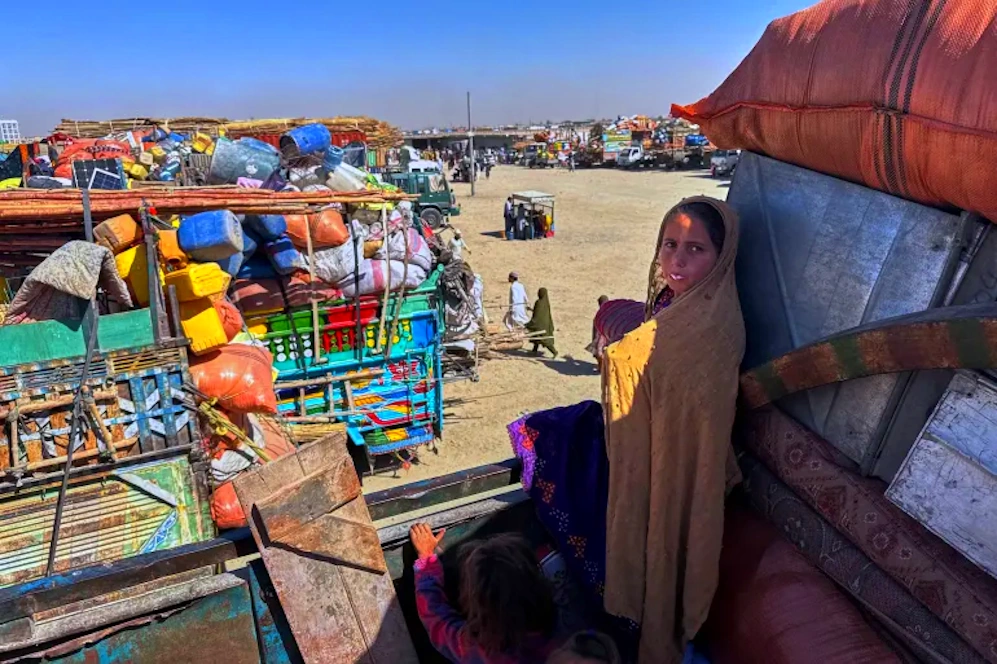
Afghanistan is confronting one of the world’s most severe displacement crises, driven by a convergence of poverty, climate-induced disasters, and the large-scale return of Afghan migrants, the United Nations warned on Monday. The country, already reeling from decades of war, is now struggling to absorb millions of returnees while grappling with recurring natural hazards and economic collapse.
According to the latest socioeconomic review released by the United Nations Development Programme (UNDP), Afghanistan’s fragile economy already battered by four decades of conflict is under further strain from the return of approximately 2.7 million Afghans, many of whom were deported or voluntarily left neighbouring countries amid worsening regional conditions. These returns, coupled with prolonged drought, devastating earthquakes, and a sharp decline in women’s participation in the workforce, are stretching already-overstretched public services and undermining household livelihoods across the country.
UNDP Administrator Alexander De Croo, who visited Afghanistan alongside UN High Commissioner for Refugees Barham Salih, met with returnee communities, humanitarian partners, and local authorities during the mission. The officials toured areas hit by recent earthquakes in Jalalabad before travelling to the Sutan Valley, where community-led reconstruction projects are helping families rebuild from natural disasters.
“In Afghanistan, crises rarely happen one at a time,” De Croo said. “Emergency aid saves lives but development gives people their lives back.” He added that the visit aimed to reaffirm the UN’s shared commitment to strengthening resilience and finding durable, sustainable solutions for the Afghan people, who have endured cascading emergencies for generations.
The UNDP report paints a grim picture of everyday survival: an estimated 74 percent of Afghanistan’s population nearly 29 million people cannot meet their basic needs, making the country one of the world’s largest and most complex humanitarian emergencies.
To address this, the UNDP continues to support displaced communities and their host populations through programmes focused on rebuilding livelihoods, improving living conditions, and bolstering long-term resilience. In the Sutan Valley, recovery initiatives include flood-protection systems and irrigation schemes that not only provide immediate employment but also reduce future disaster risks. Women have been engaged in producing wire mesh for protective barriers, while men manufacture bricks for flood-control structures designed to safeguard farmland and nearby villages.
The officials also highlighted progress made through a UN Special Trust Fund for Afghanistan, which targets returnees, internally displaced people, and host communities in Kunduz and Baghlan provinces. To date, the initiative has cleared more than 6,400 square metres of mine-contaminated land, launched dozens of community infrastructure projects, and identified hundreds of households in need of permanent housing, particularly in areas with high concentrations of returning families.
Meanwhile, the UN refugee agency (UNHCR) said it continues to strengthen protection for Afghans along migration routes while expanding opportunities for legal resettlement, education, vocational training, employment, and family reunification for those unable to safely return home. The agency estimates that more than 570,000 Afghans will require resettlement opportunities in 2026 alone a figure that underscores the staggering scale of the crisis.
After more than four decades of conflict, political upheaval, economic collapse, and repeated environmental disasters, Afghanistan remains one of the world’s largest and most protracted displacement and humanitarian crises. The UN and its partners are calling for sustained international support to address both immediate relief needs and the long-term development challenges facing the country, warning that without significant investment, the cycle of displacement and poverty will continue to deepen.
Our Pashto-Dari Website

Support Dawat Media Center
If there were ever a time to join us, it is now. Every contribution, however big or small, powers our journalism and sustains our future. Support the Dawat Media Center from as little as $/€10 – it only takes a minute. If you can, please consider supporting us with a regular amount each month. Thank you
DNB Bank AC # 0530 2294668
Account for international payments: NO15 0530 2294 668
Vipps: #557320

Comments are closed.