

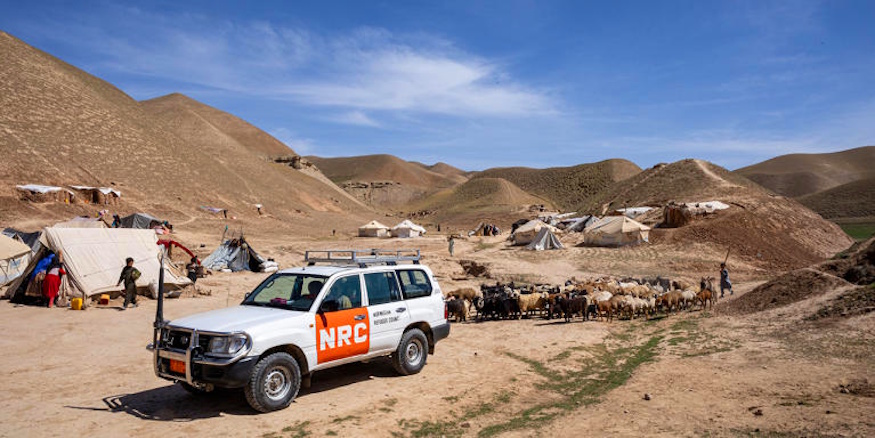
As global humanitarian budgets shrink, millions in conflict zones face a stark choice between hunger, displacement, and despair.
The Norwegian Refugee Council (NRC) has issued a stark warning that a deepening shortfall in global humanitarian funding is leaving millions of people caught in conflict and displacement crises without adequate protection or basic sustenance. Afghanistan, once a major recipient of international aid, now ranks among the world’s most underfunded emergency responses—a dramatic reversal that aid workers say could have catastrophic consequences for an already fragile population.
In a statement released on July 1, the NRC revealed that just 30.4 percent of the funding required for global humanitarian operations in 2026 had been received by June 24. The overall UN-led appeal, coordinated by the Office for the Coordination of Humanitarian Affairs (OCHA), seeks $33.66 billion to reach 143.2 million of the 252 million people worldwide who are currently in need of life-saving assistance. That shortfall nearly $23.4 billion represents one of the largest funding gaps in recent memory, and it comes at a time when overlapping crises from the war in Ukraine to famine in the Horn of Africa and protracted instability in the Middle East—are stretching donor resources thinner than ever.
Jan Egeland, the NRC’s secretary general and a veteran of some of the world’s most intractable humanitarian emergencies, described 2026 as a “critical inflection point” for millions of families already battered by war, displacement, hyperinflation, and the steady erosion of foreign aid budgets. “Families whose lives have been shattered by conflict are increasingly struggling to survive,” Egeland said in the statement. “Violence and displacement continue unabated, while spiralling inflation puts basic goods food, fuel, medicine out of reach for ordinary people. All of this is happening at the very moment when humanitarian assistance is declining due to a lack of political will and financial commitment.”
The NRC’s analysis identifies Yemen, Niger, Burkina Faso, Afghanistan, and Mali as the five lowest-funded humanitarian response plans so far this year. Collectively, these countries account for tens of millions of people in acute distress, yet they have received only a fraction of the resources allocated to better-publicised crises. According to OCHA data cited by the NRC, Afghanistan’s humanitarian needs and response plan is currently just 16.9 percent funded—a figure that Egeland called “shockingly inadequate” for a country where 21.9 million people require some form of humanitarian assistance in 2026. Of those, 17.5 million have been specifically targeted for support, meaning that under current funding levels, more than 14.5 million Afghans who were deemed a priority for aid may receive little to nothing at all.
The collapse in funding for Afghanistan is particularly alarming given the country’s recent history. For much of the past two decades, Afghanistan was one of the largest recipients of international aid, with the United States alone contributing more than 40 percent of all humanitarian assistance to the country up until 2024. However, that pipeline has largely dried up following the withdrawal of U.S. military forces and subsequent shifts in foreign policy priorities. The NRC attributes part of the current shortfall directly to the end of U.S. humanitarian support, though it cautions that final donor data from OCHA should be consulted before assigning definitive percentages. What is clear, however, is that the departure of Washington as the single largest contributor has created a vacuum that other donors have not yet filled and may never fill, given competing global demands.
Compounding Afghanistan’s woes is a new wave of forced returns. The NRC notes that millions of undocumented Afghans have been expelled or pressured to leave neighbouring countries particularly Pakistan and Iran over the past 18 months. These returnees are arriving in a country where basic services have already collapsed, the economy is in freefall, and the banking system remains paralysed by international sanctions. According to data from the International Organization for Migration (IOM) cited by the NRC, only 11 percent of surveyed undocumented returnees reported being fully employed after their return. Most rely on casual day labour, begging, or remittances from relatives abroad sources of income that are themselves becoming increasingly unreliable as global inflation erodes purchasing power.
For the first time, Afghanistan has appeared on the NRC’s annual list of the world’s most neglected displacement crises a designation that Egeland described as a “deeply troubling milestone.” “This year for the first time Afghanistan features on NRC’s list of the world’s most neglected crises,” he said. “Now we are seeing funding for Afghanistan hit record low levels with just one in every six dollars needed for aid currently available. That means that for every six people who need food, shelter, or medical care, only one will get it. The rest will be left to fend for themselves in an environment that is growing more hostile by the day.”
The human cost of these funding cuts is not abstract. The NRC shared the testimony of Momina, a 45-year-old mother of six from Nangarhar province in eastern Afghanistan, a region long plagued by insurgent violence and recurrent natural disasters. She told NRC staff that her family’s living conditions had deteriorated sharply over the past two years, as both formal employment and humanitarian distributions have all but ceased. “My husband used to work from time-to-time and humanitarian organisations also used to come in this area to assist us,” she said. “Now, we don’t see much of that assistance, and my husband is unemployed and most days is unable to get work. We have sold what little we had our cooking pots, our blankets just to buy bread. I don’t know what we will do next month.”
Momina’s story is echoed across thousands of villages and urban slums, where families are making increasingly desperate choices pulling children out of school, marrying off daughters early, skipping meals, or migrating to already overcrowded cities in search of non-existent jobs. Aid workers on the ground report that malnutrition rates among children under five have spiked in several provinces, while maternal mortality already among the highest in the world is climbing again as clinics run out of supplies and staff go unpaid.
Beyond Afghanistan, the NRC warns that the Central Sahel region encompassing Niger, Burkina Faso, and Mali is experiencing a parallel crisis of neglect. These three countries now make up three of the five least-funded humanitarian plans globally in 2026, despite being epicentres of one of the world’s fastest-growing displacement emergencies. Armed groups linked to al-Qaeda and the Islamic State have expanded their reach across the region, forcing millions from their homes, destroying thousands of schools and health centres, and triggering a protection crisis that disproportionately affects women and children. The NRC says that as both humanitarian and development financing decline, basic services such as clean water, primary healthcare, and education are collapsing, creating a vicious cycle of poverty, instability, and forced migration.
Egeland did not mince words about the underlying causes of this funding crisis. He accused major donor governments particularly wealthy Western nations of allocating aid according to geopolitical convenience rather than genuine human need. “We are not seeing a shortage of money in the world; we are seeing a shortage of solidarity,” he said. “Donors are prioritising conflicts that affect their own strategic interests, while turning a blind eye to protracted, forgotten emergencies. This is not just unfair it is short-sighted. Neglected crises do not disappear; they metastasise. They breed extremism, fuel irregular migration, and eventually come back to haunt us all.”
The NRC is calling for an urgent recalibration of donor priorities, urging governments to commit new funding before the end of the 2026 fiscal year and to base their allocations on objective needs assessments rather than media attention or political leverage. The organisation also appeals to private-sector actors, philanthropic foundations, and emerging economies to step into the gap left by traditional donors.
“Without a dramatic increase of support, countless communities in need of aid will have little chance of being helped this year,” Egeland warned. “We are not asking for the impossible we are asking for the bare minimum. The difference between a fully funded appeal and a half-funded one is not just a number on a spreadsheet. It is the difference between life and death for a child in Kandahar, a mother in Gao, or a family in Sana’a.”
As the UN General Assembly approaches later this year, humanitarian organisations are bracing for what they fear could be the most difficult winter in a decade—one marked not by natural disasters alone, but by the man-made catastrophe of collective indifference.
Our Pashto-Dari Website

Support Dawat Media Center
If there were ever a time to join us, it is now. Every contribution, however big or small, powers our journalism and sustains our future. Support the Dawat Media Center from as little as $/€10 – it only takes a minute. If you can, please consider supporting us with a regular amount each month. Thank you
DNB Bank AC # 0530 2294668
Account for international payments: NO15 0530 2294 668
Vipps: #557320

Comments are closed.