

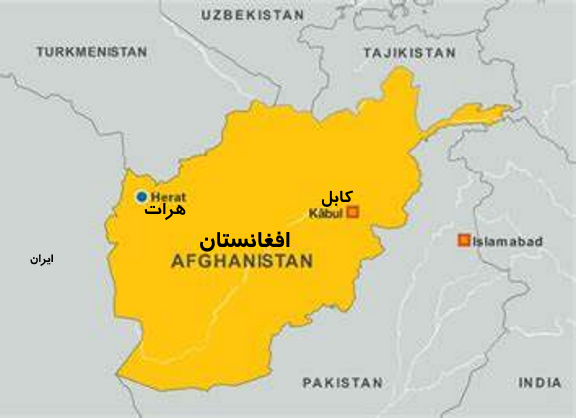
Iran’s state broadcaster has commissioned a 37-episode historical television series portraying the separation of Herat from Iran, reviving a politically sensitive narrative that has drawn criticism from historians and renewed concerns in Afghanistan over competing historical claims.
The series, titled Land of Simorgh (Sarzameen-e Simorgh), has been commissioned by Simafilm, the drama production arm of Iran’s state broadcaster (IRIB), and will be directed by television filmmaker Mohammadreza Varzi. According to Iranian media, the production will present what it describes as an Iranian account of the events that led to the separation of Herat and the formation of modern Afghanistan. The project represents a significant investment by the state broadcaster in a narrative that touches on deeply contested historical territory.
British Agents at the Center of the Story
Iranian media outlets that published the series synopsis said the story follows two British officers, Henry Pottinger and Eldred Pottinger, who are sent from Calcutta to Herat by the East India Company during the 19th century.
According to the synopsis, the officers attempt to persuade Kamran Mirza, the ruler of Herat, to rebel against the Iranian central government and facilitate the separation of territories described in the series as present-day Afghanistan from Iran. The narrative portrays the British officers as central architects of a plot to detach Herat from the Persian sphere of influence, framing the event as a product of colonial manipulation rather than internal dynamics or diplomatic failure.
The storyline reflects a long-standing narrative promoted by some Iranian historians that British colonial policy played a decisive role in preventing Qajar Iran from retaining control over Herat. This interpretation places the blame for the territorial loss squarely on foreign interference, minimizing the role of domestic political fragmentation, military weakness, and the complex realities of 19th-century regional politics.
Project Sparks Criticism Inside Iran
Iranian newspaper Hamshahri described Land of Simorgh as Mohammadreza Varzi’s latest historical production.
However, Nobonyad Iran, another Iranian publication, criticized the project and questioned the decision to entrust it to Varzi. The newspaper said the history of Herat and eastern Iran is one of the country’s most sensitive historical subjects and argued that the director’s previous historical dramas had been criticized for historical inaccuracies, selective storytelling, and controversial portrayals of historical figures.
The criticism highlights an ongoing debate inside Iran over how historical events should be represented in state-funded television productions. Some critics argue that such dramatizations risk simplifying complex historical processes into nationalist melodrama, while others contend that state media has a responsibility to present a version of history that aligns with national interests. The controversy also reflects broader tensions within Iranian cultural circles about the balance between artistic license and historical fidelity, particularly when dealing with subjects that carry contemporary political weight.
Herat Remains a Sensitive Historical Issue
Herat was part of successive Persian empires for centuries before becoming part of Afghanistan in the 19th century after wars between Qajar Iran, Afghanistan, and the British Empire.
Most contemporary historians describe the separation of Herat as the result of a complex geopolitical struggle involving the Anglo-Persian War of 1856–57 and the Treaty of Paris, which required Iran to withdraw its claims over Herat and recognize Afghanistan’s independence from Persian control. The treaty marked a decisive moment in the region’s modern history, formalizing a boundary that had been contested through decades of shifting alliances, military campaigns, and diplomatic maneuvering.
Afghanistan and Iran maintain diplomatic relations, but historical narratives surrounding Herat have periodically generated controversy, particularly when political figures or media in either country question modern borders or historical sovereignty. The issue remains a latent source of tension, capable of provoking public reactions and diplomatic discomfort when it surfaces in cultural products or political rhetoric.
Afghanistan’s Historians Reject Revisionist Narratives
Afghan historians have consistently rejected claims that Herat’s incorporation into Afghanistan was an illegitimate separation from Iran, arguing that the country’s internationally recognized borders were established through historical treaties and later accepted under international law. They point to the Treaty of Paris and subsequent agreements as the legal foundation for Afghanistan’s sovereignty over Herat, emphasizing that the modern state’s territorial integrity is not open to revision.
Analysts say state-sponsored productions that frame Afghanistan’s formation primarily through the lens of territorial loss risk fueling nationalist narratives and complicating already sensitive historical discussions between the two neighboring countries. Such portrayals, they warn, can reinforce grievance-based identities on both sides, making it more difficult to cultivate a shared understanding of a past that both nations interpret through different prisms.
The announcement comes as cultural and historical issues have become increasingly prominent in Iranian state media, with several recent productions revisiting the Qajar era and Iran’s historical conflicts with Britain and other regional powers. This trend suggests a deliberate effort by state broadcasters to shape public memory around pivotal moments of national loss and resistance, using historical drama as a vehicle for contemporary political messaging. Whether Land of Simorgh will be received as compelling drama or criticized as historical propaganda remains to be seen, but its commissioning alone has already reignited a debate that neither Iran nor Afghanistan has been able to fully lay to rest.
Our Pashto-Dari Website
Support Dawat Media Center
If there were ever a time to join us, it is now. Every contribution, however big or small, powers our journalism and sustains our future. Support the Dawat Media Center from as little as $/€10 – it only takes a minute. If you can, please consider supporting us with a regular amount each month. Thank you
DNB Bank AC # 0530 2294668
Account for international payments: NO15 0530 2294 668
Vipps: #557320

Comments are closed.