
Waiting for November Under Sanctions, Hormoz Closure: Boeing 777 Aircraft and Iran’s Shrinking Reach
Ahmad Fawad Arsala


Waiting for November Under Sanctions, Hormoz Closure: Boeing 777 Aircraft and Iran’s Shrinking Reach
The latest US sanctions are not incremental policy adjustments. They are a decisive escalation designed to shut down an entire sector. Under the newest Treasury action, Washington has moved to blacklist Iran’s aviation system at scale, targeting airlines, intermediaries, and any global service providers that keep them operational. The warning is explicit: any entity that fuels, services, insures, or facilitates Iranian flights risks being cut off from the global financial system. This is not regulatory pressure. It is systemic exclusion.
The operational consequence is immediate and severe. Iran’s international aviation network is being forced into collapse. Flights are being canceled, airports are denying access, and ground services are disappearing under the weight of secondary sanctions. What remains is not a functioning global aviation sector but a shrinking, inward-facing system struggling to maintain even minimal connectivity. The message is clear. When an airline cannot refuel, cannot land, and cannot transact, it does not operate.
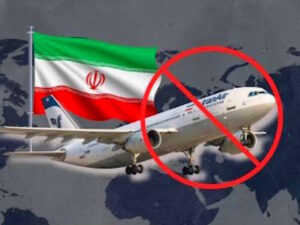
What makes this moment more consequential is the exposure of a deeper layer of vulnerability. The sanctions did not just target existing operations. They targeted the networks that allowed Iran to bypass restrictions. This includes the recent acquisition of three Boeing 777 aircraft through intermediaries and front companies. These wide-body, long-range aircraft were not symbolic purchases. They were Tehran’s attempt to rebuild intercontinental reach and restore relevance in global aviation. Instead, they have become evidence of how tightly monitored and aggressively dismantled those circumvention channels now are. The very effort to expand capacity has accelerated the collapse.
This aviation shutdown is converging with pressure at sea and across financial systems. The Strait of Hormuz remains Iran’s most critical economic artery, yet it is also its greatest vulnerability. Any attempt to escalate through Hormuz would not generate leverage. It would trigger self-inflicted damage by constraining Iran’s own exports, raising insurance costs, and pushing global shipping away from its routes. The idea that Tehran can weaponize the strait without absorbing disproportionate consequences is strategically unsound.
The result is a multi-layered compression. Airspace restrictions limit mobility and trade. Maritime vulnerability threatens energy exports. Financial sanctions sever transaction channels. Each layer reinforces the other. This is no longer a pressure campaign. It is structural isolation.
Against this backdrop, Tehran appears to be relying on a familiar assumption. Endure the pressure. Wait for the US November election. Expect a shift in tone or enforcement. That assumption is increasingly detached from reality.
Even the political signal coming out of Washington undercuts that calculation. President Donald Trump has made it clear in recent rhetoric that electoral outcomes will not constrain his approach. He has openly dismissed the significance of potential Democratic gains in the midterms and continues to project an aggressive posture toward Iran, including threats of overwhelming force if demands are not met. The implication is direct. Policy continuity is not contingent on congressional shifts. There is also a built-in window between the election and the seating of a new Congress, meaning the current administration retains full operational authority during that period. Waiting for November does not pause enforcement. It extends the timeframe in which pressure can intensify.
Time, under these conditions, is not an asset for Iran. It is a liability. Aircraft grounded today will not return quickly. International routes once lost require years to rebuild. Leasing structures, maintenance ecosystems, insurance frameworks, and financial channels all degrade with each passing month. Waiting does not preserve capacity. It erodes it.
Internally, the consequences are already compounding. Economic isolation translates into inflation, currency pressure, and declining access to global markets. The aviation shutdown disrupts trade logistics, business travel, and diaspora connectivity. Combined with maritime and financial constraints, the pressure becomes systemic rather than sectoral.
The belief that November will reset this trajectory misunderstands the scale of what is underway. Even if political dynamics shift, the enforcement architecture is already embedded across global systems. It will not unwind quickly, and certainly not in time to reverse the damage being inflicted now.
And this is where the final trigger is unmistakable. The US Treasury’s latest action confirms that this is not selective pressure but comprehensive exclusion. The targeting of Iran’s aviation sector, including the networks behind those three Boeing 777 aircraft, signals an intent to eliminate operational viability altogether.
Iran is not managing a temporary crisis. It is being structurally compressed across air, sea, and finance at the same time. The aviation shutdown is not a disruption. It is a fracture.
Waiting for an election will not reopen grounded skies, restore blocked routes, or revive dismantled systems. It will only ensure that by the time any political shift arrives, the infrastructure Iran is trying to preserve no longer exists.
Unconditional Words, Conditional Actions: Pakistan’s Saudi Double Game
Our Pashto-Dari Website

Support Dawat Media Center
If there were ever a time to join us, it is now. Every contribution, however big or small, powers our journalism and sustains our future. Support the Dawat Media Center from as little as $/€10 – it only takes a minute. If you can, please consider supporting us with a regular amount each month. Thank you
DNB Bank AC # 0530 2294668
Account for international payments: NO15 0530 2294 668
Vipps: #557320

Comments are closed.