
As India Claims Fourth-Largest Economy Spot, What It Means on the Ground Isn’t Growth for All

NEW DELHI: When Ramesh Chandra Biswal left his promising career as a space scientist in the United States, he returned to his roots in eastern India driven by a belief in his country’s economic ascent. He launched an agricultural startup in his home village in Odisha, betting on India’s narrative of rapid growth.
Nine years later, as official projections declare India the world’s fourth-largest economy by nominal GDP, surpassing Japan, Biswal is still waiting for that promise to materialize in his daily reality.
In 2017, when Villamart began, India’s economy was valued at approximately $2.6 trillion, ranking sixth globally. According to the Indian government’s recent economic review, it has now swelled to an estimated $4.19 trillion. The review confidently projects that India will overtake Germany to claim the third spot within three years, trailing only the United States and China.
Yet, for Biswal, these macroeconomic milestones feel distant and abstract. “The hype around India becoming the fourth largest economy is not grounded. People cannot relate to that,” he reflects. “We have to improve the per capita income instead of telling the story of being the fourth largest economy.”
His sentiment underscores a stark disconnect between headline-grabbing national aggregates and the lived experience of millions. While Biswal finds personal motivation in the respect his entrepreneurial struggle earns him, he has witnessed little transformative change in the economic landscape around him.
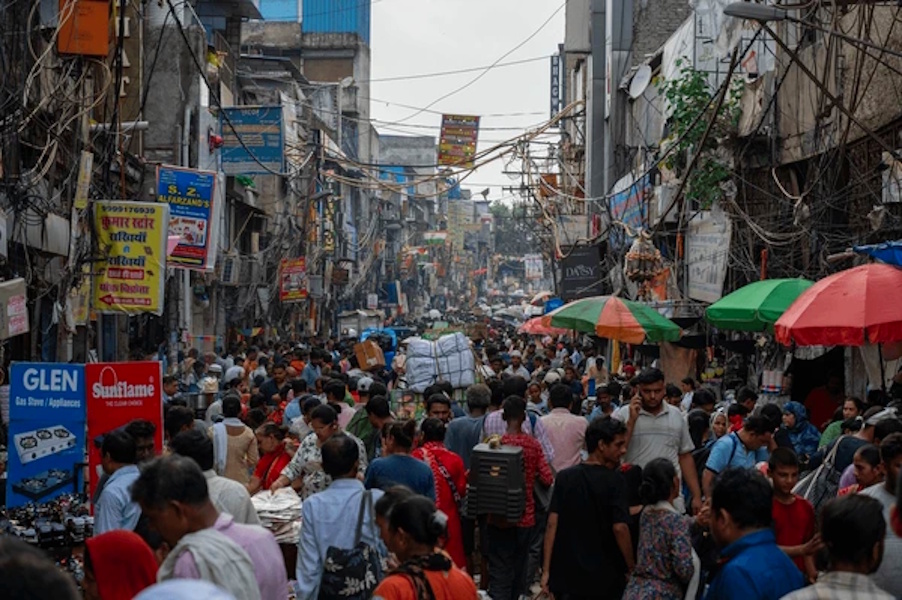
This gap between national stature and individual prosperity is palpable across sectors. For Sarvesh Sau, a fruit seller in Delhi, the economy’s expanding size has not translated into financial security. “Rich people are getting richer, those who have resources,” he observes. “But a low-income group person like me finds it difficult to manage a decent living despite putting in more than 12 hours of work every day.” He poses a poignant question: “We are a big nation, and we will look big compared to others. But are we able to match Japan?”
The comparison is telling. India, with its 1.46 billion people, has a GDP per capita estimated by the World Bank at around $2,700—roughly one-twelfth of Japan’s. This highlights how population size, rather than widespread prosperity, is a key driver of its rise in total GDP rankings.
The corrosive effect of inflation further erodes nominal gains. Yogendra Kumar, a plumber in Noida, sees his income rise but finds himself falling behind. “I have heard that India has become the fourth largest economy, but I don’t know how to react to that,” he says. “Today I earn more but inflation takes away all the money.” He details how essential commodities like cooking oil and gas have quadrupled or doubled in price over a decade, making a comfortable life increasingly elusive.
Beyond these grassroots accounts, economists raise methodological concerns that question the very foundation of the celebration. Professor Arun Kumar, a development economist, points out that India’s GDP calculations are under scrutiny. “Our GDP data, as the IMF has said, is suspect because it doesn’t include the informal sector adequately,” he argues. He estimates India remains the world’s seventh-largest economy and that actual growth is significantly lower than official figures of 7-8%.
Professor Kumar identifies a critical structural flaw: the reported growth is concentrated in the organized sector, while the vast unorganized sector—which provides livelihood to an estimated 94% of India’s workforce—is stagnating or declining. “The rate of growth is only of the organized sector,” he says. “People realize that it’s not growing so well.”
A Tale of Two Economies
India’s economic story thus bifurcates. On one track is a dynamic, formalizing sector of tech giants, startups, and corporate wealth, propelling the nation up the global rankings. On the other is the immense informal economy of small vendors, farmers, and daily-wage laborers, where progress is slow, precarious, and easily undone by inflation.
The government points to infrastructure development, digital public goods, and rising foreign investment as evidence of broad-based growth that will eventually trickle down. However, for citizens like Biswal, Sau, and Kumar, the “eventually” is taking too long. Their experiences suggest that without a more aggressive focus on job creation in the formal sector, controlling living costs, and strengthening the social safety net, the milestone of becoming the fourth-largest economy will remain a statistical achievement—a number that resonates in boardrooms and diplomatic circles but not in the bustling markets and quiet villages where India’s true economic heartbeat lies.
The challenge for India is no longer merely ascending the GDP league tables. It is ensuring that this ascent is built on a foundation that lifts the standard of living for its entire population, making the economic ground feel as solid as the headline figures suggest.
Our Pashto-Dari Website


Support Dawat Media Center
If there were ever a time to join us, it is now. Every contribution, however big or small, powers our journalism and sustains our future. Support the Dawat Media Center from as little as $/€10 – it only takes a minute. If you can, please consider supporting us with a regular amount each month. Thank you
DNB Bank AC # 0530 2294668
Account for international payments: NO15 0530 2294 668
Vipps: #557320

Comments are closed.