
Humanoid Robot Shatters Usain Bolt’s 100m World Record at Beijing Robot Games

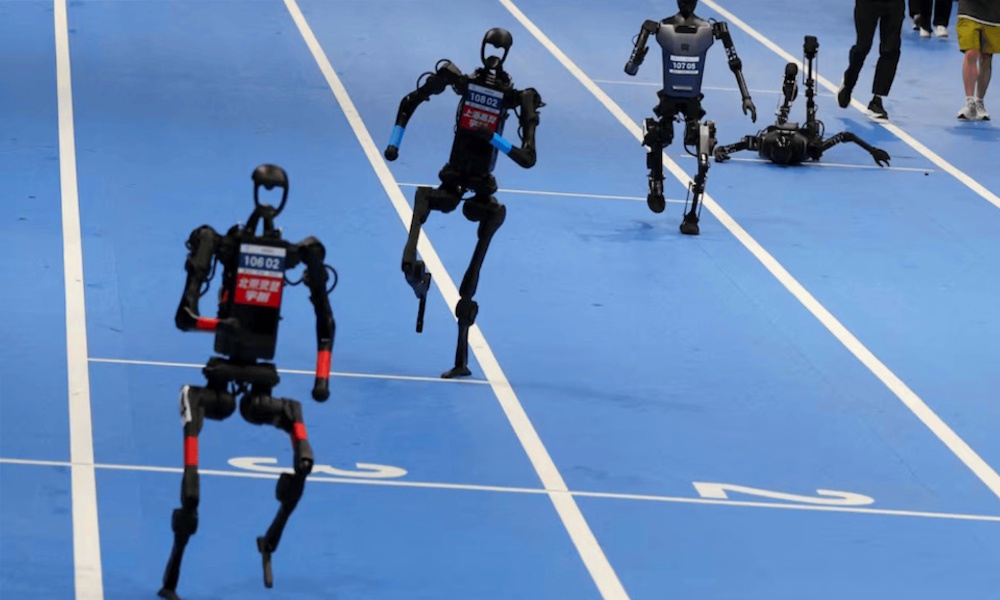
In a stunning display of engineering and speed, a Chinese humanoid robot has officially beaten Usain Bolt’s legendary 100-metre world record, electrifying the opening day of the second World Humanoid Robot Games in Beijing on Saturday.
The robot, named Tiangong Ultra, clocked an astonishing 9.39 seconds in the sprint, shattering Bolt’s long-standing human record of 9.58 seconds, set during the 2009 World Athletics Championships in Berlin. Developed by the Beijing Humanoid Robot Innovation Center, Tiangong Ultra narrowly edged out its closest competitor, Honor’s Lightning, which finished just behind with a time of 9.47 seconds.
Remarkably, Lightning had already surpassed Bolt’s record during a trial run before the official competition, recording an even faster 9.32 seconds and reaching a peak speed of 14.5 metres per second equivalent to over 52 km/h.
The record-breaking race was one of the highlights of the five-day event, held at Beijing’s National Speed Skating Oval, the iconic venue built for the 2022 Winter Olympics. This year’s games are significantly larger than the inaugural edition, bringing together 666 teams and 2,056 robots from 16 countries. The competition features 51 events and over 1,000 matches, ranging from traditional sports like football and table tennis to agility and obstacle-course challenges specifically designed to test the physical and cognitive limits of humanoid machines.
The robots didn’t stop at sprinting. In the standing high jump, a humanoid developed by Beijing-based X-Humanoid reached 2.88 metres, comfortably surpassing the human world record of 2.45 metres, set by Cuba’s Javier Sotomayor in 1993.
The leap in performance since last year’s inaugural games is nothing short of extraordinary. In 2025, Tiangong Ultra completed the same 100-metre sprint in 21.50 seconds more than twice as slow. This dramatic acceleration reflects China’s aggressive national strategy to position humanoid robotics as a pillar of future industry, with heavy investment from both state-backed enterprises and private firms in artificial intelligence, sensor technology, and advanced actuation systems. These robots are being groomed not just for athletic spectacle, but for real-world roles in manufacturing, logistics, healthcare, and domestic services.
Despite the breathtaking feats, the robots are not without their weaknesses especially in areas where human athletes naturally excel. After Saturday’s sprint, Tiangong Ultra stumbled upon deceleration, while Lightning collapsed dramatically and had to be carried off the track on a stretcher. The incidents underscored persistent engineering challenges in balance, braking, and dynamic stability at extreme speeds issues that engineers are racing to resolve as the machines push closer to physical limits.
The World Humanoid Robot Games run through August 26, and organisers say the event is as much about showcasing technological evolution as it is about stress-testing robots in demanding, unpredictable environments. With each passing day, the line between science fiction and sporting reality grows thinner and the robots are only getting faster.
Our Pashto-Dari Website

Support Dawat Media Center
If there were ever a time to join us, it is now. Every contribution, however big or small, powers our journalism and sustains our future. Support the Dawat Media Center from as little as $/€10 – it only takes a minute. If you can, please consider supporting us with a regular amount each month. Thank you
DNB Bank AC # 0530 2294668
Account for international payments: NO15 0530 2294 668
Vipps: #557320

Comments are closed.