

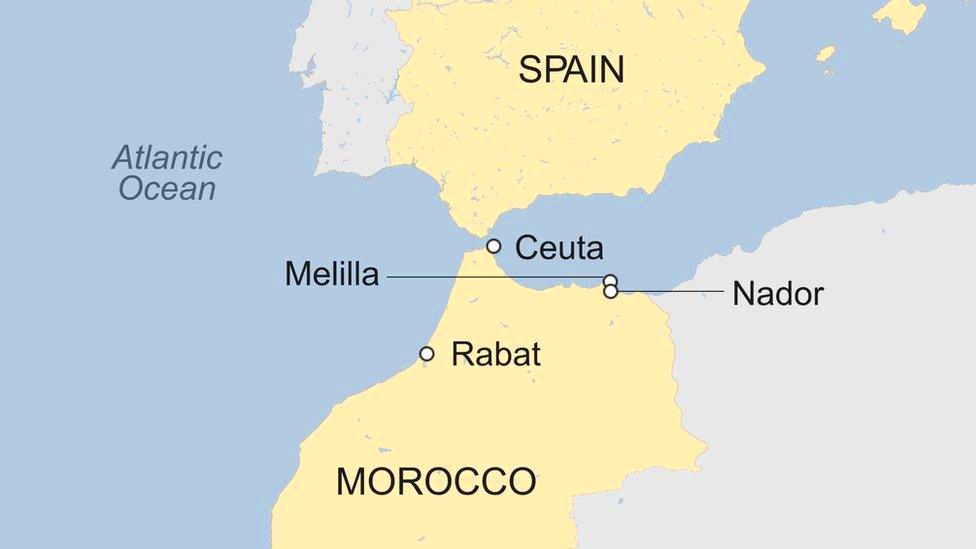
CEUTA — By Sunday, the streets of Ceuta no longer resembled a city under siege, but the echoes of the week’s extraordinary events lingered heavily in the air. The tiny Spanish exclave on the northern coast of Africa was slowly returning to its bustling routine, even as authorities continued to grapple with the human and political fallout of the largest mass migrant crossing in the territory’s history.
Over the weekend, shops reopened their shutters, and the usual blend of residents and tourists numbering some 84,000 once again filled the open-air terraces, restaurants, and cafes that line the city’s Mediterranean promenade. But the city, which prides itself on being a rare crossroads of Christian, Muslim, Jewish, and Hindu cultures, remained deeply divided over what caused the surge and who is ultimately to blame.
A Rising Death Toll and a Search for the Missing
The humanitarian cost of the influx became starker on Sunday, as local officials raised the death toll to at least 72. The government’s delegate to Ceuta, Miguel Angel Perez Triano, confirmed the updated figure, which includes migrants who drowned in the rough coastal waters and others who perished in a stampede as thousands scrambled over a breakwater barrier. Spanish civil guard ships continued to scour the waters near the urban beach the very stretch where tens of thousands had breached the border just days earlier searching for additional bodies.
The unprecedented arrival of an estimated 50,000 to 60,000 people, mostly young men, on Thursday and Friday temporarily swelled Ceuta’s population by more than half. By Sunday, however, the vast majority had voluntarily walked back across the border into Morocco. Others attempted to blend in and remain, with Spanish soldiers and police patrolling streets and housing projects to detain small groups of tired-looking stragglers. Outside a housing project near the port, troops in an armored car guarded a group of nine migrants sitting on the pavement, while Civil Guard officers escorted others off buses to return them to the border post.
‘It’s Not the Young Men’s Fault’
The crisis has reignited a fierce debate over immigration policy in Europe, with locals and politicians offering sharply divergent perspectives. In the city’s fried-fish restaurants and cafes, many expressed sympathy for the migrants while directing their anger at authorities.
“It’s not the young men’s fault,” said Mohamad Abdelkader Driss, 44, a waiter in the town. “If you open the border, of course everyone comes in. The young men aren’t to blame. The authorities are responsible.”
His sentiment was echoed by migrants who returned to Morocco, many of whom described a border that was effectively unguarded. They claimed that authorities did little to intervene as they watched thousands of people swim or scramble across. Abdelkader lamented the chaos but noted that the mostly young men who breached the border behaved relatively well. “It could have been much worse,” he added.
Far-Right Politicians Descend, Sparking Counterprotests
The political repercussions were immediate. Over the weekend, far-right, anti-immigrant Spanish politicians and well-known right-wing influencers descended on Ceuta, igniting counterprotests that drew hundreds of local residents, including many from the city’s large Muslim community of Moroccan descent.
On Saturday evening, Alvise Pérez, a far-right Spanish politician and member of the European Parliament, called for the remaining migrants to be expelled. His remarks sparked an angry backlash; as rival protesters banged on the windows of a bar where he had taken shelter, police were forced to escort him away from the volatile scene.
Among the counterprotesters was Noor Ahmed, a 20-year-old student and Ceuta native. She denounced the presence of figures like Pérez as opportunistic. “They just want to take advantage of the humanitarian crisis Ceuta is currently experiencing,” she said.
The following day, Santiago Abascal, the leader of the far-right Vox party, visited the enclave to slam the Spanish government. He labeled the mass arrival “an invasion” and accused the administration of betrayal. “The frontiers of Ceuta and Melilla are the walls of our home and homeland, and they are not being protected by a corrupt and traitorous government,” Abascal declared.
Tolerance Under Strain
For many who have long celebrated Ceuta’s tradition of relative interfaith harmony, the week exposed deep fissures beneath the surface. Eva Barrientos, a logistics company employee, came to the protest on Saturday to hear what the right-wing figures had to say. While she acknowledged that the city’s Christians, Muslims, Jews, and Hindus have historically coexisted peacefully, she expressed concern about what she called “an enemy within.”
“In Ceuta, we have always lived together. We have four cultures living very well, without any problems,” Barrientos said. “But the only thing we are realizing now is that there is an enemy within.” She accused some foreign-born residents of having more loyalty to Morocco than to the country in which they live.
The friction has drawn international attention, including from the Vatican. Pope Leo XIV on Sunday said he was “following with concern the alarming situation in Ceuta, asking God… that solutions of peace, stability and justice may be found.” Migration has been a priority for the Pope, who recently visited the Canary Islands—another major European entry point for migrants.
Blame Game and European Backlash
Spanish officials have blamed criminal gangs for spreading rumors that a recent Supreme Court ruling on immigration would ease passage into the territory a falsehood rapidly amplified on social media. The chaotic scenes have prompted a sharp European backlash. In an unusual move, Italy on Saturday implemented a one-month suspension of its Schengen agreement with Spain, effectively reinstating border checks and halting visa-free movement between the two countries.
The EU is now scrambling to respond. A video call among member states has been scheduled for Tuesday, following a joint open letter from 22 bloc members calling for an urgent meeting to agree on a coordinated strategy and prevent further uncontrolled crossings.
Spanish Prime Minister Pedro Sanchez, in a letter to EU leaders, pushed back against the criticism, blasting what he described as the “selfish” reaction of some European partners. His government faces the dual challenge of managing a humanitarian crisis while defending its border policies against a fracturing European consensus.
As Ceuta catches its breath, the city’s residents are left to ponder what the week revealed about their home and whether the fragile coexistence that has defined it for generations can withstand the pressures of a continent divided over migration.
Our Pashto-Dari Website

Support Dawat Media Center
If there were ever a time to join us, it is now. Every contribution, however big or small, powers our journalism and sustains our future. Support the Dawat Media Center from as little as $/€10 – it only takes a minute. If you can, please consider supporting us with a regular amount each month. Thank you
DNB Bank AC # 0530 2294668
Account for international payments: NO15 0530 2294 668
Vipps: #557320

Comments are closed.