

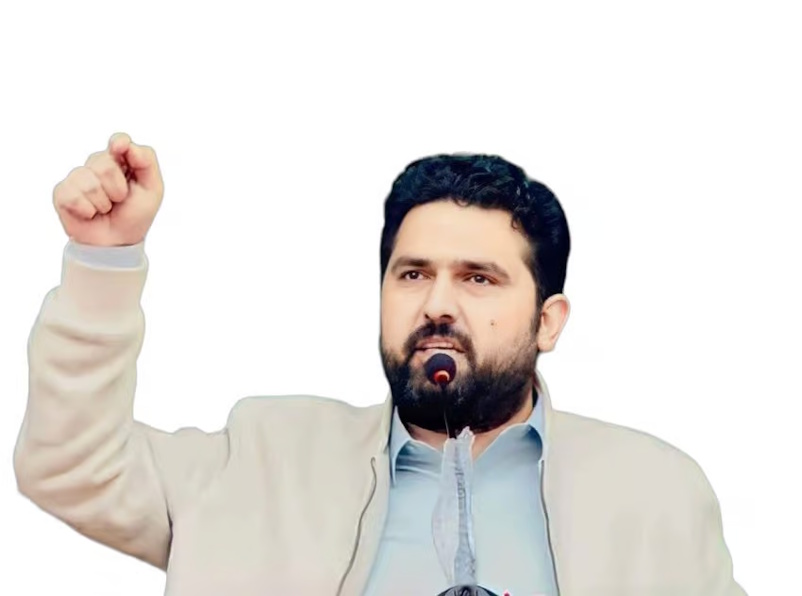
Khyber Pakhtunkhwa Chief Minister Sohail Afridi has launched a blistering attack on Pakistan’s federal government, accusing it of losing de facto administrative and security control over both his province and Balochistan. In some of his most pointed remarks to date, Afridi declared that the country’s overarching security framework has not only failed but now requires an urgent, fundamental reassessment warning that the current trajectory risks fragmenting the state’s authority along its most volatile frontiers.
Speaking before a charged public gathering in Peshawar, Afridi framed the deteriorating law-and-order situation not as a series of isolated incidents, but as systemic evidence of strategic collapse. He contended that the very institutions constitutionally mandated to safeguard national sovereignty have become dangerously distracted prioritizing political survival and internal power struggles over the mounting militant threat. “The watchmen have turned their gaze inward,” he suggested, implying that bureaucratic and security machinery had been co-opted by partisan interests rather than focused on neutralizing insurgent networks operating with renewed impunity.
In a particularly scathing passage, Afridi took aim at what he characterized as the federal elite’s detachment from grassroots suffering, drawing a stark moral line between national policy and human cost. “If you want to earn dollars or buy islands abroad, do not do it at the cost of my people’s lives,” he declared, his voice rising. “Our people are not an experimental ground. They are not sacrificial animals to be used whenever a new policy is tested.” The remark appeared to target both Islamabad’s economic overtures to foreign powers and alleged overseas acquisitions by ruling-class figures a theme that has long fuelled populist resentment in the peripheries.
Afridi went further, asserting that Islamabad has consciously or negligently allowed instability to metastasize in Khyber Pakhtunkhwa and Balochistan to the point where federal writ no longer runs effectively in large swathes of territory. He argued that militant groups now operate with a freedom unseen in years, exploiting gaps in coordination between provincial police, paramilitary forces, and the regular army. “When the centre cannot protect its own citizens in two entire provinces,” he asked, “what does sovereignty even mean?”
The chief minister also pivoted to Pakistan’s long-standing stance on Kashmir, using it as a prism to critique domestic policy failures. He accused the federal government of wielding Kashmir as a rhetorical shield while neglecting the safety of Pakistanis within its own borders. “For years we were told that Kashmir belongs to Pakistan, so where is Kashmir heading today?” he queried, implying that the state’s credibility on external territorial claims is undermined by its inability to secure internal regions. The juxtaposition was deliberate: if Kashmir is framed as the unfinished business of partition, then Khyber Pakhtunkhwa and Balochistan, he suggested, are the unfinished business of the present.
Perhaps most provocatively, Afridi questioned the military-centric approach that has dominated Pakistani counterinsurgency for over two decades. Rejecting the notion that firepower alone can yield peace, he noted that Khyber Pakhtunkhwa has been embroiled in active conflict since the early 2000s yet violence persists, and in some districts, has even escalated. “If guns could solve these problems, Khyber Pakhtunkhwa would have been peaceful after 22 years,” he said. “If force had been the answer over the past 78 years, Pakistani ministers would not be speaking today about the country’s deepening crisis.” His remarks subtly challenged the military establishment’s preferred narrative of tactical success, instead calling for a holistic strategy that incorporates political reconciliation, economic development, and judicial reform.
Afridi’s intervention arrives at a particularly sensitive juncture. Over the past several months, militant attacks—many claimed by the Pakistani Taliban (TTP) and affiliated Baloch separatist groups have surged dramatically, with ambushes on security convoys, targeted assassinations, and roadside bombings becoming almost daily occurrences. The uptick has rattled investors and prompted rare public criticism from former security officials. Against this backdrop, Afridi’s words are almost certain to deepen the already strained relationship between the provincial administration in Peshawar and the federal government in Islamabad, especially as the latter grapples with an IMF-driven austerity programme and pre-election political jockeying.
Political analysts have noted that Afridi, though a member of the ruling coalition at the national level, has increasingly positioned himself as a regional firebrand—channeling local grievances that transcend party lines. His speech, therefore, may signal not merely a policy critique, but the emergence of a new provincialist discourse that challenges the centralization of power in Pakistan. Whether Islamabad chooses to engage with his demands or dismiss them as political grandstanding will likely determine not only the fate of counterterrorism cooperation, but also the broader question of federal-provincial trust in a state already under immense strain.
In the coming days, Afridi’s remarks are expected to reverberate through parliamentary sessions, military briefings, and diplomatic circles reopening old wounds about Pakistan’s internal cohesion and forcing a rare, uncomfortable conversation about who really holds the reins in the country’s most restive lands.
Our Pashto-Dari Website

Support Dawat Media Center
If there were ever a time to join us, it is now. Every contribution, however big or small, powers our journalism and sustains our future. Support the Dawat Media Center from as little as $/€10 – it only takes a minute. If you can, please consider supporting us with a regular amount each month. Thank you
DNB Bank AC # 0530 2294668
Account for international payments: NO15 0530 2294 668
Vipps: #557320

Comments are closed.