
More Than 1,300 Missing in Nepal and Tibet After Catastrophic Glacier Collapse Triggers Deadly Floods

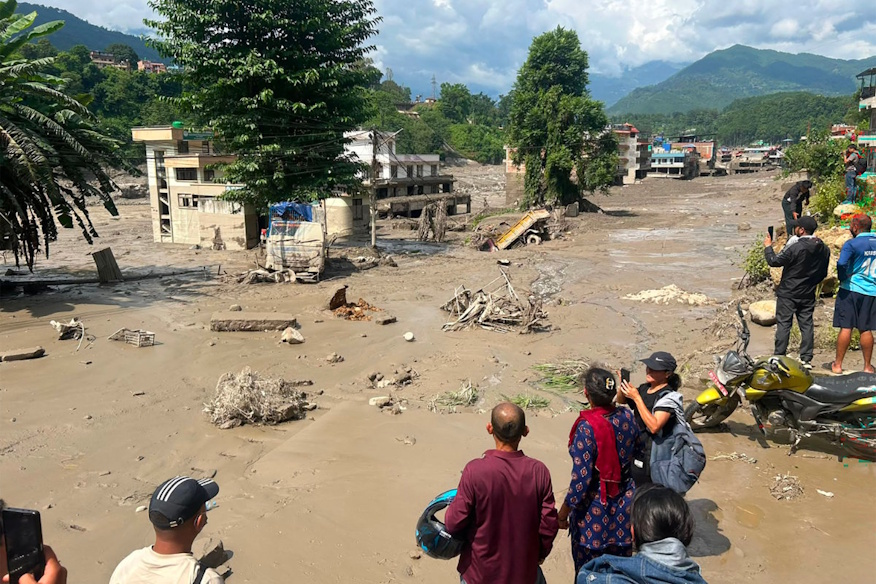
Rescue teams continued searching on Thursday for hundreds of people still unaccounted for along the Nepal-China border, following a devastating surge of floods and mud that tore through multiple communities a day earlier. The deluge was set off by a high-altitude glacier collapse, unleashing a wall of water and debris that overwhelmed the region with little warning.
The disaster has so far claimed at least 168 lives, with more than 1,300 people reported missing including foreign nationals and Hindu pilgrims and has displaced hundreds of families across the Himalayan belt. Authorities fear the death toll could rise as rescue operations push into more remote areas.
A Terrifying Wall of Water
Harrowing videos of the catastrophe show floodwaters rapidly swallowing people as they scrambled to higher ground, and sweeping away buildings, bridges, and vehicles with brutal force. Drone footage released Thursday from Nepal’s central districts revealed entire settlements reduced to wreckage, with homes split open and roads turned into rivers of brown sludge.
The region’s steep river valleys serve as vital economic lifelines and travel corridors, but their narrow gorges become deadly traps when extreme weather or glacial events strike. In Nuwakot district one of the hardest-hit areas images showed the second floors of buildings caked in thick mud after the torrent raged through, while debris dangled from tree branches and power lines. Vehicles lay overturned and buried, and stunned survivors, still coated head-to-toe in muck, wandered through the ruins in search of loved ones. Travel along several key highways has been completely halted, severing supply routes and cutting off entire villages.
“We Don’t Have Anything Left”
There was almost no time to flee. Residents described hearing a low rumble before the water arrived with astonishing speed.
Jaleshwar Kumar Sahni, a local resident, recounted receiving a phone call early Wednesday morning from a friend near the border, warning that an unusually large volume of water was surging downstream. Within 15 minutes, the flash flood had obliterated his neighborhood.
“We don’t have anything left,” Sahni said, his voice trembling. “Not our home, not our belongings just the clothes we were wearing.”
Climate Crisis at the Roof of the World
The Himalayan mountain range, which spans several South Asian nations and contains some of the planet’s highest peaks and largest remaining glaciers outside the poles, is increasingly vulnerable to such calamities. Its steep slopes and lush valleys are naturally prone to landslides and seasonal flooding, but scientists warn that climate change is dramatically accelerating the risks.
Researchers in Kathmandu found earlier this year that glaciers across the Hindu Kush Himalaya region are melting at an unprecedented rate, with ice loss having doubled since 2000. Warmer temperatures destabilize glacial structures, leading to more frequent collapses and the sudden release of meltwater lakes a phenomenon known as glacial lake outburst floods (GLOFs). Wednesday’s event appears to be one of the most catastrophic in recent memory.
Rescue Efforts Hampered by Widespread Damage
Authorities have confirmed at least 165 deaths and 826 missing in Nepal, alongside three fatalities and 558 missing in Tibet’s Gyirong County, according to official statements.
In Nepal, dozens of bridges have been destroyed and nearly 40 kilometers (25 miles) of roadway damaged, severely complicating ground access for emergency responders. The Nepalese army has deployed helicopters for aerial reconnaissance and evacuations, rescuing more than 100 people from flood-affected zones on Thursday morning alone, said army spokesperson Brig. Gen. Raja Ram Basnet. At least eight foreign nationals were airlifted to Kathmandu for safety, and army teams also evacuated workers trapped inside facilities linked to the Trishuli hydropower project a critical energy installation now under threat.
Rescuers have even recovered bodies hundreds of kilometers downstream from the epicenter, including in Chitwan district, underscoring the immense force and reach of the floodwave. Dozens of injured survivors have been transported to Kathmandu’s hospitals for advanced treatment.
Bishal Kumar Bhandari, chairman of the Nepal Red Cross Society, said the organization has shifted its focus from search-and-rescue to large-scale relief operations across the flood-hit districts. He estimated that around 1,200 people have been displaced from at least three villages, with many sheltering in temporary camps or with relatives.
Tibet Faces Its Own Crisis
On the Chinese side, state broadcaster CCTV reported that a mudslide near the Gyirong Port land-border crossing a key trade point left surrounding areas buried under an average of 1.5 meters (5 feet) of mud, with some road sections piled higher than 2 meters (6 feet). All access roads to the port were severely damaged, and officials warned that secondary collapses or landslides remain possible as rain continues to lash the region.
Adding to the complexity, CCTV said a barrier lake formed by blocked river flow has been detected in the direction of the port, posing additional risks to rescue crews and downstream communities. In response, Chinese authorities dispatched a large military transport aircraft carrying specialized response teams to the region. While electricity and communication services have been restored in Gyirong town’s central urban areas, all links to the port itself remain severed.
Hundreds of Foreigners Among the Missing
One of the most alarming aspects of the disaster is the high number of international tourists and pilgrims caught in the flood’s path. According to Nepal’s Tourism Board, 517 of the missing in Nepal are foreign nationals 178 of them from India. Many of the Indian pilgrims were reportedly en route to Mount Kailash in Tibet, a sacred site for Hindus, though officials have not yet confirmed how many were on that specific journey.
More than 60 unaccounted-for individuals are from the United States, with the remainder hailing from over 30 other countries, including the United Kingdom, Ukraine, South Africa, Japan, Australia, and several European nations. In addition, China’s Ministry of Foreign Affairs spokesperson Lin Jian stated that nearly 100 Chinese citizens are also missing on the Nepal side. CCTV earlier reported that 260 of those missing in Tibet were foreigners, sparking an international diplomatic response.
A Glacier Collapse, Not an Earthquake
Initial confusion arose when the U.S. Geological Survey (USGS) first reported a magnitude 4.4 seismic event early Wednesday, roughly 66 kilometers (41 miles) north of Kathmandu, near the border. However, the USGS later revised its analysis, concluding that the seismic signals were actually generated by a magnitude 5.2 glacier collapse not an earthquake. This determination was based on data from nearby seismic stations, long-period wave analysis, and satellite imagery, which collectively pointed to a massive icefall that triggered the ensuing floodwave.
Climate experts at the International Center for Integrated Mountain Development (ICIMOD) in Kathmandu echoed that assessment, stating that an avalanche from a glacier likely caused Wednesday’s flash flood. In an emailed statement, they noted that “hydrological observations indicate the exceptional speed and magnitude of the flood wave,” with water levels on the Trishuli River rising by as much as 9 meters (27 feet) within just 30 minutes. The Lhende Khola River, a tributary of the Bhotekoshi, experienced the most extreme flooding, they added.
Not a One-Off Event
Tragically, this disaster is not an isolated incident. The increasingly unstable Himalayan ice system threatens not only remote mountain communities but also critical infrastructure, agricultural water supplies, and hydropower generation across one of the world’s most densely populated regions. Similar flash floods struck the area in August 2025, when a glacial lake in Tibet overflowed due to abnormally high temperatures, killing nine people and damaging a vital bridge connecting Nepal and China.
As the region braces for more extreme weather linked to global warming, experts are calling for urgent investments in early warning systems, cross-border disaster coordination, and climate adaptation measures to protect vulnerable populations living downstream of the world’s third-largest ice reservoir.
Latest Toll and International Response
As of Thursday evening, Nepal police confirmed that 270 bodies had been recovered across the affected districts, with nearly 1,400 individuals still unaccounted for. Meanwhile, Chinese Prime Minister Li Qiang has visited the affected areas in Tibet, state media reported, as Beijing ramps up its domestic response.
Countries and international organizations have begun pledging cash, relief supplies, and technical assistance to Nepal. India, the United States, the European Union, and Japan are among those coordinating aid deliveries, while the United Nations has offered to support coordination efforts.
In a further update, Nepal’s Tourism Board revised the number of missing tourists to 644 comprising 517 foreigners and 127 Nepali nationals many of whom were trekking, pilgrimage, or expedition groups operating in the border regions at the time of the collapse. Rescue teams are racing against time, but with more rain forecast and communication lines still fragile, the full scale of the tragedy may not be known for days.
Our Pashto-Dari Website

Support Dawat Media Center
If there were ever a time to join us, it is now. Every contribution, however big or small, powers our journalism and sustains our future. Support the Dawat Media Center from as little as $/€10 – it only takes a minute. If you can, please consider supporting us with a regular amount each month. Thank you
DNB Bank AC # 0530 2294668
Account for international payments: NO15 0530 2294 668
Vipps: #557320

Comments are closed.