

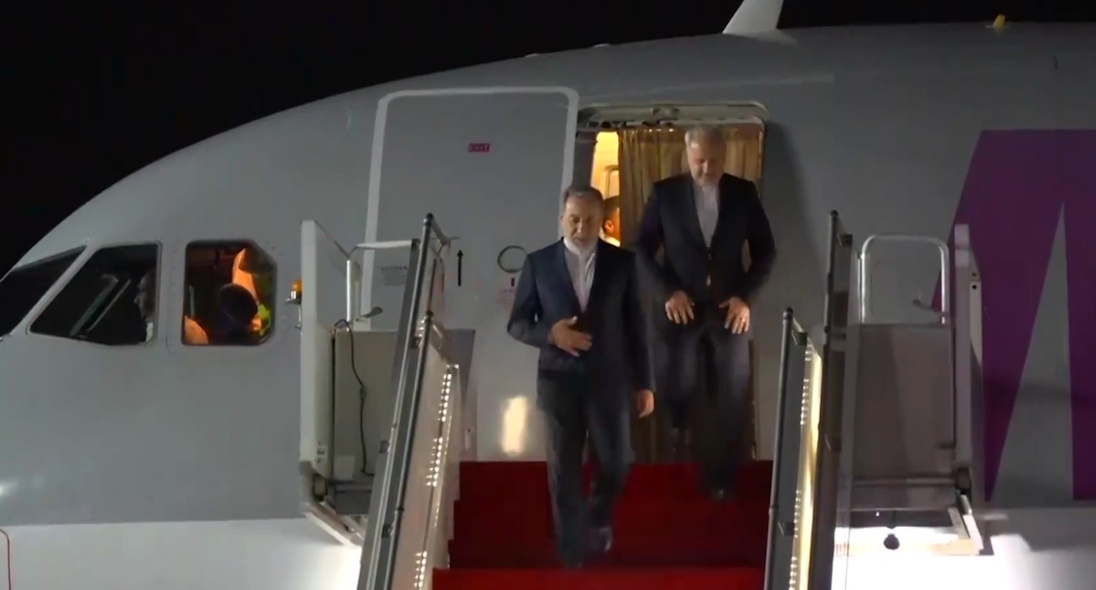
ISLAMABAD (AP): Iran’s Foreign Minister Abbas Araghchi left Pakistan on Saturday evening without any indication that U.S. envoys had arrived for planned indirect talks on the fragile ceasefire, according to two Pakistani officials who spoke to The Associated Press.
The officials, who requested anonymity because they were not authorized to speak to the media, said Araghchi was seen off at an airport in Islamabad. Before his departure, he met with Pakistan’s Army Chief Field Marshal Asim Munir and Prime Minister Shehbaz Sharif, outlining what he described as Iran’s “red lines” for any future negotiations. Araghchi added that Tehran would continue to engage with Pakistan’s mediation efforts “until a result is achieved.”
It remained unclear when U.S. envoys Steve Witkoff and Jared Kushner appointed by President Donald Trump were scheduled to arrive in the Pakistani capital. The White House declined to comment on the apparent diplomatic gap.
A Fragile Ceasefire, But Deepening Economic Fallout
An open-ended ceasefire has paused most active fighting between Iran and U.S.-led forces, but the economic consequences continue to mount. Global shipments of oil, liquefied natural gas, fertilizer, and other essential supplies remain disrupted due to the near-closure of the Strait of Hormuz, a strategic chokepoint through which roughly one-fifth of the world’s oil passed before the conflict.
The price of Brent crude oil, the international benchmark, remains nearly 50% higher than when the war began, largely because of Iran’s ability to threaten shipping lanes in the strait. This week alone, Iran attacked three ships, while the U.S. maintains a naval blockade on Iranian ports. President Trump has ordered the U.S. military to “shoot and kill” small boats suspected of laying mines.
Trust Deficit and Indirect Talks
Iranian officials have publicly questioned how they can trust the United States after previous negotiations over Tehran’s nuclear program held late last year and early this year ended with Iran being attacked by the U.S. and Israel.
Ahead of the expected talks, Islamabad had been placed under near-lockdown. Pakistan has been working to bring Washington and Tehran back to the negotiating table since Trump this week announced an indefinite extension of the ceasefire, honoring a Pakistani request for more diplomatic outreach.
The White House said Friday that Trump was sending Witkoff and Kushner to meet directly with Araghchi. However, Iran’s foreign ministry quickly clarified that any talks would be indirect, with Pakistani officials shuttling messages between the two sides.
The previous round of talks hosted by Pakistan led on the U.S. side by Vice President JD Vance lasted more than 20 hours and were conducted face-to-face, marking the highest-level direct negotiations between the longtime adversaries since the Islamic Revolution in 1979.
By contrast, Araghchi and Trump’s envoys held hours of indirect talks in Geneva on Feb. 27, but walked away without a deal. The very next day, Israel and the United States launched military operations that escalated into the current war.
Global Ripples and European Intervention
The standoff in the Strait of Hormuz has sent shockwaves through global maritime trade, even affecting shipping routes through the Panama Canal, nearly halfway around the world.
On Saturday, Germany’s Defense Minister Boris Pistorius announced that his country is dispatching minesweeper ships to the Mediterranean to help clear Iranian mines from the Strait of Hormuz once hostilities end.
Meanwhile, Iran resumed commercial flights from Tehran’s international airport for the first time since the war began two months ago. According to state-run television, flights were scheduled to depart for Istanbul, Muscat (Oman’s capital), and the Saudi city of Medina. Iran had partially reopened its airspace earlier this month due to the ceasefire.
Rising Human Toll
Even as ceasefires hold in some theaters, the war’s human cost continues to climb. Since hostilities began, authorities report at least:
-
3,375 killed in Iran
-
More than 2,490 killed in Lebanon, where new fighting erupted between Israel and the Iran-backed militant group Hezbollah just two days after the Iran war started
-
23 killed in Israel
-
More than a dozen killed in Gulf Arab states
Among the dead are 15 Israeli soldiers in Lebanon, 13 U.S. service members in the region, and six members of the United Nations peacekeeping force in southern Lebanon.
On Thursday, Trump announced that Israel and Lebanon had agreed to extend a ceasefire between Israel and Hezbollah by three weeks. Hezbollah has not participated in the Washington-brokered diplomacy.
What’s Next?
With Araghchi now back in Tehran and U.S. envoys yet to arrive in Islamabad, it remains unclear whether or when mediated talks will resume. Pakistan continues to position itself as a diplomatic bridge, but the deep mistrust between Washington and Tehran compounded by recent military action suggests that any meaningful breakthrough will face steep obstacles.
For now, the Strait of Hormuz remains a flashpoint, global energy markets remain on edge, and a fragile ceasefire does little to address the underlying fault lines of a conflict that has already reshaped the Middle East.
Our Pashto-Dari Website

Support Dawat Media Center
If there were ever a time to join us, it is now. Every contribution, however big or small, powers our journalism and sustains our future. Support the Dawat Media Center from as little as $/€10 – it only takes a minute. If you can, please consider supporting us with a regular amount each month. Thank you
DNB Bank AC # 0530 2294668
Account for international payments: NO15 0530 2294 668
Vipps: #557320

Comments are closed.