
Afghanistan’s First Astronaut, Abdul Ahad Momand, Laid to Rest in Kabul Amid National Tributes

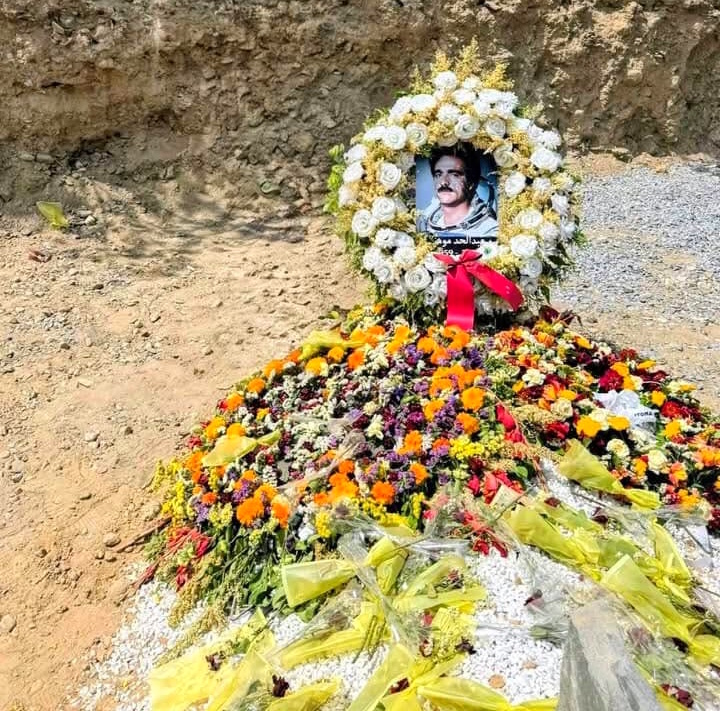
Afghanistan’s first and only astronaut, Abdul Ahad Momand, was laid to rest in Kabul on Monday, following the repatriation of his body from Germany, where he died last week at the age of 67 after a prolonged battle with cancer. His passing has drawn widespread reflection across the Afghan diaspora and within the country, where he is remembered not only as a space pioneer but as a rare symbol of national unity in an era of deep division.
Funeral prayers were held at Kabul’s historic Eidgah Mosque, one of the city’s largest and most significant religious sites, before Momand’s coffin was carried to Maranjan Hill Cemetery for burial. The ceremony drew a diverse crowd that included senior Taliban officials, former colleagues from Afghanistan’s pre-1990s military and scientific institutions, family members, and hundreds of ordinary mourners who braved chilly weather to pay their final respects. Many held portraits of Momand in his cosmonaut uniform, while others recited verses from the Quran and praised his humility and lifelong dedication to science.
According to a statement from the Taliban-led Ministry of Foreign Affairs, Momand’s body was repatriated from Stuttgart, Germany, at the explicit request of his family, who wished for him to be interred in his homeland. His eldest son, speaking at the graveside, confirmed that his father had been receiving treatment in Germany for several years but had often expressed a desire to return to Afghanistan in his final days. “He loved his country, despite all its trials,” the son said. “He wanted to come home.”
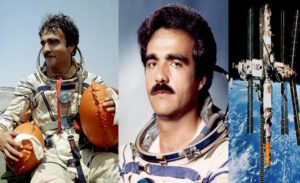
Momand’s place in history was secured in 1988, when he blasted off aboard the Soviet Soyuz TM-6 mission, becoming the first Afghan and only the fourth Muslim to travel into space. The mission launched from the Baikonur Cosmodrome in present-day Kazakhstan and docked with the Mir space station, where Momand spent nearly nine days conducting a series of scientific experiments in materials science, biology, and Earth observation alongside Soviet commander Vladimir Lyakhov and Syrian cosmonaut Musa Manarov. His flight was part of the Soviet Union’s Interkosmos program, which sought to strengthen ties with allied nations through crewed space missions. At the time, Momand’s achievement was celebrated as a triumph for Afghanistan’s modernization efforts and its partnership with Moscow.
Born in 1959 in the rural Andar district of Ghazni province, Momand grew up in a modest family and showed early aptitude for mathematics and engineering. He graduated from Kabul’s prestigious military academy before being selected for advanced pilot training in the Soviet Union. His exceptional performance as a fighter pilot in the Afghan Air Force led to his nomination for the grueling cosmonaut training program at the Yuri Gagarin Cosmonaut Training Center near Moscow, where he endured centrifugal force tests, zero-gravity simulations, and survival drills in remote Siberian conditions. His Soviet instructors reportedly praised his discipline and composure under pressure—qualities that would serve him well during the mission’s minor technical challenges, including a thruster malfunction during docking.
After the collapse of the Soviet-backed government in Afghanistan and the ensuing civil war, Momand chose to remain abroad, eventually settling in Germany, where he worked in various technical roles and kept a low profile. Despite his quiet life in exile, he never fully retreated from public view; he gave occasional interviews to Afghan media, urging young Afghans to pursue education and science, and he remained a beloved figure in online communities where his spaceflight photos are still widely shared. In 2019, on the 30th anniversary of his mission, he was honored in a virtual ceremony by Afghan space enthusiasts, who called him “the star that never faded.”
His death has prompted an outpouring of tributes across social media, with Afghans from all political backgrounds hailing him as a unifying icon. Many drew contrasts between his historic voyage a moment of international cooperation and national pride and the country’s subsequent decades of war, isolation, and humanitarian crisis. “He showed us that Afghans could reach the stars,” wrote one user on X (formerly Twitter). “We should remember that, even when everything else seems dark.”
The Taliban administration, which has sought to project a more pragmatic image on certain cultural and historical matters, facilitated the repatriation and funeral arrangements, with senior officials praising Momand as “a son of the soil” and ordering that his grave be maintained as a site of remembrance. While the regime has faced widespread international criticism over its restrictions on education and women’s rights, its handling of Momand’s burial has been noted by some observers as a rare gesture of cross-political reverence.
Momand’s burial in Kabul overlooking the city from the slopes of Maranjan Hill, where several other prominent Afghan figures are interred brings a quiet closure to a life that traversed the Cold War, the Soviet-Afghan conflict, exile, and the shifting tides of his homeland’s tumultuous history. Though he leaves behind no new generation of Afghan astronauts, his legacy endures as a reminder that even from a nation battered by conflict, human ambition can reach beyond the atmosphere.
In the final analysis, Abdul Ahad Momand was more than a footnote in space history. He was a bridge between Afghanistan’s past aspirations and its present realities a man who looked down on Earth from orbit and chose, in the end, to return to the soil that shaped him. His grave now stands as a quiet monument to that enduring bond.
Support Dawat Media Center
If there were ever a time to join us, it is now. Every contribution, however big or small, powers our journalism and sustains our future. Support the Dawat Media Center from as little as $/€10 – it only takes a minute. If you can, please consider supporting us with a regular amount each month. Thank you
DNB Bank AC # 0530 2294668
Account for international payments: NO15 0530 2294 668
Vipps: #557320

Comments are closed.