
The Silent Siege: How Barring Afghan Girls from School is Strangling a Nation, One Life at a Time

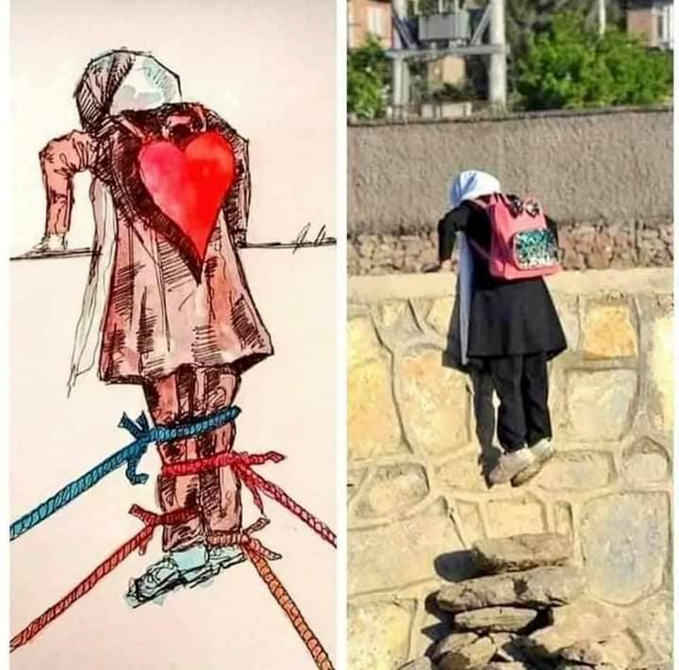
Every morning, even after the Taliban’s decree banned Afghan girls from the classroom, Fariba got ready for school. The teenager would leave the house with her head held high, a stubborn smile on her face, insisting to her mother that she was simply going to ask her teachers when she could finally wear her uniform again. Each evening, the charade collapsed. A crestfallen, hollow-eyed Fariba would return home, the light in her gaze extinguished.
“She looked so devastated that we couldn’t recognize her,” says her mother, who spoke to the Associated Press on the condition of anonymity for fear of Taliban reprisal. “Months passed like this. The silence in our house became our worst enemy.”
One night, the family went to bed unaware of the tragedy that was about to unfold. “We didn’t think she could reach such a breaking point,” her mother whispers. At just 16 years old, Fariba died by suicide. In a note left for her family, she wrote that it was simply too hard to be a girl in Afghanistan.
That sentiment is not new. Being a girl or a woman in this war-scarred land has been fraught with peril for decades, and for many in rural provinces, for centuries. It grew grotesquely worse under the Taliban’s first reign of terror from 1996 to 2001, where women were erased from public life and beaten for showing their ankles. It has eroded again with staggering speed since the religious movement’s acolytes retook power in the chaotic summer of 2021, following the United States’ withdrawal.
And to hear many Afghan women and international observers tell it, the situation is not merely stagnant it is actively deteriorating. Tragedies like Fariba’s are the canaries in the coal mine, a critical signal of the situation’s severity. Examining these cases offers a harrowing glimpse into the state of women writ large, and how their systematic oppression ripples outward, destabilizing the economy, decimating public health, and poisoning the country’s future.
A Broken Promise and a Vanishing Future
When the Taliban retook power this time around, they stood before the world and pledged to uphold women’s rights, presenting a veneer of moderation. Instead, within months, they closed schools to girls beyond the sixth grade, citing their rigid interpretation of Islamic law. They have also halted medical courses for women, a move which directly imperils the lives of millions of mothers and infants. Though Taliban officials insist they are working on “conditions” for the return of female education, they have failed to clarify what these conditions might be, while simultaneously erecting more barriers. International condemnation has been vocal but largely focused on broader human rights violations, with little tangible pressure applied.
The bans, however, are not just a moral failing; they are a profound act of economic and social self-sabotage. Experts warn of a looming tsunami of rising child marriages, a spike in maternal mortality, and an estimated annual economic loss of $500 million from the secondary school ban alone. That is the macro view. But for families like Fariba’s, the cost is devastatingly personal.
The Uncounted Dead: A Crisis of Despair
“This was the time for her studies, the time when she should have been progressing,” Fariba’s mother says, her voice cracking. “It causes me so much pain when I see other girls. I can neither sleep at night nor find peace during the day.” She now lives in constant fear for her two remaining daughters, terrified that the walls of their home are closing in.
There are no recent overall statistics on suicide in Afghanistan a country where such acts are forbidden in Islam and carry a deep, suffocating cultural stigma. However, U.N. experts stated in 2023 that accounts of escalating suicides among women and girls were a source of “increasing concern.” Afghan Witness, a U.K.-based rights group, has reported a surge in female suicides since the Taliban takeover, linking them directly to forced marriage, Taliban violence, and the crushing restrictions on education and employment.
A doctor in southern Afghanistan describes a grim routine: distressed girls regularly arrive at the hospital after trying to end their lives, some horrifically setting themselves alight. “Most of them are in a bad condition and die here in front of our eyes,” the doctor says, helpless. Compounding the trauma is the community’s reaction. Another woman told journalists that when her sister died by suicide because she could no longer study, “nobody showed sympathy. They only asked how someone could kill themselves over school.”
The Fatal Shortage: A Future Without Female Doctors
Under the Taliban, restrictions on women have multiplied exponentially. Now, with formal education off limits, Afghanistan is staring into an abyss: a future without female professionals, particularly in the critical field of medicine. The country already possessed one of the world’s highest maternal mortality rates and a dire shortage of midwives. Now, experts say, the education bans will be fatal. UNICEF reported in 2024 that the shortage of qualified female medical professionals could lead to an additional 1,600 mothers and over 3,500 infants dying unnecessarily.
Dr. Najumussa Shefajo, who runs a private maternity hospital in Kabul, finds herself in a bitter paradox. Her wards are largely empty because patients cannot afford care, but her reception area is crowded with women seeking free advice and desperately consuming the fruits and nuts available for nutrition. The Taliban themselves are part of the problem they have created. “The Taliban bring their wives here for treatment,” Shefajo says, her eyes narrowing in disbelief. “They ask for female doctors. Now they want female doctors?” She shakes her head. “The Taliban have wives, daughters, mothers. Their sons will marry and have children. Those women will need care. But who will treat them if there are no female professionals left?”
Her youngest patient is just 14. “A child cannot raise a child,” she says flatly. But crushing poverty drives families to marry off girls early, exchanging them for dowries or even to settle gambling debts. In western Afghanistan, a teacher recounts the story of a 13-year-old student who was sold for 500,000 Afghanis (about $7,400). “The longer the girls stay out of school, the more violence they face,” the teacher says. “We in the villages and mountains see it. Afghan women die here without anyone hearing their voices.”
The Education of a Mother is the Health of a Nation
The impact of the bans transcends health; they dismantle the very scaffolding of Afghan society. Cultural norms dictate that male teachers do not teach girls beyond the primary level. With universities closed to women, the pool of female educators is evaporating. The country is projected to face a shortage of 11,000 teachers by 2030, leaving an entire generation of young girls without mentors or role models.
“Even the girls we have up to grade six have lost their morale and motivation,” says Torpekai Mohmand, principal of Maryam Afifa High School in Kabul. “They come to class, but they are discouraged. They know the road ends for them in just a few years.”
Half of her students in grades one through six have already dropped out. Families, facing economic ruin, are preparing daughters for marriage or redirecting school costs toward food and fuel. More than 2 million girls are barred from school beyond the sixth grade; their numbers grow with each passing year, creating a demographic time bomb of uneducated, disenfranchised youth.
Classrooms were once sanctuaries among the few places where girls could socialize, dream, and connect outside the confines of their homes. Mohmand, who worked in the Education Ministry before 2021, remembers the Taliban’s first rule in the late 1990s. Once, she says, a fighter whipped her hands in a market simply because they were visible. “A girl has the same value as a boy when she is economically independent,” Mohmand insists. “All that was lost when schools closed.”
The Silent Suffocation of a Generation
The data is devastating. U.N. Women stated in 2025 that the bans on university and secondary education are projected to increase child marriage by 25%, increase childbearing among adolescent girls by 45%, and increase maternal mortality by at least 50%. In April 2026, UNICEF warned that Afghanistan could lose up to 20,000 women teachers and 5,400 healthcare workers by 2030, losing trained female professionals while actively “preventing the next generation” from replacing them.
Mohmand worries about the irreversible loss of knowledge. “Some subjects, especially sciences, build lesson by lesson. Afghan girls have missed the basics. The longer the bans persist, the harder it will be to recover even one lost year.” Students who were studying advanced subjects are now forced to relearn the alphabet of their stolen futures.
Farahnaz, 24, stands as a testament to this intellectual suffocation. She had just one year left of her Dari literature degree when universities closed for women. Now, she takes sewing classes at Mohmand’s high school. Only her eyes are visible behind her veil a veil she insists is not worn by choice. “Education is a right to freedom,” she says, her voice trembling. “When there is no education, there is no future. We want female doctors. We want someone to treat us.”
A Shrinking Future: The Economic Collapse
Before the takeover, girls accounted for four out of 10 students in Afghanistan, and 100,000 young Afghan women were attending college. Now, the majority of Afghan females are out of school after the primary years. Every additional year of schooling increases an Afghan girl’s potential earnings by 20%. Without it, her future, and Afghanistan’s, contracts into a smaller, darker space.
Times are hard, and education is becoming a luxury. If a family cannot afford the associated costs clothes, transport, stationery it is inevitably the girls who are excluded. A changing curriculum, a shortage of qualified teachers, and the use of corporal punishment have also driven down boys’ attendance. With the economy in crisis, parents increasingly send their children to work instead of class.
Educated women once helped stabilize households and blur social divisions. Teachers and doctors took their salaries home, easing financial strain and shifting perceptions of girls’ worth. Yet without education, the pathways to work narrow. Fewer workers mean less household income, a smaller tax base, fewer consumers, and a weaker economy overall. The removal of women from the workforce strips away a noticeable share of Afghanistan’s gross domestic product. In 2023–24, the loss was estimated to be $1 billion. In 2001, Afghan women’s GDP per capita was $277. By 2021, it had nearly doubled to $528. That progress has been brutally reversed.
The Death of a Dream: The Seamstress’s Story
One woman, a seamstress, described how quickly her livelihood collapsed after the education bans. Before the Taliban’s takeover, she had expanded from her home into a rented space with six sewing machines and workstations. She trained female apprentices, including high school graduates looking to start earning. Together, they produced more than a dozen garments a day.
Much of their work was connected to schools headscarves and uniforms. After the schools closed, clients vanished. The business didn’t stop immediately, but it suffered a debilitating blow. Over time, the apprentices stopped coming, the orders dried up, and overheads outpaced earnings. The owner lowered her prices to cover rent and electricity, but even that wasn’t enough.
Mounting losses, a drop in household income, and Taliban harassment forced her tailoring business to shut down. The workers took the clothes back home. The Taliban used to tell the seamstresses they had no reason to be in the market. “However, we understood how much this shop had impacted our economy and improved our lives,” the owner says, reflecting on what was lost. “Only we knew its importance.”
Now, as Afghanistan descends deeper into isolation, the silence of empty classrooms echoes louder than the explosions of war ever did. The nation is not just denying girls an education; it is denying itself a future, suffocating slowly under the weight of its own cruel decrees.
Our Pashto-Dari Website

Support Dawat Media Center
If there were ever a time to join us, it is now. Every contribution, however big or small, powers our journalism and sustains our future. Support the Dawat Media Center from as little as $/€10 – it only takes a minute. If you can, please consider supporting us with a regular amount each month. Thank you
DNB Bank AC # 0530 2294668
Account for international payments: NO15 0530 2294 668
Vipps: #557320

Comments are closed.