

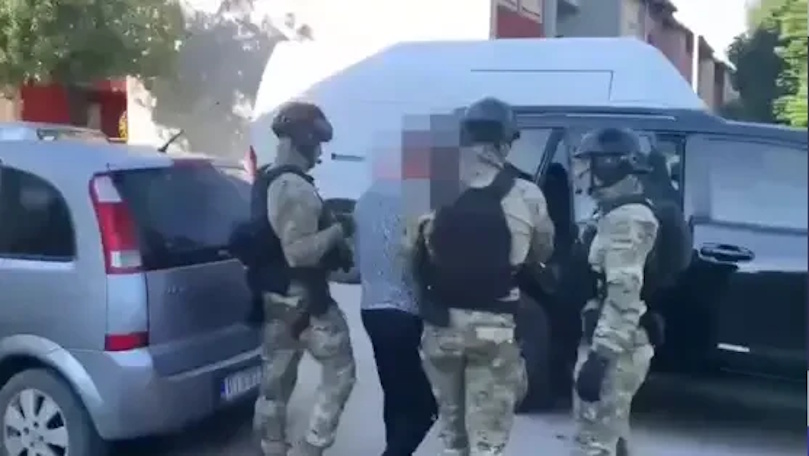
Europol announced on Friday that it has dismantled a suspected human smuggling network responsible for transporting Afghan migrants from Türkiye through the Balkans to Western Europe, following a joint operation with Bulgarian and Serbian authorities. Five suspects have been arrested, including the alleged ringleader and two serving police officers.
The coordinated operation, conducted in close collaboration with law enforcement agencies in Bulgaria and Serbia, targeted a criminal network that has been active since 2025. According to Europol, the group systematically organized the movement of Afghan nationals first smuggling them from Türkiye into Bulgaria, then facilitating their transit across Serbia, and finally onward to destinations in Western European countries. The arrests mark a significant breakthrough in broader European efforts to combat organized migrant smuggling along the Balkan route.
Europol confirmed that investigators have detained five individuals connected to the operation. Among those arrested are the network’s suspected leader, who is believed to have coordinated logistics and finances, and two active-duty police officers accused of complicity in the smuggling activities. Authorities are currently examining the officers’ alleged involvement, which may have included providing safe passage, tipping off the network about border patrol movements, or facilitating the bribing of other officials along the route.
During a series of coordinated searches at multiple locations, law enforcement seized a substantial amount of evidence linked to the criminal enterprise. Confiscated items include three vehicles believed to have been used for transporting migrants, several firearms and ammunition, a radio communication device likely employed for coordinating border crossings, and a large number of mobile phones. In addition, investigators recovered approximately €5,700 in cash and 40,000 Serbian dinars (roughly €340), which authorities suspect represent profits from recent smuggling operations.
The investigation has also shed light on the network’s pricing structure. Migrants were reportedly charged around €1,000 per person for the initial leg of the journey from the Bulgarian border into Serbia. For those continuing further north, an additional €300 was required for transportation toward the Serbia-Poland border, from where migrants would typically be moved into Germany or other Western European nations. Most payments, Europol noted, were processed through the hawala informal money transfer system a traditional, trust-based method of remittance that operates outside formal banking channels, making financial tracking particularly challenging for investigators.
In its statement, Europol underscored that migrant smuggling remains one of the most significant organized crime threats facing the European Union today. Criminal networks, the agency warned, continue to exploit the desperation of vulnerable migrants seeking safety and better livelihoods in Europe, often subjecting them to life-threatening conditions, physical abuse, and extortion. The agency stressed that close cross-border cooperation between national police forces, judicial authorities, and international bodies like Europol is vital for identifying, infiltrating, and dismantling such transnational criminal structures.
The Balkan corridor has long been a primary transit route for migrants and asylum seekers heading toward the European Union. Since the Taliban takeover of Afghanistan in August 2021 and the subsequent collapse of the Afghan economy, Afghan nationals have consistently represented a large share of those traversing this route. Many embark on the perilous journey after fleeing persecution, poverty, or violence, often spending months in transit and facing extreme risks, including drowning, dehydration, and detention in harsh conditions.
European authorities have ramped up their counter-smuggling efforts over the past several years, deploying additional border guards, enhancing surveillance technology, and launching joint investigation teams with non-EU countries along the migration trail. Officials have repeatedly warned that organized criminal groups are becoming more sophisticated in their methods, using encrypted communications, false documentation, and bribery to evade detection. At the same time, they emphasize that these networks generate hundreds of millions of euros in illicit revenue annually, fuelling other forms of organized crime such as drug trafficking and money laundering.
The five arrested suspects are expected to face charges related to people smuggling, participation in an organized criminal group, and, in the case of the police officers, abuse of office and corruption. Further arrests have not been ruled out as the investigation continues, with Europol and national authorities analyzing the seized data and financial records to identify additional members of the network and potential links to other smuggling operations across the region.
Our Pashto-Dari Website

Support Dawat Media Center
If there were ever a time to join us, it is now. Every contribution, however big or small, powers our journalism and sustains our future. Support the Dawat Media Center from as little as $/€10 – it only takes a minute. If you can, please consider supporting us with a regular amount each month. Thank you
DNB Bank AC # 0530 2294668
Account for international payments: NO15 0530 2294 668
Vipps: #557320

Comments are closed.