
Six Afghan and Cuban Deportees Arrive in Guyana Under US Third-Country Relocation Agreement

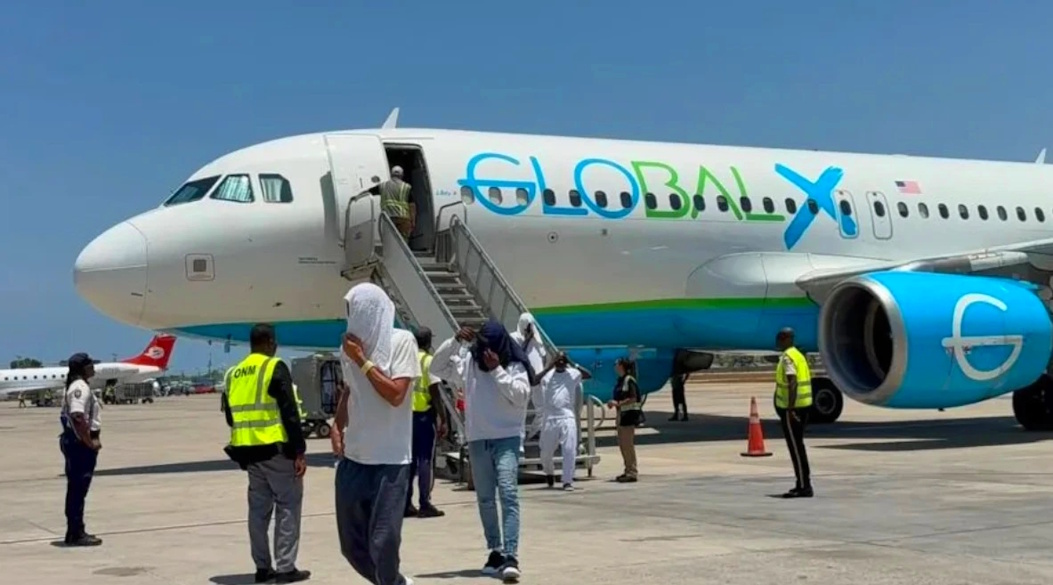
GEORGETOWN, Guyana — Six nationals from Afghanistan and Cuba, deported from the United States, have arrived in Guyana as part of a new migration cooperation framework between the U.S. and Guyanese governments. The move marks the latest expansion of the Trump administration’s use of third-country deportations, a policy that has drawn both international attention and criticism.
The group consisting of two Afghan men and four Cuban nationals landed in Guyana on Friday after being removed from the United States for immigration-related violations, according to Guyana’s Foreign Secretary Robert Persaud. He confirmed that Guyanese authorities conducted background checks on all six individuals and found no criminal records.
Speaking at a press briefing in Georgetown, Persaud emphasized that the agreement, which took months to negotiate, is temporary and will remain in effect for one year. He clarified that the arrangement does not constitute permanent resettlement and noted that the United States has not submitted any additional requests to send non-Guyanese deportees to the country.
Under the terms of the framework, the six individuals will receive support through the International Organization for Migration’s (IOM) Assisted Voluntary Return Programme while their immigration status is being assessed. Depending on the outcome of that process, they may eventually be returned to their countries of origin or seek relocation to a third country.
The Guyanese government has retained the right to review and reject any individual proposed for relocation under the agreement. Persaud stressed that Georgetown will only accept people who have voluntarily chosen to relocate to Guyana. The United States will cover all relocation costs, while the IOM will oversee the operational aspects of the program, including temporary housing, legal assistance, and other support services.
Guyana now joins a growing list of more than 30 countries that have entered into similar third-country deportation arrangements with the Trump administration, according to recent reports. These agreements allow the U.S. to send foreign nationals to nations other than their own, often as an alternative to detention or as a deterrent to future unauthorized entry.
However, the policy has drawn sharp criticism from human rights organizations, which have raised concerns about the lack of transparency in such agreements and the potential risks faced by deportees. Critics argue that sending individuals to countries where they have no familial, cultural, or linguistic ties can exacerbate trauma and increase vulnerability. They have also questioned whether these migrants will receive adequate legal protections and whether they could face persecution or unsafe conditions upon arrival.
The Trump administration has defended the policy as a necessary tool in its broader immigration enforcement strategy, arguing that it enhances deterrence and facilitates the swift removal of individuals who lack legal status in the U.S. Officials have also pointed to the involvement of international bodies like the IOM and UNHCR as a safeguard for deportees’ rights.
For its part, Guyana has sought to frame the agreement as a measured and humane exercise of its sovereign migration policy. The government has reiterated that all relocations will be carried out in coordination with the IOM, the UNHCR, and domestic authorities, and in accordance with Guyana’s international human rights obligations. Officials have also stressed that the country is not acting as a detention center or permanent resettlement hub, but rather as a temporary transit point under a clearly defined, time-limited arrangement.
As the Trump administration continues to expand its third-country deportation network, observers are closely monitoring the humanitarian and diplomatic implications of such agreements, particularly for smaller nations like Guyana that may face capacity constraints in receiving and processing displaced individuals.
Our Pashto-Dari Website

Support Dawat Media Center
If there were ever a time to join us, it is now. Every contribution, however big or small, powers our journalism and sustains our future. Support the Dawat Media Center from as little as $/€10 – it only takes a minute. If you can, please consider supporting us with a regular amount each month. Thank you
DNB Bank AC # 0530 2294668
Account for international payments: NO15 0530 2294 668
Vipps: #557320

Comments are closed.