

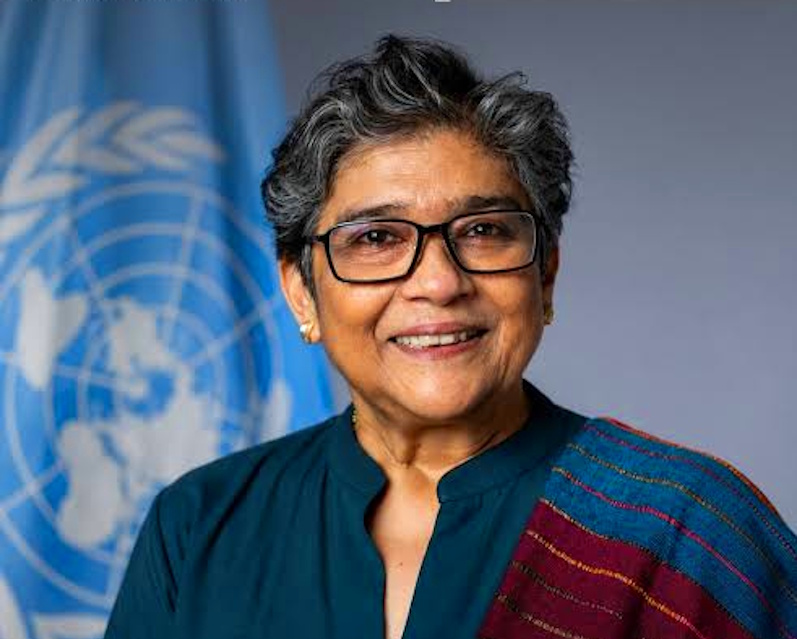
Rabab Fatima, the United Nations’ newly appointed Special Representative for Afghanistan and head of the UN Assistance Mission in Afghanistan (UNAMA), has arrived in Kabul and formally assumed her duties, the United Nations said.
In a statement published on Sunday, the UN confirmed that Fatima began her role on October 16, taking over leadership of the mission as Afghanistan continues to face political, humanitarian and human rights challenges under Taliban rule. She succeeds Roza Otunbayeva of Kyrgyzstan, whose tenure ended in September 2025, and becomes the second woman diplomat in five years to lead the UN mission in Afghanistan .
Fatima brings more than 30 years of experience in national and international public service, including bilateral and multilateral diplomacy, policymaking, advocacy, and the planning and implementation of programmes. Before her appointment, she served as UN under-secretary-general and high representative for the least developed countries, landlocked developing countries and small island developing states.
The Bangladeshi diplomat previously served as her country’s ambassador and permanent representative to the UN in New York from 2019 to 2022. During that period, she led the executive boards of UNICEF and UN Women and became the first woman elected chair of the UN Peacebuilding Commission in 2022. She has also served as Bangladesh’s ambassador to Japan and held senior positions at the country’s foreign ministry and diplomatic missions.
Guterres announced Fatima’s appointment on July 15. The secretary-general also acknowledged the service of Georgette Gagnon, UNAMA’s deputy special representative, who had been overseeing the mission during the leadership transition.
A Mission Under Strain
UNAMA plays a central role in the United Nations’ political engagement with Afghanistan, supporting dialogue, coordinating humanitarian efforts and monitoring the country’s human rights situation. Its mandate was renewed by the Security Council in June 2026 through resolution 2822, which extended the mission until 17 June 2027 and maintained its core tasks: political good offices, coordination of international assistance, and human rights monitoring and reporting .
Fatima assumes leadership at a moment of compounding crises. According to the latest Integrated Food Security Phase Classification analysis, 15.9 million Afghans 32 percent of the population faced crisis-level acute food insecurity between September and October 2026, including 3.4 million in emergency conditions. Those figures are projected to deteriorate to 19.2 million people, or 38 percent of the population, during the November 2026–April 2027 winter lean season, with 5 million facing emergency levels of hunger . The World Food Programme and FAO have warned that funding shortfalls are crippling the humanitarian response just as needs peak .
On human rights, UNAMA’s own quarterly report covering July to September 2026 documented more than 50 cases of women arrested, detained or cautioned for alleged hijab violations, mostly in Herat and Kabul, including a 13-year-old girl held overnight . Girls remain barred from formal education beyond grade six—a ban now in its fifth year . The Taliban also continue to prohibit Afghan women from entering UN premises, a restriction in place since September 2025 that UN officials say severely undermines the delivery of aid to women and girls, as assistance in Afghanistan must be delivered by women to reach women .
Immediate Tests
According to BBC reporting, Fatima’s first scheduled meeting is expected to be with Taliban Foreign Minister Amir Khan Muttaqi, with the ban on Afghan women UN staff among the most urgent issues on the agenda . She is also due to present her quarterly report to the Security Council in mid-December and is expected to address a meeting of the “Afghanistan Contact Group” in Doha by video conference at the end of this week, a coordination forum co-chaired by UNAMA and the European Union .
The Taliban authorities have already signaled their expectations. Mullah Abdul Ghani Baradar, the Taliban’s deputy prime minister for economic affairs, said at a gathering in Kabul that UNAMA should remain “impartial” in its reports and not ignore what he described as Afghanistan’s economic and security achievements . Taliban spokespeople have repeatedly rejected UNAMA’s human rights findings as biased.
Fatima’s challenge is structural: she must maintain a channel of political engagement with authorities who reject the premises of her human rights mandate, while advocating for the reversal of policies particularly the exclusion of Afghan women from education, employment and UN premises that the Taliban treat as non-negotiable. Her three decades of multilateral experience, including leadership of the Peacebuilding Commission and the least developed countries portfolio, may serve her well in the diplomatic balancing act. But the gap between the Security Council’s expectations and the Taliban’s posture remains wide, and the humanitarian clock is ticking toward winter.
Our Pashto-Dari Website

Support Dawat Media Center
If there were ever a time to join us, it is now. Every contribution, however big or small, powers our journalism and sustains our future. Support the Dawat Media Center from as little as $/€10 – it only takes a minute. If you can, please consider supporting us with a regular amount each month. Thank you
DNB Bank AC # 0530 2294668
Account for international payments: NO15 0530 2294 668
Vipps: #557320

Comments are closed.