

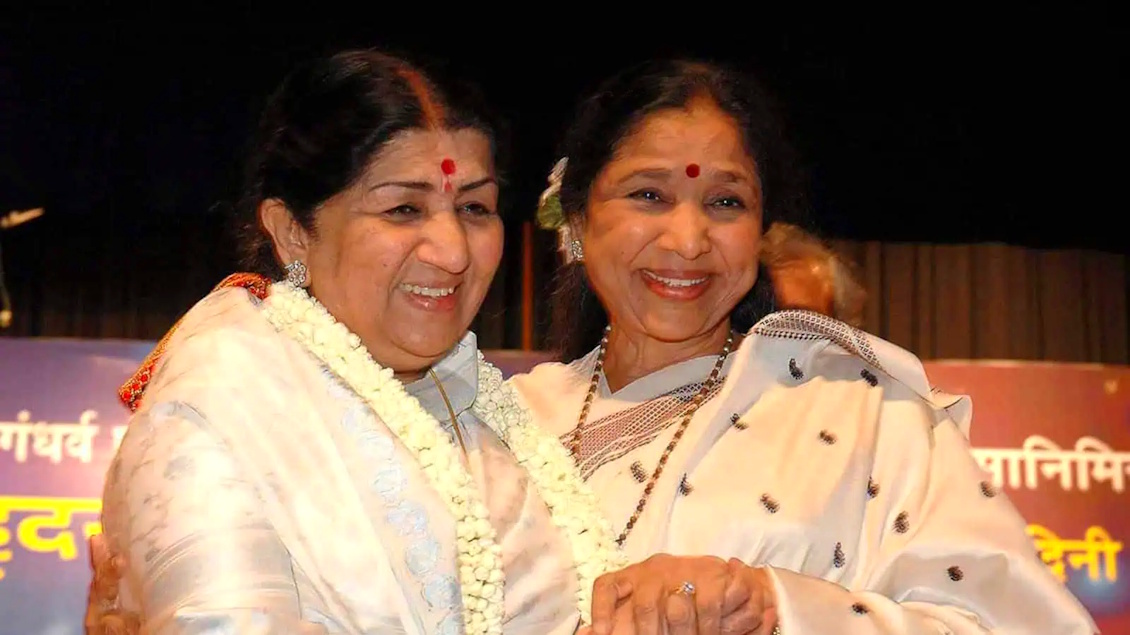
Mukesh, Kishore, Rafi, Lata, Asha… the golden greats are gone, but their songs play on.
New Delhi: In the days following Asha Bhosle’s death, an AI-generated meme circulated widely: Mukesh, Kishore Kumar, Mohammed Rafi, and Lata Mangeshkar, depicted in fluffy clouds, welcoming Asha into heaven. For generations of music lovers, the image carried a pang of bittersweet realisation the golden quintet is now forever framed in remembrance.
It has been two weeks since Bhosle passed away at the age of 92. Yet the world of music she leaves behind continues to play on, as it has for decades and as it will for the decades ahead. With her death, the last of the greats has gone. A page has turned in the history of Indian popular music a chapter that opened in the early days of India’s independence, and even earlier, has now closed.
An Heirloom of Thousands of Songs
“Abhi Na Jao Chhod Kar,” “Yeh Chand Sa Roshan Chehra,” “Jeena Yahan Marna Yahan,” “Awara Hoon,” “Pyar Kiya To Darna Kya,” “Lag Ja Gale,” “In Aankhon Ki Masti,” “Chura Liya,” “Dil Cheez,” “Mera Kuchh Saaman”… The many thousands of songs from the golden five will pass from one generation to another like heirlooms but with no new additions.
“The era has come to an end with the passing of Asha ji,” lyricist Sameer told PTI. “These artists never considered singing as their job. It was their passion and they gave it their all… The generation after them has not been able to create that same kind of great music because cinema has changed and OTT has arrived.”
‘The Last Mughal’ A Self-Aware Queen
In an interview with PTI on her 90th birthday, Bhosle famously called herself “the Last Mughal.” She was not off the mark. The Mangeshkar sisters did rule the Indian playback industry like true queens their reign spanning over seven decades.
“It feels good when people love our songs, even outside India,” she had said. “It is because some of the old songs were very well written, well composed, and well sung. All the singers would sing so well, be it Mohammed Rafi sahab, Kishore, Mukesh ji, and others. Abhi, sab khali ho gaya hai (Today, it feels empty).”
She once contemplated a concert with Lata Mangeshkar titled “The Last Mughal.” “I just said that because Didi had said we both sisters will do a show and call it ‘Last Mughal.’ That thing was playing in my head… I didn’t mean to say ‘I’m a maharani or I’m great.’ What I meant is I know the industry closely for many years.” Lata Mangeshkar died in February 2022.
Why Their Voices Matched Every Actor
According to music critic Rajiv Vijaykar, the five great singing stars had voices that could match any actor from Dev Anand to Dilip Kumar, from Madhubala to Kajol. “They were in their own league,” he said. “Youngsters today are still singing Rafi, Mukesh, Kishore, Udit Narayan, and Kumar Sanu songs on reality shows. They are not singing beyond Sonu Nigam and Shreya. That spark is missing completely.”
Singer Madhushree, known for hits such as “Tumhe Aaj Maine Jo Dekha” and “Kabhi Neem Neem,” agreed with the Mughal analogy. “She, along with Lata ji, Rafi Sahab, Mukesh Sahab, and Kishore Da, truly represented the last of the ‘Mughals’ of that unmatched golden era. They were fortunate to work with extraordinary lyricists, visionary music directors, and passionate producers who together created magic that remains timeless. That combination of talent, poetry, melody, and soul is very rare to find today.”
Eight Decades, 11,000 Songs, and a Guinness Record
Bhosle’s career, which began when she was just 10 and extended across some eight decades, stands as testimony to how a great artist can ride the highest crests and deepest troughs through sheer talent and discipline. She held a Guinness World Record as the most recorded artist in music history, with over 11,000 songs in more than 20 Indian languages since 1947 singing for everyone from Madhubala, Sadhana, and Tanuja to Urmila Matondkar and Tanuja’s daughter, Kajol.
Her success came despite the overwhelming popularity of her elder sister, Lata, who was already an established star. The fact that Asha managed to stand out on her own is no small feat.
“She was a powerful singer whose knowledge of both classical and Western music was incredible,” singer Kumar Sanu told PTI. “I’ve been in the industry for 40 years, as have Alka Yagnik Ji and Kavita Krishnamurthi Ji, but the singers of today may not have a career as long as Asha and Lata ji, or even half of theirs.”
Sanu, who collaborated with Asha on 1990s hits including “Tumhari Nazron Mein Humne Dekha,” “Chehra Kya Dekhte Ho,” and “Mujhko To Kuchh Kuchh Hota Hai,” said he feels lucky to have worked with her. “Asha Ji worked until the very end, collaborating with composers and singers across generations. We are still here and willing to lend our voices, but there aren’t enough exciting opportunities that do justice to the legacy we’ve created.”
The Critics’ View: Soul vs. Speed
According to film historian, author, and archivist S. M. M. Ausaja, Asha was the last of the legends to leave. “There’s no one half as good as her. Most singers today don’t have any clue about raga or the traditional way of singing. Besides, they lack knowledge of Hindustani music. The Urdu diction of both Mangeshkar sisters was impeccable.”
Ausaja believes the connection listeners had with their favourite artists was deeper because music was never just a medium of entertainment. “These people were rooted in traditional music. The composers had a history of Indian classical music. Besides, there was poetry in those lyrics poetry enhances music. Hence, the songs were masterpieces, long-lasting, and are still being redone today. Today’s music is a mixture. It has no soul. There’s no poetry left. There’s a dearth of creativity.”
A Gentle Counterpoint: The Future May Sound Different
Madhushree offered a gentler counterpoint. “The new generation of lyricists, music directors, and singers are creating some beautiful work too in their own way and for their own time. The music industry is still capable of creating songs that could be remembered for 50+ years, but it will look and sound very different.
“Everything today moves much faster. Attention spans are shorter; consumption is instant via streaming, and songs often hook listeners in the first ten to fifteen seconds or they get skipped. That doesn’t mean depth or longevity is impossible. It just means the path to enduring relevance has changed.”
An Ending That Is Also a Beginning
Perhaps that is the final irony. The golden greats Mukesh, Kishore, Rafi, Lata, and Asha sang in an era of patience: of vinyl, of radio, of songs that took weeks to compose and a lifetime to master. Today, we skip, swipe, and stream. But we also still stop for “Lag Ja Gale.” We still hum “Chura Liya” in the rain. We still press repeat on “Mera Kuchh Saaman.”
The voices are gone. The heirlooms remain. And as long as there are ears to listen, the last Mughals of Indian music will never truly fall silent.
Our Pashto-Dari Website

Support Dawat Media Center
If there were ever a time to join us, it is now. Every contribution, however big or small, powers our journalism and sustains our future. Support the Dawat Media Center from as little as $/€10 – it only takes a minute. If you can, please consider supporting us with a regular amount each month. Thank you
DNB Bank AC # 0530 2294668
Account for international payments: NO15 0530 2294 668
Vipps: #557320

Comments are closed.