

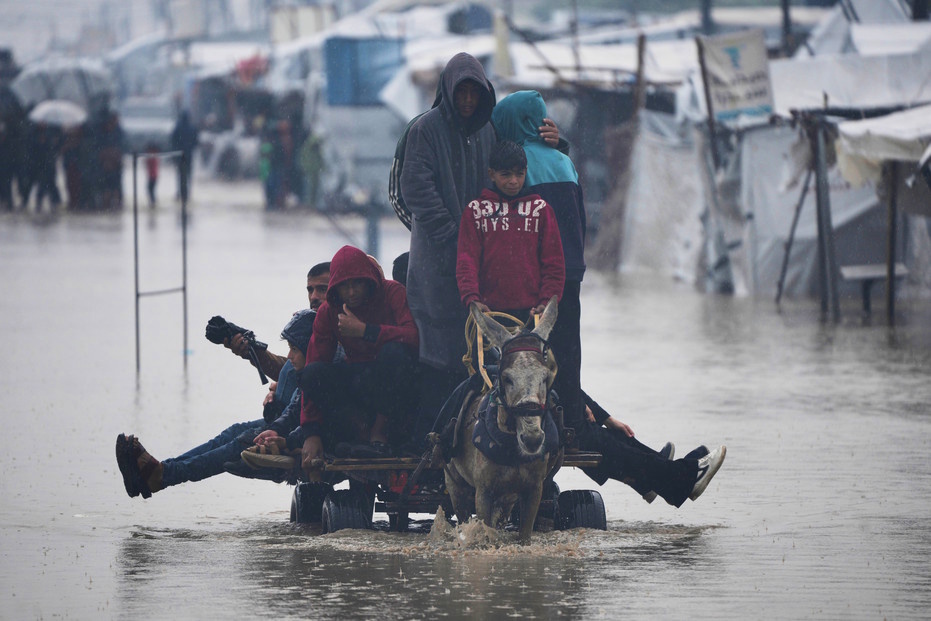
Fresh winter rains have lashed the Gaza Strip, flooding streets, sweeping through tent camps, and claiming lives in a territory already brought to its knees by two years of devastating war between Israel and Hamas.
The downpour, brought by Storm Byron, has transformed streets into rivers and refugee camps into quagmires. Residents, their lives upended by conflict, now face a bitter battle against the elements. Some pushed stalled cars through knee-deep water, while others resorted to donkey-pulled carts to navigate the inundated roads.
For the estimated 1.3 million displaced Palestinians living in makeshift shelters, the storm is a catastrophe atop a catastrophe. Canvas tents, plastic-sheeted lean-tos, and damaged buildings offer little protection. The UN warns of a rapidly increasing risk of hypothermia, particularly for the most vulnerable.
Tragedy has already struck. Gaza’s Health Ministry reported that a two-week-old baby, Mohammed Khalil Abu Al-Khair, died from severe hypothermia on Monday after being admitted to intensive care. The ministry directly linked his death to the extreme cold.
“With heavy rain and cold brought in by Storm Byron, people in the Gaza Strip are freezing to death,” said Philippe Lazzarini, head of the UN Relief and Works Agency for Palestine Refugees (UNRWA), in a social media post. He lamented that vital supplies, which could cover the needs of hundreds of thousands, have been waiting for months to enter the territory.
A Landscape of Ruin, Prone to Collapse
The rains are testing a landscape scarred by bombardment. Gaza’s Civil Defense agency, which operates as a rescue force under Hamas authority, reported that at least 16 people died within 24 hours last week from building collapses and the effects of the cold. On Tuesday, spokesman Mahmoud Bassal said a man was killed in northwest Gaza City when the roof of a war-damaged building gave way under the weight of rainwater.
AFP footage from the scene showed rescuers retrieving a man’s body from under collapsed concrete slabs as grieving relatives wept in the flooded street.
“We call on the world to solve our problems and rebuild the territory so that people can have homes instead of being displaced and living in the streets,” said Ahmed Al-Hosari, who lost a relative in the incident.
Aid Flow Insufficient Amidst Vast Need
While a ceasefire that took effect in October has partially eased restrictions, UN agencies and aid groups consistently report that the volume of humanitarian assistance entering Gaza remains woefully inadequate for the scale of the need. The storm has only magnified the urgency for shelter materials, winter clothing, fuel, and medical supplies.
The crisis underscores the precarious living conditions for Gaza’s 2.3 million residents. Located on a narrow coastal strip between the Sinai desert and the Mediterranean Sea, Gaza receives nearly all of its annual rainfall during the late autumn and winter. Without functional drainage systems, adequate shelter, or a robust civic infrastructure—all severely degraded by repeated conflicts—even routine winter weather now poses a lethal threat.
The freezing floodwaters now soaking Gaza’s ruins serve as a stark testament to a humanitarian emergency where survival, even amid a tentative calm, remains a daily struggle against the compounded ravages of war and nature.
Our Pashto-Dari Website


Support Dawat Media Center
If there were ever a time to join us, it is now. Every contribution, however big or small, powers our journalism and sustains our future. Support the Dawat Media Center from as little as $/€10 – it only takes a minute. If you can, please consider supporting us with a regular amount each month. Thank you
DNB Bank AC # 0530 2294668
Account for international payments: NO15 0530 2294 668
Vipps: #557320

Comments are closed.