

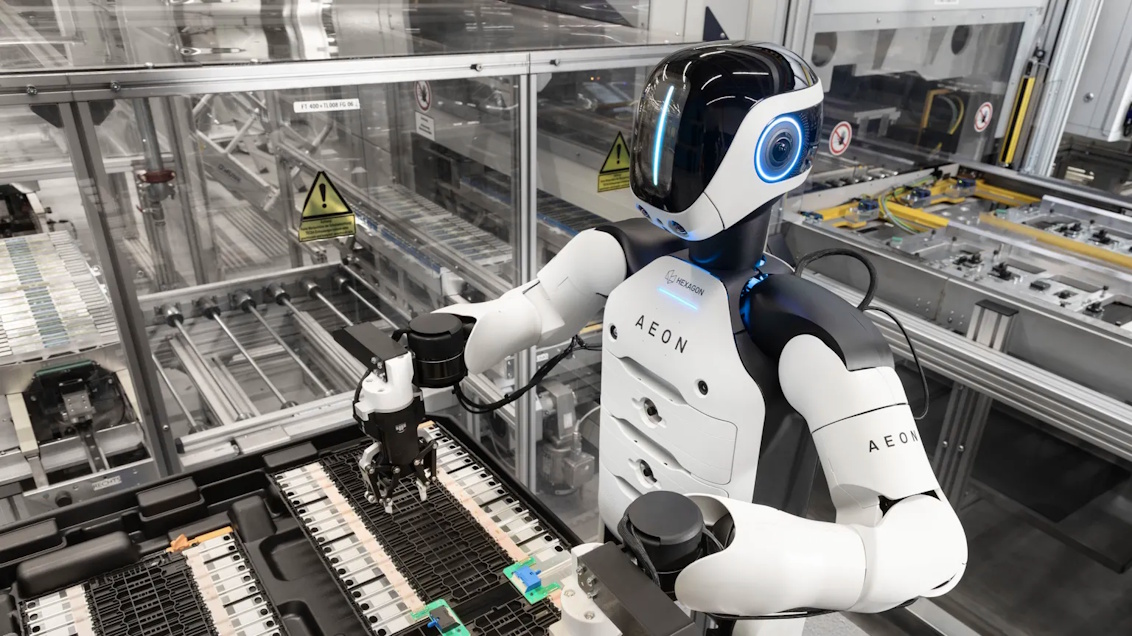
For decades, automotive factories have relied on robotic arms, conveyor systems, and industrial automation to build cars faster and more efficiently. Now, a new generation of machines is entering the factory floor humanoid robots.
For the first time in Europe, BMW is preparing to deploy humanoid robots in live vehicle production. Two robots developed by Hexagon Robotics are currently undergoing testing at BMW’s Leipzig factory in Germany and are expected to begin working on production tasks this summer.
According to Michael Nikolaides, BMW’s head of process management and digitalisation, the move marks a major shift in manufacturing technology.
“This will be the future of automotive production,” he says.
Why Humanoid Robots?
Industrial robots have been part of car manufacturing since the 1970s, but most traditional robots are designed for a single task in a highly controlled environment. Changing production layouts to accommodate them can be expensive and time-consuming.
Humanoid robots, however, are designed differently.
“If you have a humanoid form, you can pretty much set it to any workplace where a human is working today because it has the same size and the same capabilities,” Nikolaides explains.
As robot hardware becomes cheaper, manufacturers no longer want to redesign entire assembly lines around massive specialized machines. Instead, companies are increasingly interested in robots that can adapt to existing workplaces originally designed for humans.
Bill Ray, distinguished vice president analyst at Gartner, says economics are driving this transition.
“When a robot costs 17 million, you reorganise your factory around the robot,” he says. “But it doesn’t anymore. Now you want to fit it into your existing way of working.”
Meet Aeon: BMW’s New Factory Worker
The humanoid robot being tested at BMW is called Aeon. Built by Hexagon Robotics, the robot resembles a human in both shape and movement.
Aeon stands approximately 1.65 meters tall (5 feet 5 inches) and weighs around 60 kilograms. It can move at speeds of up to 2.4 meters per second and is capable of carrying 15 kilograms for short durations or 8 kilograms continuously.
The robot is equipped with 21 sensors, including:
- Cameras
- Radar systems
- Microphones
- Force and torque sensors
These allow Aeon to navigate factory environments, interact with objects, and safely work around humans.
Unlike some humanoid robots that walk on legs, Aeon uses wheels for movement.
“It makes more sense on a shop floor because Aeon can roll around from one place to another,” says Nikolaides.
How the Robots Learn
Training humanoid robots has become one of the fastest-growing areas in artificial intelligence and robotics.
At BMW, Aeon was trained using a combination of teleoperation and digital simulation. Engineers first created a “digital twin” a virtual copy of the factory environment using Nvidia software.
Inside this virtual environment, the robot repeatedly practiced tasks through reinforcement learning, an AI method where systems improve through trial and error. The robot tested thousands of possible movements to discover the most effective solutions.
Teleoperation was also used, where human workers wore sensors while performing tasks such as picking up parts. The robot then learned the different ways humans naturally complete those actions.
According to Arnaud Robert, president of robotics at Hexagon, one of the biggest breakthroughs in robotics is imitation learning.
This allows robots to learn simply by observing humans either through videos or movement sensors.
“The best translation from the human to the robot is when the teacher and the student have the same form factor,” Robert says.
Imitation learning can reportedly reduce robot training time from months to only a few days.
Robert believes the industry is approaching a future where robots can observe workers performing a task and quickly replicate it themselves.
“That’s the ultimate scenario,” he says. “You’re describing probably something that’s a year or two out.”
Smarter and More Flexible Than Traditional Machines
BMW says humanoid robots are particularly useful because they can adapt to small variations that would normally confuse conventional industrial robots.
Nikolaides explains that traditional machines often fail if a component is slightly misaligned.
“If you changed the position of the sheet metal a little bit or shifted it or tilted it, with a standardised industry robot, you would have a failure,” he says.
“But these humanoid robots can analyse that and they will just keep on working.”
This flexibility is one reason AI-powered robots are attracting enormous interest from manufacturers worldwide.
Working Alongside Humans
At BMW, the robots will initially perform repetitive and physically demanding tasks, including:
- Feeding parts into manufacturing tools
- Pick-and-place operations in battery assembly
- Transporting materials within the production line
Although Aeon is technically multi-functional, BMW says the robots will usually specialize in a small number of tasks, similar to human workers on factory lines.
One current limitation is battery life. Aeon can only operate for around three hours before recharging. However, the robot has been designed to replace its own battery autonomously in roughly three minutes, including travel time to and from the charging station.
BMW believes humanoid robots could eventually help solve labor shortages expected in manufacturing industries over the coming years.
“We know that staff will be short in a matter of years, and humanised robots help,” says Nikolaides.
He rejects fears that robots will eliminate jobs entirely.
“When we automated car production in the 1970s, everybody said this would lead to massive job losses,” he says. “But the opposite happened. New jobs were created by this technology.”
A Global Race in Robotics
BMW is not alone in exploring humanoid robotics.
Several major automakers are investing heavily in AI-powered factory robots:
- Toyota plans to deploy Digit robots developed by Agility Robotics following successful trials.
- Xiaomi has tested its own humanoid robots in electric vehicle production.
- Hyundai already uses Spot inspection robots and plans to introduce Atlas humanoid robots from Boston Dynamics, in which Hyundai is a majority shareholder.
BMW itself has already experimented with humanoid robots in the United States. At its Spartanburg factory, the Figure O2 robot reportedly helped assemble around 30,000 BMW X3 vehicles while operating at roughly the same pace as human workers.
The company also previously used a Boston Dynamics Spot robot shaped like a robotic dog for maintenance inspections inside factory facilities.
“He had to be able to walk stairs,” Nikolaides says. “He was able to go down to the basement where a lot of machinery was.”
The Human Side of Humanoid Robots
Interestingly, BMW says employees have reacted positively to the arrival of humanoid robots.
Workers have even begun treating the robots more like colleagues than machines.
Nikolaides says employees naturally tend to give robots names something already common with older industrial robots.
Gartner analyst Bill Ray believes this human connection matters.
“If it doesn’t have a name, it’s a machine,” he says. “If it gets it wrong, it’s broken. If it has a name, people expect it to make mistakes. People forgive it.”
Aeon itself does not have a human-like face, but it does feature a display panel on its head that communicates through symbols. For example, a line appears while the robot is working, while a circle indicates that it is listening.
Hexagon says the company is still developing this visual language to make interactions between humans and robots feel more natural.
Hype vs Reality
Despite the excitement surrounding humanoid robotics, experts caution that the technology is still in its early stages.
Bill Ray believes public expectations have been inflated by flashy demonstrations and marketing campaigns.
“The primary use case for a humanoid robot today is to walk on stage and artificially inflate your share price,” he says.
He argues that demonstrations of robots dancing or performing staged movements can create unrealistic assumptions about their capabilities.
“When you see a humanoid robot walking, your brain assumes it can run, jump, and climb,” Ray explains. “Most of them cannot.”
Still, even skeptics acknowledge that the technology is improving rapidly.
Within the next three to five years, Ray predicts that humanoid robots may be able to receive simple spoken instructions and autonomously carry out practical factory tasks.
If that happens, the modern car factory could soon look very different with humans and humanoid robots working side by side on the production lines of the future.
Our Pashto-Dari Website

Support Dawat Media Center
If there were ever a time to join us, it is now. Every contribution, however big or small, powers our journalism and sustains our future. Support the Dawat Media Center from as little as $/€10 – it only takes a minute. If you can, please consider supporting us with a regular amount each month. Thank you
DNB Bank AC # 0530 2294668
Account for international payments: NO15 0530 2294 668
Vipps: #557320

Comments are closed.