

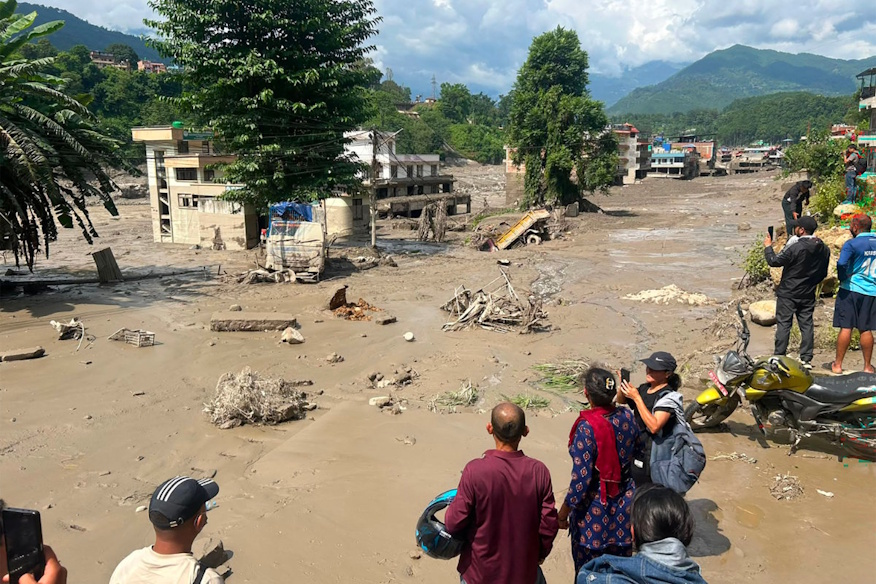
KATHMANDU, Nepal — The death toll from this week’s catastrophic floods in Nepal has climbed to at least 675, according to the country’s disaster management authority, as rescue teams on both sides of the Himalayan border continue to search for thousands of missing persons. The disaster, which struck near the Nepal-China frontier, has unleashed what survivors describe as a “tsunami-like wall of water and debris,” obliterating villages, sweeping away infrastructure, and leaving entire communities in ruins.
Chinese state media confirmed seven fatalities in Tibet’s Gyirong County following Wednesday’s deluge, bringing the combined death toll to 682. However, with nearly 3,000 people now listed as missing across both countries, authorities fear the final count could rise significantly.
A Catastrophe of Unprecedented Scale
The flash floods were triggered by a glacial lake outburst or a sudden avalanche-induced surge experts are still assessing the precise cause that sent a torrent of ice, mud, and boulders cascading down river valleys. The force of the water was so immense that it carved new channels, swept away bridges, and inundated settlements in a matter of minutes.
In Nepal alone, the disaster authority reported that 633 bodies had been recovered as of Saturday. The number of missing persons has soared to nearly 2,426 within Nepal, with hundreds of foreigners among them many of whom were trekkers, pilgrims, or workers at hydropower projects. Across the border, Tibet’s state-run Xinhua news agency put the missing count at 554, with seven confirmed dead and over 500 tourists and residents evacuated from the most affected zones.
In a grim spillover effect, Indian authorities have recovered seven bodies from rivers flowing out of Nepal, raising fears that some victims may have been swept hundreds of kilometers downstream.
Hydropower Workers Among the Missing
The Trishuli River valley, a corridor heavily developed for energy production, has become one of the epicenters of the tragedy. Nepal’s disaster authority added 933 hydropower project workers to the missing list, joining pilgrims en route to Tibet’s sacred Mount Kailash and foreign trekkers who had been traversing the region’s popular Himalayan routes.
Survivors from the dam sites have recounted harrowing escapes. Buddha Tamang, a worker who was trapped inside a tunnel at the Trishuli 3A hydropower project when the flood struck, was airlifted to safety after being marooned for more than 24 hours. “The senior officers working on the other side they were all swept away,” he told AFP, his voice still trembling from the ordeal.
The Nepali military has located a group of survivors trapped inside the same project’s tunnel network, but rescue operations have been complicated by the near-total destruction of access roads and the difficulty of identifying entry points buried under mud and rubble. “Two helicopters have been dispatched, but it is challenging because it is tough to even locate the entry points of the tunnel,” said army spokesman Raja Ram Basnet. More than 350 workers and residents have been rescued from the site so far, but over 100 remain unaccounted for in that area alone.
Survivors Speak: ‘All the Settlements Were Swept Away’
For those who made it out alive, the loss is immeasurable. Buddhi Ram Dangol, a villager from the banks of the Trishuli, stood amidst the debris of his former home. “All the settlements near the river were swept away. There is nothing left,” he told AFP. His words echoed the grief of countless others now facing the prospect of rebuilding their lives from scratch.
Samjhana Thing, whose brother has been missing for three days, waited anxiously at a relief camp. “We don’t know anything. Hopefully he is in a safe place,” she said, clutching a faded photograph. Across the region, families have gathered at makeshift information centers, pleading for any news of their loved ones.
Secondary Threats Complicate Rescue Efforts
The disaster has created secondary hazards that are hampering search-and-rescue missions. The sudden deluge of ice and sediment has formed large, unstable lakes in the upper reaches of the valley. One such lake has posed a direct threat to emergency workers, prompting Nepali police to issue an urgent warning for all rescuers to “immediately move to a safe location” after reports that “a water dam has burst again on the Tibetan side.”
In Tibet, Chinese authorities temporarily suspended rescue operations in the hardest-hit area of Gyirong over renewed flooding risks, though they later stated the threat had eased. State media reported early Saturday that two villagers had been rescued, but access to the region remains heavily restricted, and foreign journalists have been largely barred from the affected zone.
‘Enormous’ Trauma and Widespread Displacement
The Red Cross has described the psychological and physical toll of Wednesday’s catastrophe as “enormous,” estimating that up to 93,000 people may have been affected. Food and water supplies are running dangerously low in isolated pockets, and emergency teams are racing against time to deliver aid to communities cut off by landslides and broken roads.
The pilgrimage route to Mount Kailash a site sacred to Hindus, Buddhists, and Jains has been particularly hard hit. Sivaranjani Muthunathan, a 46-year-old devotee from India, was traveling by bus with 56 others toward the Chinese border when they encountered what they initially thought was a traffic jam. “Then there was fog, smoke, something that seemed to suddenly engulf us,” she recalled, showing a phone video of a raging torrent surging toward her vehicle. Around them, trucks and cars were either buried under mud or swept away like toys. “One by one, we climbed out through the driver’s side,” she said, describing a desperate scramble up a nearby hill to safety.
International and Regional Response
Nepal’s government has appealed for international assistance, with neighboring India and China offering technical and logistical support. However, the scale of the destruction combined with difficult terrain and unpredictable weather has slowed the pace of relief efforts.
In India, authorities in the state of Bihar have issued high alerts for districts along rivers originating in Nepal, as water levels remain volatile. The recovery of seven bodies from Indian rivers underscores the transboundary nature of this disaster, which has struck a region already vulnerable to the impacts of climate change and rapid glacial melt.
A Long Road Ahead
As the search continues, the focus is gradually shifting from rescue to recovery. The sheer scale of displacement entire villages erased, livelihoods destroyed, and families torn apart points to a humanitarian crisis that will require sustained international support for months, if not years, to come.
For now, survivors like Buddhi Ram Dangol are left with nothing but the clothes on their backs and the anguish of not knowing whether their loved ones will ever be found. “There is nothing left,” he repeated, staring at the river that once sustained his community and now bears the weight of its destruction.
Our Pashto-Dari Website

Support Dawat Media Center
If there were ever a time to join us, it is now. Every contribution, however big or small, powers our journalism and sustains our future. Support the Dawat Media Center from as little as $/€10 – it only takes a minute. If you can, please consider supporting us with a regular amount each month. Thank you
DNB Bank AC # 0530 2294668
Account for international payments: NO15 0530 2294 668
Vipps: #557320

Comments are closed.