
Trump Departs Beijing After High-Stakes China State Visit as Leaders Claim Progress Despite Deep Divisions

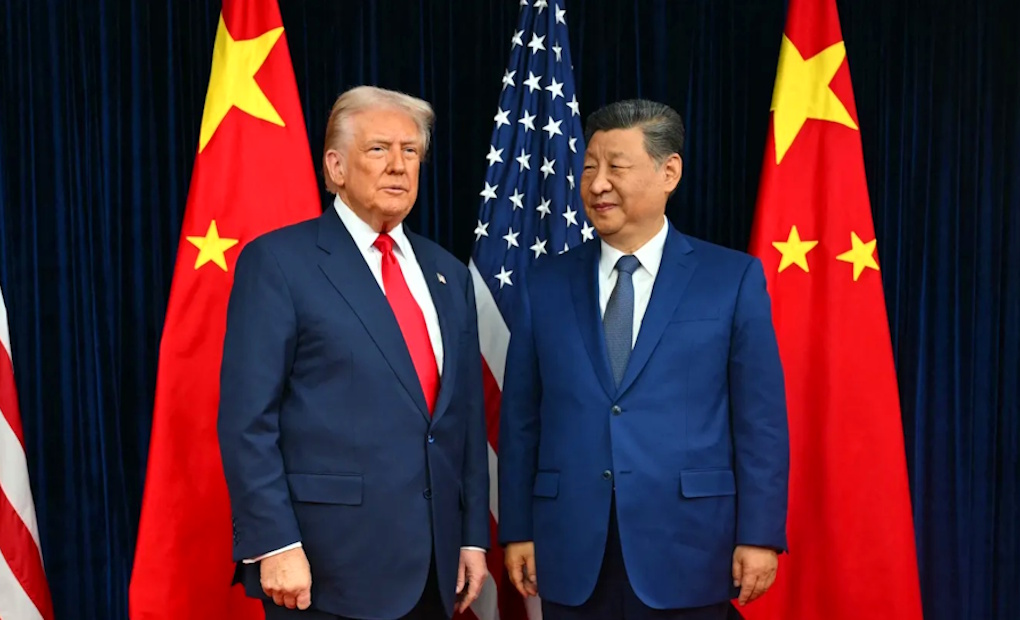
Trump and Xi Conclude Summit With Optimistic Tone, but Major Differences Persist Over Taiwan, Iran, Trade, and Security
BEIJING (AP) — U.S. President Donald Trump departed Beijing on Friday after concluding a closely watched three-day state visit to China, wrapping up a summit with Chinese President Xi Jinping that both leaders described as productive and historic, even as significant disagreements remain unresolved between the world’s two largest powers.
The visit, marked by elaborate state ceremony and extended private discussions, was aimed at stabilizing increasingly strained U.S.-China relations amid disputes over trade, Taiwan, technology competition, and global security concerns, including the conflict involving Iran.
Trump boarded Air Force One following a ceremonial farewell at Beijing’s airport, where Chinese Foreign Minister Wang Yi personally saw him off. Schoolchildren dressed in Air Force One’s signature light blue and white waved American and Chinese flags in synchronized formation, underscoring Beijing’s effort to present the visit as a symbol of renewed cooperation.
Final Talks at Zhongnanhai
The summit concluded with a highly symbolic final meeting at Zhongnanhai, the official residence and political headquarters of China’s top leadership — a rare venue for foreign dignitaries and a gesture widely interpreted as Xi’s attempt to cultivate personal diplomacy with Trump.
The two leaders took a private stroll through the historic compound’s manicured gardens, ancient trees, and rose-lined pathways before gathering for nearly three hours of talks over tea and lunch, accompanied by senior aides and interpreters.
Trump praised the atmosphere and hospitality, telling reporters afterward:
“It’s been really a great couple of days.”
He also marveled at the gardens, reportedly remarking that the Chinese roses were “the most beautiful” he had ever seen. Xi responded by promising to send Trump rose seeds for planting in Washington.
Xi called the visit “a milestone” in bilateral relations.
“We have established a new bilateral relationship a constructive, strategic, and stable relationship,” Xi said.
Speaking later at a lavish state banquet, Xi said he and Trump had held an “in-depth exchange of views” and emphasized that China-U.S. ties remain “the most important bilateral relationship in the world.”
Trump echoed the positive tone, calling the discussions “extremely positive and constructive.”
“The relationship between the United States and China is one of the most consequential in world history,” Trump said.
Xi also suggested that China’s long-term vision of national rejuvenation and Trump’s “Make America Great Again” agenda could “go hand in hand,” portraying cooperation as beneficial for both powers.
Taiwan Emerges as Central Point of Tension
Despite the public warmth, Taiwan remained the most contentious issue during the summit.
According to Chinese officials, Xi warned Trump in private that mishandling differences over the self-governed island could push the two countries toward “clashes and even conflict.”
Beijing has increasingly framed Taiwan as the “core of its core interests” and has made clear that any U.S. support for Taiwan’s sovereignty aspirations would cross a red line.
U.S. Secretary of State Marco Rubio, who joined Trump for the meetings, reaffirmed Washington’s longstanding position.
“Our policy toward Taiwan is unchanged,” Rubio told NBC News. “It would be a terrible mistake for China to attempt to take Taiwan by force.”
Rubio characterized Xi’s warnings as routine diplomatic messaging, adding:
“They always raise it on their side. We always make clear our position, and we move on to the other topics.”
Trump has sent mixed signals on Taiwan in recent months. While his administration announced an $11 billion weapons package for Taiwan in December — the largest in U.S. history implementation has yet to begin.
Trump has also publicly criticized Taiwan for “stealing” America’s semiconductor industry and has demanded Taipei increase defense spending and compensate Washington for protection.
These comments have fueled speculation that Trump could be open to recalibrating U.S.-Taiwan relations as part of broader negotiations with Beijing.
Iran Conflict and the Strait of Hormuz
Another major focus of the talks was the ongoing Iran conflict and the closure of the Strait of Hormuz, through which roughly 20% of global oil supplies passed before hostilities erupted on February 28.
Trump and Xi agreed that reopening the strategic waterway is essential for global economic stability.
“We feel very similarly about how we want it to end,” Trump said while standing beside Xi. “We don’t want them to have a nuclear weapon.”
Trump told Fox News that Xi had privately offered Chinese assistance in encouraging Iran to negotiate an end to the conflict.
However, Beijing has publicly shown little enthusiasm for deeper involvement and has criticized U.S. and Israeli military actions in Iran.
White House officials said Xi also opposed proposals to impose tolls on vessels crossing Hormuz and expressed interest in future purchases of U.S. oil as a way to reduce China’s dependence on Gulf energy supplies.
China holds substantial leverage as Iran’s largest trading partner, though analysts say prolonged disruption could eventually damage China’s export-driven economy despite its strategic petroleum reserves.
Meanwhile, Washington continues to pressure Beijing over allegations that Chinese companies have supplied satellite imagery to Tehran and purchased sanctioned Iranian oil through intermediary networks.
Fentanyl and Security Concerns
Trump also pressed Xi on Chinese-made precursor chemicals used to manufacture fentanyl trafficked through Mexico into the United States.
The White House maintains that China must do more to curb exports of these materials, which U.S. officials say contribute to America’s opioid crisis.
The issue remains a persistent source of tension despite previous Chinese pledges to strengthen controls.
Trade and Business Deals
Trade was another major topic of the summit, with both sides signaling progress toward potential commercial agreements.
Trump said “fantastic trade deals” had been reached but declined to provide details.
According to Trump, Xi indicated China may purchase 200 Boeing aircraft, a potentially massive boost for U.S. manufacturing.
The two leaders also discussed expanded Chinese purchases of American agricultural products, including soybeans and beef, key exports for U.S. farmers.
White House officials said discussions included plans to establish a formal U.S.-China Board of Trade to help address commercial disputes and create more predictable market access.
Trump also pushed for expanded access for American financial companies such as Mastercard and Visa, whose CEOs joined the presidential delegation.
He said he personally raised concerns about barriers facing U.S. credit card companies operating in China’s tightly regulated financial market.
Personal Diplomacy and Strategic Reality
Trump described Xi as direct and pragmatic.
“I think he’s a warm person, actually. But he’s all business. There’s no games.”
The carefully staged hospitality appeared designed to strengthen the personal rapport both leaders have repeatedly emphasized.
Yet beneath the diplomatic pageantry lies an increasingly competitive relationship shaped by profound strategic mistrust.
While both presidents projected optimism and highlighted progress, the summit left unresolved fundamental disputes over Taiwan, trade imbalances, technology restrictions, military competition in Asia, and differing approaches to global conflicts.
For now, both Washington and Beijing appear eager to prevent open confrontation but the difficult issues that define the relationship remain far from settled.
Our Pashto-Dari Website

Support Dawat Media Center
If there were ever a time to join us, it is now. Every contribution, however big or small, powers our journalism and sustains our future. Support the Dawat Media Center from as little as $/€10 – it only takes a minute. If you can, please consider supporting us with a regular amount each month. Thank you
DNB Bank AC # 0530 2294668
Account for international payments: NO15 0530 2294 668
Vipps: #557320

Comments are closed.