
Trump Offers Ukraine License to Produce Patriot Systems, Upends NATO Summit with Greenland Demands

By Dawatmedia24 News Desk
ANTAKYA, Türkiye — In a dramatic pivot from years of strained relations, President Donald Trump announced Wednesday that the United States will grant Ukraine a license to domestically manufacture Patriot air defense systems a long-sought breakthrough for Kyiv as it enters the fifth year of grinding war against Russia.
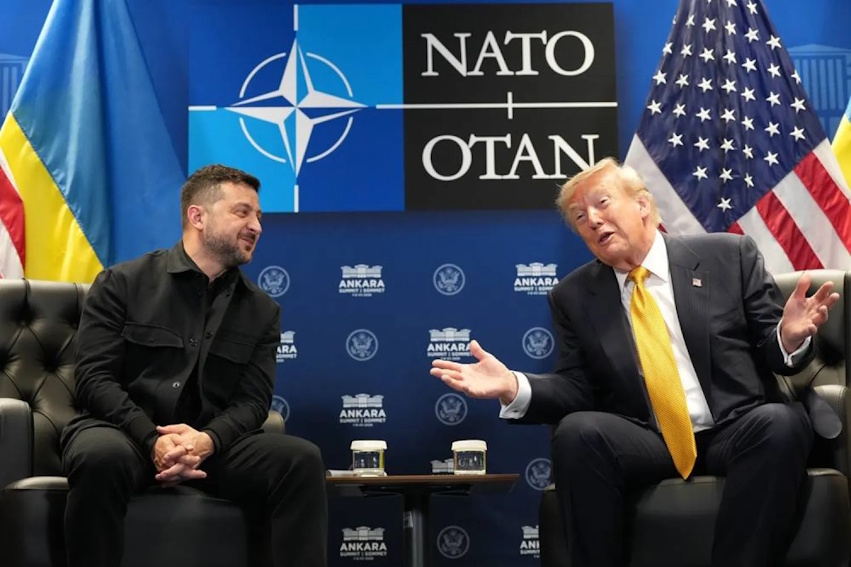
“We’ll give them the right to make Patriots. We’ll show them how to do it,” Trump declared during a high-stakes bilateral meeting with Ukrainian President Volodymyr Zelenskyy on the sidelines of the NATO summit in Türkiye. “I think they can produce them pretty quickly.”
The move represents a significant strategic coup for Ukraine, which has desperately relied on a limited number of donated Patriot batteries to intercept Russian ballistic missiles, drones, and aircraft. The systems are notoriously expensive each interceptor missile costs roughly $4 million—and production backlogs at U.S. defense giant Raytheon mean new units can take up to two years to deliver. By transferring production know-how, Washington aims to bypass supply-chain bottlenecks while bolstering Ukraine’s long-term self-sufficiency.
Zelenskyy, who has lobbied successive U.S. administrations for both more Patriots and the licensing rights to build them, hailed the decision as “a game-changer for our air defense umbrella.” He noted that Ukraine’s industrial base, though battered, retains the engineering talent to rapidly scale up production if given blueprints and critical components.
A Chilly Thaw in U.S.-Ukraine Relations
The warmth of Wednesday’s encounter marked a stark departure from previous Trump-Zelenskyy meetings, which were often marred by public recriminations and political tensions. This time, Trump offered uncharacteristically effusive praise for the Ukrainian leader.
“He’s done an amazing job. He’s been very effective in this war,” Trump said, gesturing toward Zelenskyy. “We’ve actually developed a good relationship. It’s hard to believe, but it’s true.”
Trump further suggested that a negotiated end to the conflict was “on the horizon” and pledged that the U.S. would “work on some kind of security package” to underpin any ceasefire. While he offered no specifics, officials familiar with the discussions indicated the package could include U.S. intelligence-sharing and expedited military aid in exchange for Kyiv’s commitment to territorial compromises a prospect that has alarmed some European allies.
Trump Targets NATO Allies Over Greenland and Iran
While Trump extended an olive branch to Ukraine, he arrived at the 32-nation summit with a clenched fist for many of America’s traditional NATO partners. The president reignited a long-simmering dispute over Greenland, the semiautonomous Danish territory he has repeatedly sought to acquire.
“Greenland is very important for the United States but not for Denmark,” Trump told reporters ahead of the summit. “We need it for the protection of the world, not just for ourselves. Denmark has been negligent in its defense responsibilities there.”
Danish Prime Minister Mette Frederiksen shot back, insisting her country is “ready to defend every inch of NATO territory, including our own,” and reaffirmed her expectation that allies would honor their mutual-defense commitments under Article 5. The clash threatened to overshadow summit deliberations and raised fears that Trump’s territorial ambitions could fracture alliance unity.
Compounding tensions, Trump singled out Spain as “a terrible partner in NATO” for refusing to participate in U.S.-led military strikes against Iran, and renewed his threat to cut trade ties with countries that do not back his Middle East policy. Overnight, U.S. forces launched a series of strikes on Iranian targets after Tehran attacked three merchant ships in the Strait of Hormuz an escalation that Trump defended as “absolutely necessary.”
NATO Secretary-General Mark Rutte publicly endorsed the U.S. action, telling Trump: “It was a very strong response, and I’m with you on this.” However, Trump dismissed the ongoing interim nuclear deal with Iran, saying, “For me, I think it’s over. It’s just a waste of time dealing with them.”
NATO’s Spending Dilemma and the Push for “NATO 3.0”
Behind the rhetorical fireworks, Rutte worked tirelessly to keep the alliance on track, praising Trump for what he called the “Trump Trillion” the $1.2 trillion in additional defense spending that European allies and Canada have committed since 2017. At a “big reveal” event on Wednesday, Rutte showcased how much of that new funding would flow to U.S. defense contractors, potentially creating thousands of American jobs.
“Grab the win. It’s there,” Rutte told Trump, urging him to acknowledge the progress.
NATO leaders agreed last year to invest 5% of GDP on defense 3.5% for operational budgets and 1.5% for infrastructure but new data released Tuesday showed Slovenia, Belgium, Spain, and the Czech Republic still falling short of the old 2% target. The Trump administration is now pushing for a leaner “NATO 3.0” framework, under which Europe would assume primary responsibility for conventional defense including arming Ukraine while the U.S. maintains its nuclear umbrella and reduces its troop footprint on the continent.
The Pentagon has launched a six-month review of U.S. military deployments across Europe, leaving allies anxious about the scale of potential drawdowns. “We need clarity, not just signals,” said a senior German diplomat, speaking on condition of anonymity.
Zelenskyy Renews Push for NATO Membership
Undeterred by the alliance’s cautious stance on enlargement, Zelenskyy used the summit to make a fresh case for Ukraine’s eventual NATO membership. He argued that Ukraine’s battle-hardened forces which he said are “eliminating” an average of 30,000 Russian troops monthly would significantly bolster the alliance’s eastern flank.
“We are already de facto NATO in capability and spirit,” Zelenskyy told reporters. “Formal membership would only enhance our collective security.”
In the summit’s final declaration, NATO leaders pledged $80 billion in military and humanitarian aid to Ukraine for 2026 and 2027, acknowledging “the long-term threat Russia poses to Euro-Atlantic security.” The pledge comes amid growing unease among Baltic and Scandinavian members that Moscow, frustrated by its stalled offensive, may turn to hybrid warfare combining cyberattacks, disinformation, and sabotage against NATO states.
A Summit of Contradictions
For all the pageantry of alliance solidarity, the Ankara summit laid bare the deepening contradictions within NATO. Trump rewarded Ukraine with a coveted defense-industrial prize while berating European partners over Greenland and Iran. He praised Zelenskyy’s leadership while signaling impatience with Kyiv’s territorial maximalism. And he demanded more European spending while preparing to withdraw U.S. troops.
As Rutte adjourned the meeting, he struck a cautiously optimistic tone: “NATO has survived 75 years of crises. We will survive this one, too but only if we remember that our strength lies in our unity, not our divisions.”
Whether that unity can withstand Trump’s transactional worldview and the grinding realities of two ongoing wars remains the most urgent question facing the transatlantic alliance.
Our Pashto-Dari Website

Support Dawat Media Center
If there were ever a time to join us, it is now. Every contribution, however big or small, powers our journalism and sustains our future. Support the Dawat Media Center from as little as $/€10 – it only takes a minute. If you can, please consider supporting us with a regular amount each month. Thank you
DNB Bank AC # 0530 2294668
Account for international payments: NO15 0530 2294 668
Vipps: #557320

Comments are closed.