

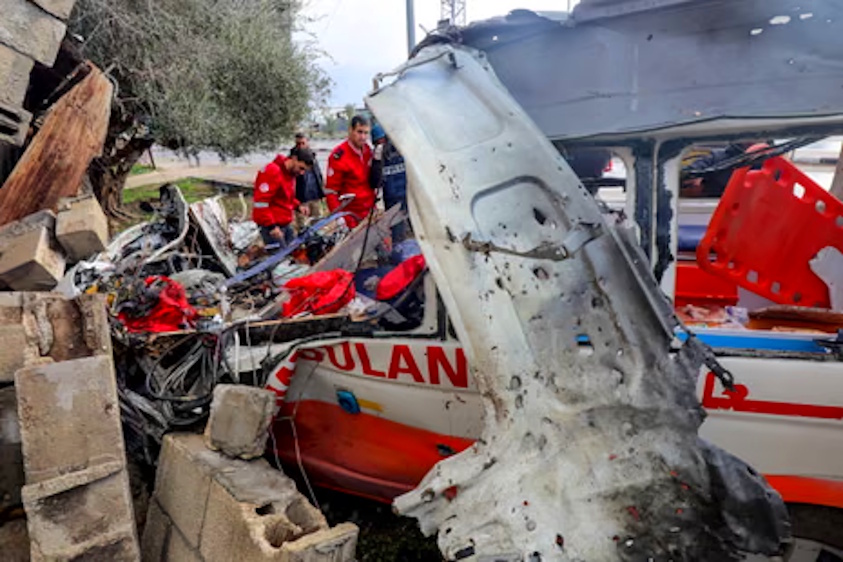
Geneva / New York – Three of the world’s leading humanitarian and health organizations have jointly condemned the international community’s failure to protect health care workers, hospitals, and patients in conflict zones, warning that the situation has grown even more dangerous than a decade ago.
In a rare joint statement issued on Sunday, the World Health Organization (WHO), the International Committee of the Red Cross (ICRC), and Doctors Without Borders (Médecins Sans Frontières, MSF) issued an “urgent call for action” amid a surge in violence against medical facilities and personnel.
The statement marks the 10-year anniversary of United Nations Security Council Resolution 2286, which was unanimously adopted to condemn attacks on health care infrastructure, medical staff, and patients in war zones. Yet, according to the three agencies, “the situation is even worse” today than when the resolution was passed.
“As violence affecting medical facilities, transport, and personnel continues unabated, the harm this resolution sought to prevent has not diminished,” the statement read. “It has continued and, in many contexts, intensified.”
The agencies emphasized that the erosion of health care protections is both a symptom and a driver of broader breakdowns in international humanitarian law. “When health care is no longer safe, it is often the clearest warning sign that the rules and norms intended to limit the harm of war are breaking down,” they said.
Drawing on field reports from Gaza, Sudan, Ukraine, Myanmar, and the Democratic Republic of Congo, the three organizations noted that attacks on hospitals and ambulances have become increasingly systematic, with health workers being threatened, kidnapped, or killed, and medical supplies deliberately destroyed.
“When hospitals come under attack, we face not only a humanitarian crisis but a crisis of humanity,” the agencies stated. “States and all parties to armed conflict must comply with the rules protecting health care.”
They urged world leaders to move beyond condemnation and take concrete action, including conducting independent investigations into attacks, ensuring accountability for perpetrators, and restoring the protected status of medical missions under international humanitarian law.
“We urge world leaders to act and show the needed political leadership to end this violence,” they concluded. “Ten years after Resolution 2286, words are no longer enough.”
Our Pashto-Dari Website
Support Dawat Media Center
If there were ever a time to join us, it is now. Every contribution, however big or small, powers our journalism and sustains our future. Support the Dawat Media Center from as little as $/€10 – it only takes a minute. If you can, please consider supporting us with a regular amount each month. Thank you
DNB Bank AC # 0530 2294668
Account for international payments: NO15 0530 2294 668
Vipps: #557320

Comments are closed.