
Aisha Wahab Calls for U.S. Diplomatic Engagement With Afghanistan, Argues Dialogue Could Advance Human Rights

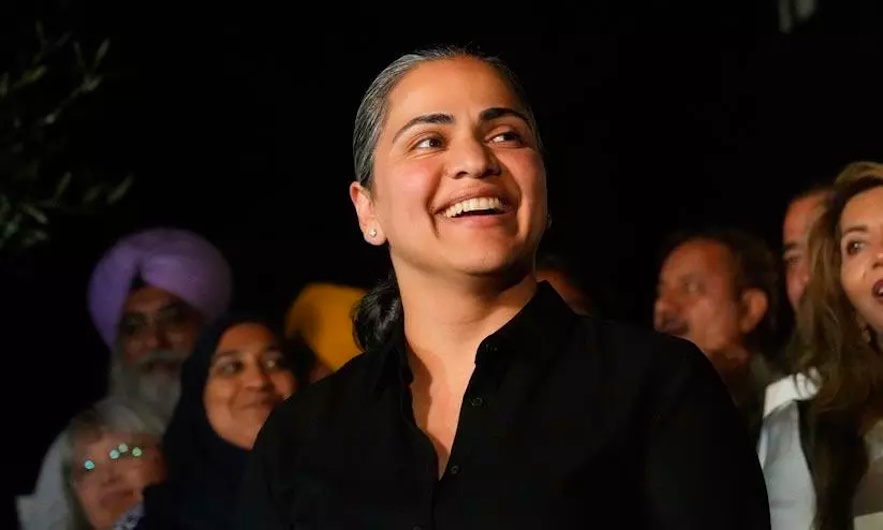
In a landmark moment for Afghan American representation, Aisha Wahab recently elected as the first Afghan American woman to the U.S. House of Representatives issued a forceful call on Monday for the United States to sustain diplomatic engagement with Afghanistan, irrespective of who holds power in Kabul. Speaking candidly in an interview with Democracy Now!, Wahab argued that isolationism would be a strategic misstep, and that sustained dialogue could serve as a powerful lever to press for improvements in human rights, particularly for Afghan women and girls.
Wahab, a former California state senator who won a special election last week in California’s 14th Congressional District, stressed that U.S. foreign policy should not abandon Afghanistan in its hour of greatest need. “The United States should pursue diplomacy. That means remaining committed to diplomacy and maintaining relations with the country, regardless of which group is in power,” she said. Rather than severing ties with the Taliban-led government, she contended, Washington should use official channels to advocate for incremental policy shifts, while keeping the door open for broader cooperation.
The 39-year-old lawmaker, born in New York to Afghan immigrant parents, described the current humanitarian and social landscape in Afghanistan as deeply troubling even “hopeless” in her words citing the systematic exclusion of women and girls from education, public life, and employment. She warned that if the Taliban’s restrictive policies continue unabated, the consequences could prove “disastrous” for the country’s long-term stability and demographic future. However, Wahab expressed cautious optimism that formal U.S. engagement could nudge the Taliban toward moderating its stance, particularly if tied to tangible incentives.
Beyond human rights advocacy, Wahab urged Washington to explore economic partnerships with Afghanistan, including investment in the nation’s vast, largely untapped mineral reserves estimated to be worth over $1 trillion. “The United States should at least work with Afghanistan on partnerships and contracts in different sectors,” she said. “Afghanistan also needs other allies, and we really haven’t taken advantage of that capacity so far.” She suggested that economic interdependence could create mutual interests that foster stability and gradually open space for social reform.
In a notably sharp turn, Wahab also took aim at Afghan opposition factions, including former warlords and exiled political elites who have long vied for power. She accused these groups of failing the Afghan people by prioritizing their own political ambitions over national reconstruction and reconciliation. “There are also different groups of warlords who want power,” she said. “Many of these groups are deeply failed and misguided because instead of thinking about the interests of the country, they are pursuing their own interests.” Without naming specific individuals, she criticized certain U.S.-backed factions from the previous republic for perpetuating corruption, instability, and abuses arguing that Afghanistan’s current crisis cannot be laid solely at the Taliban’s feet.
Her remarks immediately drew sharp rebuke from Afghan women’s rights activists, civil society leaders, and anti-Taliban politicians, who expressed concern that unconditional diplomatic engagement could inadvertently legitimize a regime responsible for widespread gender-based persecution and summary executions. Critics argued that any dialogue must be conditioned on verifiable progress—such as the reopening of secondary schools for girls and the reversal of bans on women in the workforce lest the international community signal acceptance of the Taliban’s hardline agenda.
The debate over engagement versus isolation unfolds as the United States maintains limited, issue-specific contacts with the Taliban, focusing on counterterrorism coordination, humanitarian aid delivery, and the release of detained American citizens. However, Washington has not formally recognized the Taliban government since its return to power in August 2021, leaving U.S. policy in a state of cautious ambiguity.
Against this political backdrop, Afghanistan remains mired in one of the world’s most acute humanitarian crises. According to the United Nations, more than 22 million Afghans over half the population require humanitarian assistance in 2026. Acute food insecurity, economic collapse, recurring natural disasters, and drastic funding cuts to international aid operations have pushed millions to the brink, while repeated displacement has upended entire communities. The UN has also documented unprecedented restrictions on women and girls: secondary schools and universities remain closed to female students, women are barred from most NGO and public-sector employment, and stringent dress codes and mobility limits have effectively erased women from public life. Human rights organizations have consistently condemned these measures as systematic gender apartheid and have called for intensified international pressure to reverse them.
Wahab’s election, meanwhile, has been hailed as a historic milestone for Afghan American visibility in U.S. politics. Her ascent to Congress comes at a time when the Afghan diaspora is increasingly finding its voice in American civic life, and her willingness to tackle one of the most intractable foreign policy dilemmas head-on signals a new generation of leadership unafraid to challenge orthodoxies on both sides of the aisle. Whether her call for engagement will gain traction in Washington remains uncertain, but it has already reignited a vital conversation about the moral and strategic responsibilities of the United States toward a country it helped shape and, many argue, abandoned.
Our Pashto-Dari Website
Support Dawat Media Center
If there were ever a time to join us, it is now. Every contribution, however big or small, powers our journalism and sustains our future. Support the Dawat Media Center from as little as $/€10 – it only takes a minute. If you can, please consider supporting us with a regular amount each month. Thank you
DNB Bank AC # 0530 2294668
Account for international payments: NO15 0530 2294 668
Vipps: #557320

Comments are closed.