

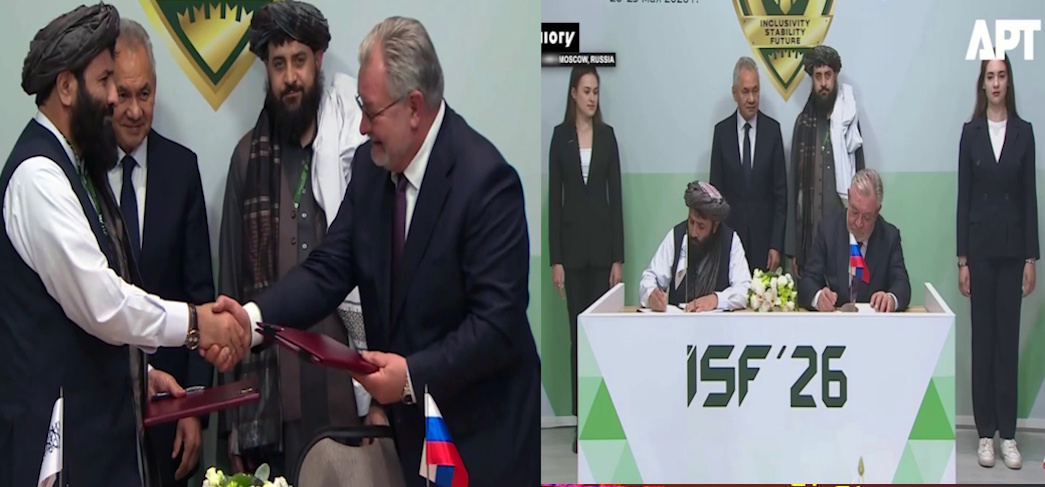
Russian and Taliban officials have signed a military-technical cooperation agreement during the visit of Afghanistan’s acting defense minister, Mawlawi Mohammad Yaqoob Mujahid, to Moscow, according to Russian state media reports published Thursday.
The agreement, signed on May 27 on the sidelines of the International Security Forum in the Moscow region, marks another significant step in the deepening relationship between Russia and the Islamic Emirate of Afghanistan (IEA).
Although neither side has publicly disclosed the full details of the agreement, officials and analysts say it is expected to strengthen defense and security cooperation between Kabul and Moscow at a time of increasing geopolitical realignment across the region.
According to the Russian news agency Interfax, the agreement was discussed during a meeting between Yaqoob Mujahid and Sergei Shoigu, secretary of Russia’s Security Council and a close ally of Russian President Vladimir Putin.
The Taliban Defense Ministry confirmed the meeting and stated that the two sides discussed bilateral cooperation and “a number of other important issues,” though it stopped short of publicly mentioning a formal military agreement.
Expanding Relations Between Kabul and Moscow
The reported deal comes amid rapidly expanding diplomatic engagement between Russia and the Taliban administration.
During his meeting with Shoigu, Yaqoob emphasized the importance of relations with Moscow and said cooperation between the two countries had grown significantly in recent months.
“We have historical relations and we want to further expand them,” Yaqoob said, according to Russian media reports.
Shoigu welcomed the Taliban delegation and described the visit as part of ongoing efforts to implement previous understandings reached between Moscow and Taliban authorities.
“We are interested in Afghanistan being a united, independent and peaceful state,” Shoigu said. “We note the measures taken by your country to combat terrorism and drug trafficking in Afghanistan.”
Earlier this month, speaking at a regional security meeting in Bishkek, Kyrgyzstan, Shoigu said Russia had established direct dialogue with the Islamic Emirate and was moving toward what he called a “full-fledged partnership” with Afghanistan’s current rulers.
He also urged neighboring countries and regional powers to expand engagement with Kabul, arguing that broader cooperation was necessary for regional stability and economic development.
Russia’s Strategic Interests in Afghanistan
Moscow has increasingly positioned Afghanistan as an important regional partner as Russia seeks to expand its influence in Central and South Asia following major geopolitical changes in recent years.
Russian officials have repeatedly warned about the threat posed by instability in Afghanistan, particularly the risk of terrorism and extremism spreading into Central Asian republics allied with Moscow.
Earlier this month, Shoigu claimed that between 18,000 and 23,000 fighters affiliated with more than 20 armed groups were operating inside Afghanistan. He identified terrorism and drug trafficking as the primary threats to regional security.
Shoigu also said that ISIS-K, the regional affiliate of the Islamic State group, currently has around 3,000 fighters in Afghanistan and remains responsible for several major attacks in the region in recent years.
Despite these concerns, Russia has steadily deepened political, economic, and security ties with the Taliban since the group returned to power in August 2021.
Russia recently became the first country to formally recognize Taliban rule in Afghanistan, further signaling Moscow’s willingness to work closely with the Islamic Emirate despite international criticism and the lack of broad global recognition of the Taliban government.
Possible Military Cooperation and Arms Discussions
Russian analysts and media outlets have increasingly speculated about the possibility of deeper military cooperation between Moscow and the Taliban authorities.
The Russian newspaper Nezavisimaya Gazeta reported that one possible focus of Yaqoob’s visit involved discussions regarding potential Taliban access to Russian military equipment and weapons systems.
Neither Moscow nor Kabul has officially confirmed such negotiations.
The precise nature of the military-technical agreement also remains unclear, and officials have not publicly stated whether it includes weapons sales, military training, intelligence sharing, logistical support, or broader defense cooperation.
Shoigu Rejects Return of US and NATO Military Presence
During the Moscow security meetings, Shoigu also reiterated Russia’s strong opposition to any return of U.S. or NATO military infrastructure to Afghanistan or neighboring countries.
“We consider unacceptable both for us and for our Afghan friends the return of military structures or facilities of the United States and NATO to Afghanistan or neighboring states under any pretext,” Shoigu said.
According to Russian and regional media reports, Shoigu argued that recent developments in Iran and the broader Middle East demonstrated that renewed Western military deployment in the region would only increase instability and security threats.
He further stated that the United States and its allies should bear responsibility for rebuilding Afghanistan after two decades of war.
“We are convinced that Western countries should unfreeze Afghan assets and recognize their full responsibility for their 20-year presence in Afghanistan,” Shoigu said.
Shoigu also stressed the importance of expanding cooperation with Kabul and reviving the activities of the Shanghai Cooperation Organisation (SCO) contact group on Afghanistan, describing both measures as essential for regional security and economic integration.
Russia Expands Broader Military Posture
The agreement with Afghanistan comes as Russia continues to strengthen its broader military and strategic posture amid ongoing global tensions.
Russian lawmakers recently granted President Vladimir Putin expanded authority to deploy troops abroad in situations involving the detention or protection of Russian citizens overseas.
Meanwhile, the Washington-based Institute for the Study of War has reported that Russia is modernizing and expanding its nuclear capabilities at what analysts describe as the fastest pace since the Cold War.
Against this backdrop, Moscow’s growing engagement with Afghanistan appears to reflect a broader Russian strategy aimed at consolidating influence across Eurasia while countering Western presence and alliances in the region.
The signing of the military-technical cooperation agreement signals that relations between Russia and the Taliban government are moving beyond diplomatic contacts toward more formalized security and defense cooperation a development likely to attract close attention from regional powers and Western governments alike.
Our Pashto-Dari Website
Support Dawat Media Center
If there were ever a time to join us, it is now. Every contribution, however big or small, powers our journalism and sustains our future. Support the Dawat Media Center from as little as $/€10 – it only takes a minute. If you can, please consider supporting us with a regular amount each month. Thank you
DNB Bank AC # 0530 2294668
Account for international payments: NO15 0530 2294 668
Vipps: #557320

Comments are closed.