

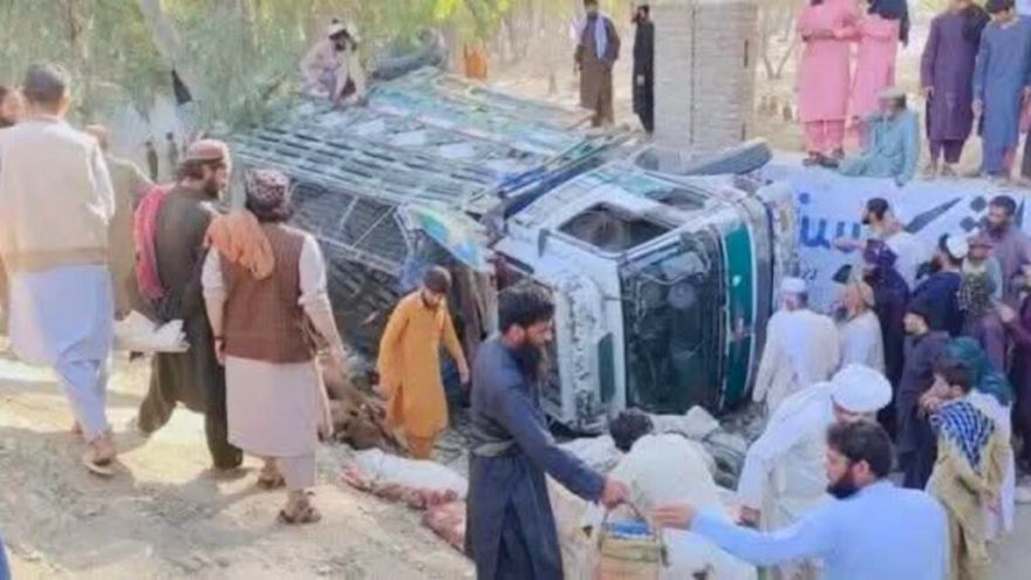
At least 18 people including 10 children, five women, and three men were killed and up to 35 others injured when a truck carrying Afghan returnees from Pakistan overturned on the Kabul–Jalalabad highway in eastern Afghanistan on Saturday morning. The crash is the latest in a series of deadly road accidents striking a country already stretched by a mounting humanitarian crisis driven by mass deportations from neighbouring Pakistan.
The accident occurred at around 5:30 a.m. near the Surkhkano area in Qarghayi district of Laghman province. Provincial police said the driver lost control, causing the vehicle to veer off the road and overturn on the highway linking Kabul to the eastern provinces. The injured were transported to healthcare facilities in neighbouring Nangarhar province for medical treatment.
According to Habibullah Mubarez, the Taliban’s traffic director in Laghman, all of the victims were Afghan migrants who had recently returned from Pakistan and had been temporarily settled in Kunar Province. They were being transported to Kabul when the vehicle overturned. The Taliban governor’s office in Laghman initially reported 35 injured, while Taliban disaster management officials put the figure at 29; the discrepancy has not yet been resolved by authorities.
Preliminary findings from provincial police suggest reckless driving was the primary cause of the crash, although investigations are ongoing. Poor road conditions, mechanical failure, and overloading endemic problems across Afghanistan’s transport network have not been formally ruled out.
A Crisis on Wheels
Saturday’s tragedy is not an isolated incident. In late August 2025, at least 25 people were killed and 27 injured when a passenger bus overturned near Kabul, with authorities attributing the crash to reckless driving on the Kandahar–Kabul highway part of a deadly week on Afghan roads that claimed over 90 lives across Herat, Badakhshan, and Helmand provinces. In December 2025, a bus overturned in the Salang area of Baghlan province, killing five and injuring 44. Fatal crashes involving overloaded passenger vehicles and trucks are now regularly reported on Afghanistan’s main highways.
Experts and aid workers point to a convergence of structural factors: mountainous terrain, roads deteriorated by decades of war and neglect, ageing and overloaded vehicles, reckless driving, and almost no enforcement of traffic regulations. Emergency response capacity remains critically limited across most provinces, meaning that injuries which would be survivable elsewhere routinely prove fatal.
The Deportation Surge Behind the Journey
The Laghman crash is inseparable from the broader context of one of the largest forced migration flows in the world. From September 2023 to April 2026, a total of 5.8 million Afghan migrants have been deported from Iran and Pakistan to Afghanistan. The United Nations projects that returns this year alone will reach 3.2 million surpassing last year’s figure with 1.6 million expected from Iran and a further 1.1 million from Pakistan between April and December.
The deportations from Pakistan have coincided with the ongoing conflict between Islamabad and the Taliban. Pakistan closed key border crossings in late February following the outbreak of hostilities, before reopening them in recent weeks primarily to facilitate deportations, while other forms of cross-border movement remain heavily restricted.
Human Rights Watch has reported that Pakistani authorities have intensified arbitrary arrests and forced deportations of Afghan migrants, conducting house-to-house raids, nighttime searches, and arrests without warrants since February 2026. Police have detained Afghans while shopping, going to school, or seeking daily work, confiscating their phones and cash and demanding bribes. Over 1.3 million Afghan refugees effectively became undocumented when Pakistan stopped renewing Proof of Registration cards, putting close to 2 million Afghans at risk of deportation. Refugees International has condemned the deportations as violations of the principle of non-refoulement under international law.
The families on the crashed truck had followed a pattern now common across eastern Afghanistan: crossing the border, registering with Taliban authorities, being temporarily housed in a border or transit province in this case Kunar and then making the long, often hazardous overland journey toward Kabul or their home provinces. Women and children make up 50 percent of the returning migrant population, according to UN estimates a statistic reflected grimly in the demographics of Saturday’s victims, where 15 of the 18 dead were children or women.
The UN estimates nearly 22 million people close to half of Afghanistan’s population require humanitarian assistance this year, while around 4 million children are suffering from acute malnutrition. Many returnees arrive having spent years or decades in Pakistan or Iran, and now face profound difficulties reintegrating into communities with limited infrastructure, no employment, and overstretched public services.
The agencies coordinating the response to the returnee crisis have requested $529.2 million in funding to address urgent needs, though that figure remains largely unmet.
Authorities have not announced any charges or disciplinary action following Saturday’s crash. No statement has been issued by Taliban leadership at the national level.
Support Dawat Media Center
If there were ever a time to join us, it is now. Every contribution, however big or small, powers our journalism and sustains our future. Support the Dawat Media Center from as little as $/€10 – it only takes a minute. If you can, please consider supporting us with a regular amount each month. Thank you
DNB Bank AC # 0530 2294668
Account for international payments: NO15 0530 2294 668
Vipps: #557320

Comments are closed.