


There is a widening gap between what Pakistan’s military leadership says and what it actually does. Nowhere is this more visible than in its posture toward Saudi Arabia. Public statements are emphatic, even theatrical. Pakistan’s military spokesman declares “unconditional” commitment to Saudi security, projecting an image of unwavering alliance and readiness. Yet the operational reality unfolding across the region tells a far more calculated story.
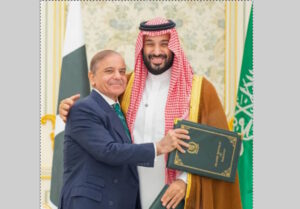
Pakistan is not acting with Saudi Arabia. It is positioning itself around Saudi Arabia.
The distinction matters.
At a moment when Saudi Arabia faces mounting pressure from regional threats, including escalating attacks by Iran-aligned forces, Islamabad has chosen language over action. Analysts already note that despite defense agreements and decades of military cooperation, Pakistan has remained cautious, emphasizing diplomacy and restraint rather than direct involvement. This is not hesitation. It is design.
Pakistan’s military establishment is signaling solidarity to Riyadh while carefully avoiding the costs of genuine alignment.
At the same time, it amplifies a parallel narrative. The people of Pakistan, it suggests, stand firmly with Saudi Arabia. This messaging is deliberate. It creates a buffer between public sentiment and institutional behavior, allowing the state to claim moral alignment while preserving strategic flexibility. The burden of loyalty is shifted to the population, while the decision-making core remains noncommittal.
And then, almost on cue, internal instability intensifies.
A surge of violence across Pakistan’s western regions, including deadly bombings, militant attacks, and counter-operations, reinforces the image of a country overwhelmed by its own security crises. These incidents are real and deadly, but they also serve a secondary function. They provide a ready-made justification for inaction abroad. A state that appears internally consumed cannot be expected to project power externally.
This is not coincidence. It is timing.
Simultaneously, diplomatic traffic increases in another direction. Turkey and Qatar step forward, engaging Kabul, attempting to mediate tensions, and exploring arrangements that could ease pressure along the Afghanistan-Pakistan frontier. The optics are revealing. While Pakistan publicly aligns with Saudi Arabia, it quietly facilitates a regional environment where others take on the burden of stabilization.
The result is a layered strategy.
Pakistan reassures Saudi Arabia with rhetoric, reassures its domestic audience with symbolic alignment, and reassures itself with plausible deniability. It neither abandons Riyadh nor fully commits to it. Instead, it creates space. Space to maneuver, to hedge, to wait.
This is not the behavior of a state trapped by circumstance. It is the behavior of an institution that understands leverage.
By projecting loyalty without binding action, Pakistan preserves its relationships across competing axes. It avoids entanglement in Saudi Arabia’s escalating confrontations while maintaining access, influence, and financial ties. It leverages instability at home as both reality and shield. And by enabling intermediaries like Turkey and Qatar to manage regional frictions, it reduces its own exposure while remaining central to the equation.
But such strategies carry risk.
For Saudi Arabia, the message beneath the messaging is clear. Public assurances do not necessarily translate into operational commitment. For the region, the pattern reinforces a cycle of managed instability, where crises are not resolved but redistributed.
Pakistan’s military establishment is not confused. It is calculating.
It is playing multiple boards at once, signaling allegiance in one direction while quietly shifting responsibility in another. The question is not whether this strategy is intentional. The evidence suggests that it is.
The real question is how long such a balance can hold before words and reality collide.
Our Pashto-Dari Website
Support Dawat Media Center
If there were ever a time to join us, it is now. Every contribution, however big or small, powers our journalism and sustains our future. Support the Dawat Media Center from as little as $/€10 – it only takes a minute. If you can, please consider supporting us with a regular amount each month. Thank you
DNB Bank AC # 0530 2294668
Account for international payments: NO15 0530 2294 668
Vipps: #557320

Comments are closed.