

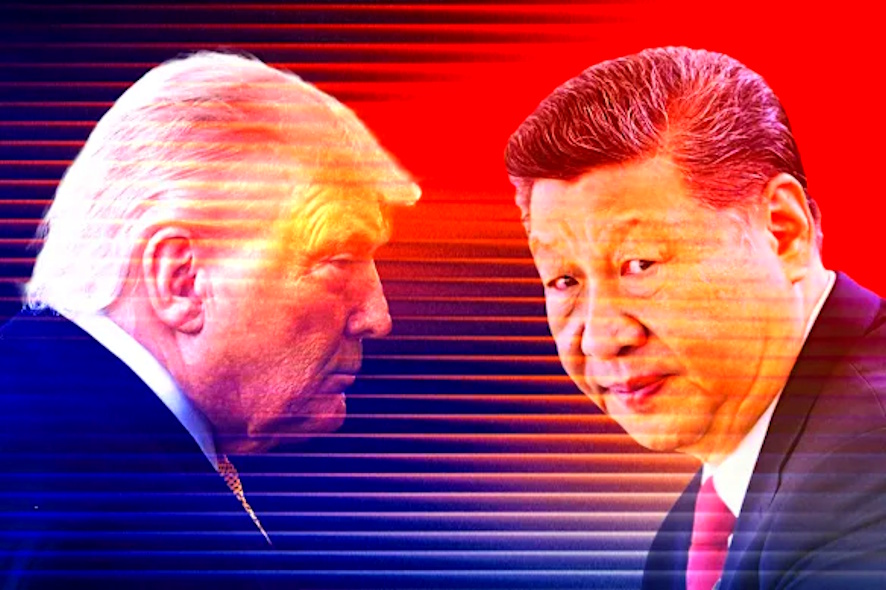
President Donald Trump arrives in Beijing this week carrying three sharply competing narratives about American power, strategic leverage, and Washington’s ability to shape events in an increasingly unstable world.
To his supporters, Trump is not arriving as a weakened president seeking accommodation. He is arriving after years spent reshaping the strategic balance between the United States and China. They point to his efforts to expand American domestic energy production, restrict Beijing’s access to advanced semiconductor technology, strengthen U.S. military alliances in the Indo-Pacific, and intensify pressure on Iran one of China’s most critical long-term energy suppliers.
From this perspective, Trump enters Beijing having systematically narrowed China’s room for maneuver. His backers see the trip as the culmination of sustained economic and strategic pressure that has forced Beijing to the negotiating table.
His critics, however, see a very different picture.
On the political left, Trump’s visit is being portrayed as a summit undertaken at a moment of visible American strain. They argue he arrives in Beijing while the United States is once again deeply entangled in Middle Eastern instability, global oil prices remain volatile, inflation concerns persist at home, and confidence is eroding in Washington’s ability to control the pace of escalation in the Persian Gulf.
To them, Trump is not projecting strength abroad but reacting to pressure on multiple fronts at once.
A third group national security hawks, many of them traditionally aligned with Trump’s own foreign-policy instincts argue something even more direct:
He should not make the trip at all.
A recent editorial in TIPP Insights urged Trump to postpone his Beijing visit entirely so long as China continues purchasing Iranian oil in open defiance of U.S. sanctions.
The editorial’s argument was blunt and strategically uncompromising:
China should not be rewarded with the prestige of hosting an American president while it is simultaneously helping finance the very regime Washington is attempting to constrain.
The logic behind this position is difficult to dismiss.
Every barrel of Iranian crude purchased by Chinese refiners weakens U.S. sanctions pressure and provides Tehran with the financial breathing room necessary to sustain regional proxy operations. Iranian-backed militias have repeatedly targeted U.S. personnel and assets across the Middle East. Critics argue that by continuing these purchases, Beijing is indirectly underwriting the pressure campaign Washington is trying to contain.
Why, they ask, should Trump legitimize this behavior with a summit?
Democrats frame the problem differently but arrive at a similar conclusion: Trump may be entering talks from a position of weakness.
Arizona Senator Mark Kelly recently warned that prolonged conflict with Iranian-backed forces has exposed serious strains on American military readiness. He cited concerns over ammunition stockpile depletion, industrial production shortfalls, and the long-term sustainability of U.S. force projection after repeated regional deployments.
The deaths of 13 American service members and injuries to hundreds more since hostilities escalated have deepened public frustration and intensified scrutiny over Washington’s broader strategic posture.
To Democratic critics, this matters because diplomacy is never detached from military credibility.
If Beijing senses Washington is overstretched, distracted, or politically exhausted, Trump’s leverage at the negotiating table could diminish significantly.
This debate whether Trump arrives as the stronger party or the weaker one now defines the significance of this visit.
A Lesson from Beijing in 2008
This moment recalls a similar strategic debate inside the White House in 2008, when I served on the National Security Council during President George W. Bush’s trip to the Beijing Olympics.
At the time, conservatives, human-rights advocates, and anti-China activists strongly urged Bush to boycott the Games in protest of Beijing’s repression of dissidents, restrictions on religious freedom, and harsh policies toward Tibet.
Bush went anyway.
But he did so while openly criticizing China’s human-rights record, publicly defending religious liberty, and meeting Chinese dissidents before arriving in Beijing—moves that angered Communist Party leaders while preserving the broader diplomatic framework.
That trip carried another lesson Washington should remember now.
While world leaders gathered in Beijing celebrating Olympic symbolism and international unity, Russia invaded Georgia.
Moscow understood a timeless geopolitical reality:
Moments of diplomatic spectacle often create windows for aggression elsewhere.
When the world’s attention narrows, opportunistic powers test boundaries.
That lesson matters today.
As Trump and Xi meet under global scrutiny, every other major actor Russia, Iran, North Korea, and regional proxies across the Middle East will be watching closely for signs of distraction, division, or strategic hesitation.
The Conservative Counterargument: China Needs America More
Many conservative commentators reject the narrative of American weakness entirely.
Figures such as Ben Shapiro argue the opposite: China needs the United States far more than America needs China.
Their case rests on hard structural realities.
China faces:
- Slowing economic growth
- Deepening demographic decline
- Massive local-government debt burdens
- A struggling property sector
- Growing pressure from industrial overcapacity
- Heavy dependence on imported energy
Most critically, China remains highly vulnerable to disruptions in energy shipments passing through the Strait of Hormuz.
Nearly half of China’s imported crude oil depends directly or indirectly on maritime flows vulnerable to disruption in the Gulf.
This creates strategic exposure.
If Hormuz becomes unstable, China’s economy absorbs immediate pressure through higher import costs, slower industrial production, and rising inflation risk.
From this perspective, Trump arrives in Beijing after years of applying coordinated strategic pressure across trade, energy, technology, and regional security.
Supporters believe Xi Jinping comes to the table needing stability far more urgently than Trump does.
The Strait of Hormuz: The Hidden Center of the Summit
The real issue behind this visit is not tariffs, trade balances, or diplomatic ceremony.
It is energy security.
The Strait of Hormuz remains one of the world’s most strategically important chokepoints. Roughly one-fifth of global oil consumption and a substantial portion of liquefied natural gas exports pass through that narrow corridor.
Even minor disruptions trigger immediate ripple effects:
- Shipping insurance costs surge
- Tanker delays increase
- Energy futures spike
- Inflation expectations rise globally
- Political pressure builds in energy-importing nations
No country feels this vulnerability more acutely than China.
This is why Gulf instability now shadows every major U.S.-China discussion.
Trump wants to arrive projecting control and resolve, not appearing distracted by another regional escalation.
Xi wants uninterrupted energy flows but cannot appear to bend under American pressure.
Iran wants exactly what it has always wanted: leverage, time, and strategic survival.
This triangle defines the summit.
Pressure Versus Pressure
Modern geopolitics no longer functions primarily through traditional diplomacy.
It increasingly operates through layered coercive pressure.
The United States pressures China through:
- Tariffs
- Technology export restrictions
- Financial sanctions
- Naval alliances
- Semiconductor controls
- Expanded energy competition
China pressures the United States through:
- Manufacturing dominance
- Rare earth mineral control
- Supply-chain dependence
- Market exposure
- Strategic patience
Iran pressures both by threatening uncertainty in Hormuz and injecting instability into global energy markets.
These are not classic diplomatic negotiations.
They are endurance contests.
The central question is no longer who can impose pressure.
It is who can withstand pressure longer without losing political control.
Trump built his negotiating instincts in construction and finance industries where leverage is immediate and transactional.
Xi negotiates through statecraft measured in decades, not quarters.
That difference matters.
Three Likely Outcomes
1. Trump Secures a Strategic Deal
In the most optimistic scenario, Trump convinces Xi that China’s long-term interests require a more stable Gulf and a weaker Iran.
Washington offers calibrated incentives:
- Selective tariff relief
- Expanded agricultural imports
- Greater civilian aviation access
- Limited easing on commercial technology exports
- Softer rhetoric on trade tensions
In exchange, Beijing quietly reduces Iranian oil purchases, pressures Tehran behind closed doors, or at minimum ceases openly undermining sanctions enforcement.
This would be a significant strategic win for Trump.
2. Xi Plays for Time
Xi may conclude political time favors Beijing.
If he believes Trump faces congressional vulnerability in November and the natural political erosion of a second-term presidency, patience becomes China’s strongest weapon.
Beijing could offer symbolic cooperation while making no meaningful concessions, staging a successful summit for optics while waiting for domestic U.S. political pressure to weaken Trump’s hand further.
This would preserve China’s relationship with Iran while extracting incremental U.S. concessions on tariffs, Taiwan rhetoric, technology restrictions, and trade access.
3. Ceremony Without Change
This is perhaps the most historically familiar outcome.
The summit produces:
- Handshakes
- Carefully staged meetings
- Business announcements
- Positive diplomatic language
- New commercial contracts
Executives from Boeing sign deals.
Markets briefly rally.
Commentators declare “progress.”
Then nothing fundamental changes.
Pressure in Hormuz continues.
Iran keeps testing boundaries.
China maintains its balancing act.
Washington remains stretched across multiple theaters.
And strategic rivalry deepens beneath the appearance of cooperation.
The Real Danger
Trump arrives convinced China needs stability more than America does.
Xi likely believes the United States is exhausted and searching for an exit from yet another dangerous Middle Eastern confrontation.
Both leaders may genuinely believe the other needs this meeting more.
That mutual confidence is precisely what makes the summit dangerous.
History shows that great-power miscalculation rarely begins with panic.
It begins with overconfidence.
The greatest risk is not that both Washington and Beijing feel pressure.
It is that each believes it can outlast the other and acts accordingly.
Our Pashto-Dari Website

Support Dawat Media Center
If there were ever a time to join us, it is now. Every contribution, however big or small, powers our journalism and sustains our future. Support the Dawat Media Center from as little as $/€10 – it only takes a minute. If you can, please consider supporting us with a regular amount each month. Thank you
DNB Bank AC # 0530 2294668
Account for international payments: NO15 0530 2294 668
Vipps: #557320

Comments are closed.