

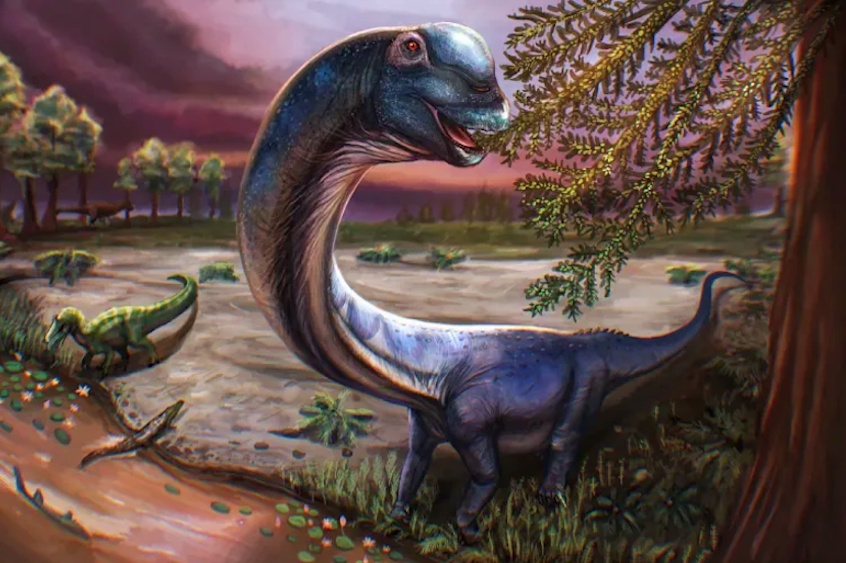
Scientists have identified a massive new dinosaur species following a long-running excavation in northeastern Thailand, shedding new light on the prehistoric ecosystems of Southeast Asia.
The newly described species, Nagatitan chaiyaphumensis, is estimated to have weighed around 27 tonnes roughly equivalent to nine adult elephants and stretched about 27 metres (89 feet) in length. Researchers say it is the largest known dinosaur ever discovered in Southeast Asia.
The findings were published in the journal Scientific Reports after analysis of fossils recovered from a dig site in Thailand that began more than a decade ago and was only fully completed in 2024.
A giant member of the sauropod family
Nagatitan belonged to a group of long-necked herbivorous dinosaurs known as sauropods, a lineage famous for producing the largest land animals in Earth’s history. These dinosaurs typically had small heads, extremely long tails, and massive column-like legs built to support their enormous bodies.
Although the skull and teeth were not preserved in the fossil record, scientists were able to infer its diet from related sauropods. It likely fed as a “bulk browser,” consuming large quantities of soft vegetation with little chewing, such as conifers and possibly seed ferns.
“The last titan” of Thailand
According to lead researcher Thitiwoot Sethapanichsakul, a PhD student at University College London, the species represents one of the final giants of its kind in the region. He described it as a “last titan” because it was discovered in one of the youngest rock formations in Thailand known to preserve dinosaurs.
Southeast Asia underwent dramatic environmental changes during the Cretaceous period, eventually becoming dominated by shallow seas. Researchers believe this shift likely contributed to the disappearance of large land-dwelling sauropods in the region.
Sethapanichsakul also noted that Nagatitan was larger than the well-known Diplodocus specimen “Dippy,” estimating it may have outweighed it by at least 10 tonnes.
Evolutionary significance
Sauropods as a whole originated roughly 140 million years ago. Over time, different groups rose and disappeared, with only a few lineages surviving until the end of the age of dinosaurs around 66 million years ago, when an asteroid impact triggered a mass extinction.
Nagatitan is considered part of one of the final surviving branches of these giant herbivores, making its discovery particularly important for understanding how sauropods evolved and persisted in changing environments.
Discovery and naming
The first fragments of the dinosaur were uncovered by local residents in northeastern Thailand about ten years ago. However, full excavation and scientific analysis were not completed until recently.
While the remains showed clear similarities to previously known sauropods, they also contained enough distinctive anatomical features for scientists to classify it as a new species.
The name Nagatitan draws inspiration from the “Naga,” a serpent-like mythical creature found in various Asian religious traditions and commonly depicted in Thai culture and temple art. The species name chaiyaphumensis refers to the Chaiyaphum region where the fossils were found.
A growing fossil record in Thailand
With this discovery, the number of officially named dinosaur species from Thailand now stands at 14. Researchers say the find highlights the country’s growing importance in global paleontology, particularly for understanding dinosaur diversity in Southeast Asia.
A life-size reconstruction of Nagatitan chaiyaphumensis is currently on display at Bangkok’s Thainosaur Museum, helping bring one of Asia’s last prehistoric giants back into public view.
Our Pashto-Dari Website

Support Dawat Media Center
If there were ever a time to join us, it is now. Every contribution, however big or small, powers our journalism and sustains our future. Support the Dawat Media Center from as little as $/€10 – it only takes a minute. If you can, please consider supporting us with a regular amount each month. Thank you
DNB Bank AC # 0530 2294668
Account for international payments: NO15 0530 2294 668
Vipps: #557320

Comments are closed.