

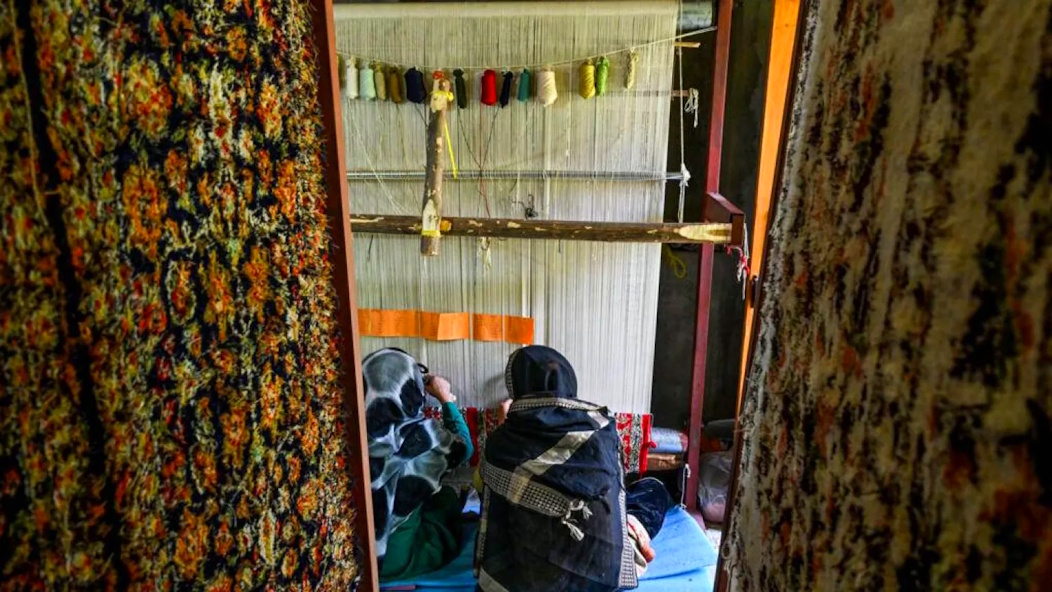
It has survived wars, political upheavals, and the shifting tides of empire but the legendary handwoven Kashmir carpet industry now faces its most precarious battle yet: a steady, quiet decline as younger generations turn away from the painstaking craft that once defined their homeland.
For centuries, masterpieces woven from lustrous mulberry silk or pure, soft sheep wool have graced the floors of imperial courts, adorned museum halls, and added warmth to luxury homes across the globe, according to AFP. Each carpet is a testament to human patience and precision hand-spun yarn, dyed in rich natural colors derived from plants, minerals, and insects, is painstakingly knotted on creaking wooden handlooms. Depending on the intricacy of the design, a single square inch can contain anywhere from 300 to several thousand knots, each one tied by calloused fingers that have spent decades perfecting their rhythm.
Until the 1980s, Kashmir carpets were the region’s crown jewel export, generating substantial revenue and employing hundreds of thousands. But volumes have steadily dwindled since, and the latest geopolitical tremors the wars in Ukraine and the Middle East have dealt fresh blows to an already fragile trade, severing supply chains and dampening demand in key overseas markets.
“It hurts me to see this,” said Bashir Ahmad, 78, a veteran weaver whose wrinkled hands still move with the muscle memory of youth. “If more young people had taken up this craft, they could have made a decent living from it. It’s not just a job it’s an inheritance.” Yet the long, hunched hours, meager wages, and changing aspirations have rendered the profession deeply unattractive to younger Kashmiris. Today, a master weaver earns barely 500 rupees ($5) a day less than many unskilled labourers, and far below what a smartphone salesman or a delivery driver can command with far less training.
“There are no government jobs for everyone, and my child or anyone else’s child could have taken up this work and built a career out of it,” Ahmad added, his voice heavy with resignation. “But things are no longer the same. The world moves faster now, and we are still tying knots one by one.”
The soul of the craft: talim and tradition
At the heart of this ancient art lies the talim a cryptic, handwritten code on a narrow strip of paper that serves as the carpet’s blueprint. Scrawled with shorthand symbols for numbers, colours, and knot sequences, the talim is chanted aloud by artisans as they work, like a quiet liturgical chant, guiding each string into place with monastic precision. Depending on the size and complexity of the design, a single carpet can take a group of weavers up to a full year to complete. Such pieces, rich in symbolic motifs and flawless in execution, can fetch as much as $20,000 on the international market though the weavers themselves see only a fraction of that sum.
The art of fine carpet weaving first arrived in the Himalayan valley of Kashmir in the 15th century, brought by Persian travellers along the ancient Silk Road. It flourished under the enlightened patronage of Sultan Zain-ul-Abidin Budshah, the last local king, who invited master craftsmen from Persia and Central Asia to settle in Srinagar. From the royal workshops of the capital, the craft gradually spread to towns and villages across Indian-administered Kashmir, becoming woven into the very identity of the valley.
A fading workforce, a stubborn flame
Despite the sharp contraction in volume, a handful of weavers remain fiercely devoted to the loom. “As long as I have strength in my fingers and days ahead of me, I will continue doing this work,” said Mushtaq Ahmad, 75, who has spent half a century bent over a loom, his eyes still sharp enough to read the finest talim script. His sentiment echoes across the dwindling workshops of Srinagar, where the clack of shuttles grows fainter with each passing year.
Industry estimates now place the total workforce in the sector at around 30,000 people a dramatic plunge from the hundreds of thousands employed just three decades ago. Entire villages that once hummed with the rhythm of looms have fallen silent, their young men and women seeking work in call centres, construction, or retail instead.
Can modernization save a dying art?
Government officials insist that efforts are underway to breathe new life into the industry. “We are providing modern carpet looms free of cost to artisans,” said Zubair Ahmad, director of the Indian Institute of Carpet Technology in Srinagar. These upgraded looms are designed to reduce physical strain and increase productivity, though purists worry that mechanisation may erode the very soul of the handwoven craft.
In a bid to protect the industry from the flood of cheap, machine-made imitations flooding the market many of them from neighbouring countries the government has also introduced “Geographical Indication” (GI) tags for genuine Kashmiri carpets. These certification labels guarantee authenticity, detailing the origin, materials, and weaving technique used. “The idea is to restore trust between buyers and sellers, because a serious trust deficit had developed over the years,” director Ahmad explained. “When a customer in New York or London pays thousands of dollars, they deserve to know they are buying a real Kashmir carpet not a factory copy.”
Whether these measures will be enough to reverse the decline remains uncertain. The younger generation, armed with degrees and dreams of urban life, shows little interest in returning to the dimly lit workrooms of their forefathers. And yet, in a narrow alley of old Srinagar, the rhythmic chant of the talim can still be heard faint, but not extinguished as a few old hands keep the knots tied, the colours bright, and a centuries-old legacy alive, one thread at a time.
Support Dawat Media Center
If there were ever a time to join us, it is now. Every contribution, however big or small, powers our journalism and sustains our future. Support the Dawat Media Center from as little as $/€10 – it only takes a minute. If you can, please consider supporting us with a regular amount each month. Thank you
DNB Bank AC # 0530 2294668
Account for international payments: NO15 0530 2294 668
Vipps: #557320

Comments are closed.