

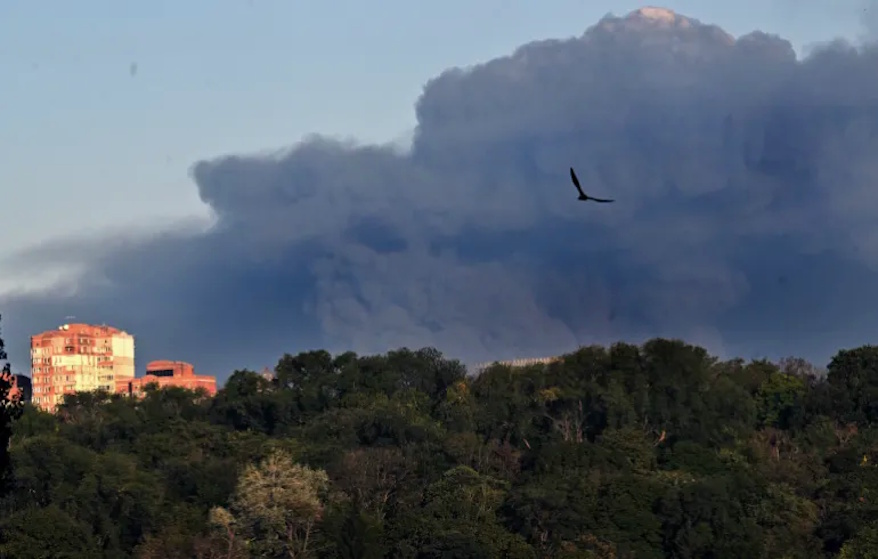
A deadly overnight attack on a military storage facility near Ukraine’s capital has reignited questions about ammunition safety protocols and civilian protection in wartime.
KYIV, UKRAINE – At least 37 people are confirmed dead after a Russian drone struck a munitions warehouse on the western outskirts of Kyiv late Friday, sparking a massive fire and a cascade of explosions that devastated nearby residential areas, Ukrainian officials said Saturday.
The attack, which occurred around 8:10 p.m. local time in the town of Myla, Bucha district, sent a towering column of black smoke over the capital’s western suburbs that could be seen for miles. The facility, which authorities said appeared to contain “explosive objects,” ignited with such force that the blaze spread to at least 50 residential buildings, a restaurant, and other local infrastructure, according to Kyiv region governor Tymur Tkachenko.
Rescue crews continued to comb through the smoldering debris on Saturday as the death toll rose from an initial 12 to 37. Nearly 400 people have been evacuated from the affected area, and dozens more are reported injured. Among the deceased is Taras Didych, the mayor of the nearby village of Dmytrivska, Tkachenko confirmed in a Telegram post.
Ukrainian prosecutors have launched a criminal investigation, but their focus is not solely on the Russian attack. The inquiry will examine “the legality of the storage of explosive objects and materials on the enterprise’s grounds,” as well as whether the unnamed company responsible held the “necessary permits and approvals” to house such dangerous materials so close to civilian zones.
A Recurring Pattern of Negligence?
The tragedy has drawn sharp rebukes from senior Ukrainian officials, who pointed to a similar incident in July in the town of Vyshneve, also near Kyiv, where a munitions depot explosion exposed serious safety failings by a state-owned enterprise. That investigation revealed that the company had failed to comply with storage standards, despite the proximity of residential apartment blocks.
“In the fifth year of the full-scale invasion, making the same mistakes over and over is criminal negligence,” said Prime Minister Sergiy Koretskyi in a fiery statement on Telegram. “Everyone responsible, without exception, must face severe punishment so that such situations never happen again.”
President Volodymyr Zelenskyy echoed that sentiment, underscoring that existing regulations explicitly prohibit ammunition storage near homes or populated areas. “There are regulations in place ammunition cannot be stored near homes or other residential areas. Appropriate conclusions will certainly be drawn,” he posted on X (formerly Twitter). While Zelenskyy did not specify the site’s purpose, he confirmed that criminal proceedings would follow, and noted that the drone strike was “followed by a detonation” a phrase suggesting the stored materials worsened the catastrophe.
Escalating Long-Range Warfare
The strike on Myla was part of a wider wave of Russian attacks launched between late Friday and early Saturday. Ukraine’s Air Force reported that Russia deployed at least two missiles and 267 drones across multiple regions during that period. In addition to the warehouse tragedy, Russian strikes early Saturday claimed three more lives in the Kyiv area, including a two-year-old child and a 14-year-old girl in the capital’s outer suburbs.
Moscow has not commented specifically on the Myla strike, but Russian officials confirmed their own casualties from Ukrainian drone operations. In the Belgorod region, at least three people were killed and nine wounded, with three in serious condition, according to local authorities. Separately, one person died and three were injured in a Ukrainian drone attack on Sevastopol, the Russian-annexed Crimean port city, said the city’s Russian-appointed governor, Mikhail Razvozhayev.
Both sides have significantly intensified long-range strikes in recent months, increasingly targeting not only military logistics but also civilian infrastructure such as grain storage warehouses, oil depots, and port facilities. The shift has led to a sharp rise in civilian casualties and has placed renewed international scrutiny on the conduct of the war.
A Grim Milestone in a Protracted War
As rescue operations continue in Myla, the incident underscores the dual dangers facing Ukrainian civilians: the constant threat of Russian aerial bombardment and the perils of domestic safety lapses in a war economy where ammunition depots are often hastily established or poorly regulated.
For many Ukrainians, the disaster is a painful reminder that while external enemies are ever-present, internal accountability remains just as critical. “We are fighting for our survival,” one local resident told AFP, standing near the cordoned-off blast zone. “But we should not have to fear our own warehouses exploding next to our homes.”
The investigation into the Myla facility is expected to take weeks, but officials have promised swift action. “Lessons must be learned,” Prime Minister Koretskyi insisted. “There can be no room for error when lives are at stake.”
This report includes contributions from AFP and local Ukrainian officials. Additional reporting by [Dawatmedia24].
Our Pashto-Dari Website

Support Dawat Media Center
If there were ever a time to join us, it is now. Every contribution, however big or small, powers our journalism and sustains our future. Support the Dawat Media Center from as little as $/€10 – it only takes a minute. If you can, please consider supporting us with a regular amount each month. Thank you
DNB Bank AC # 0530 2294668
Account for international payments: NO15 0530 2294 668
Vipps: #557320

Comments are closed.