

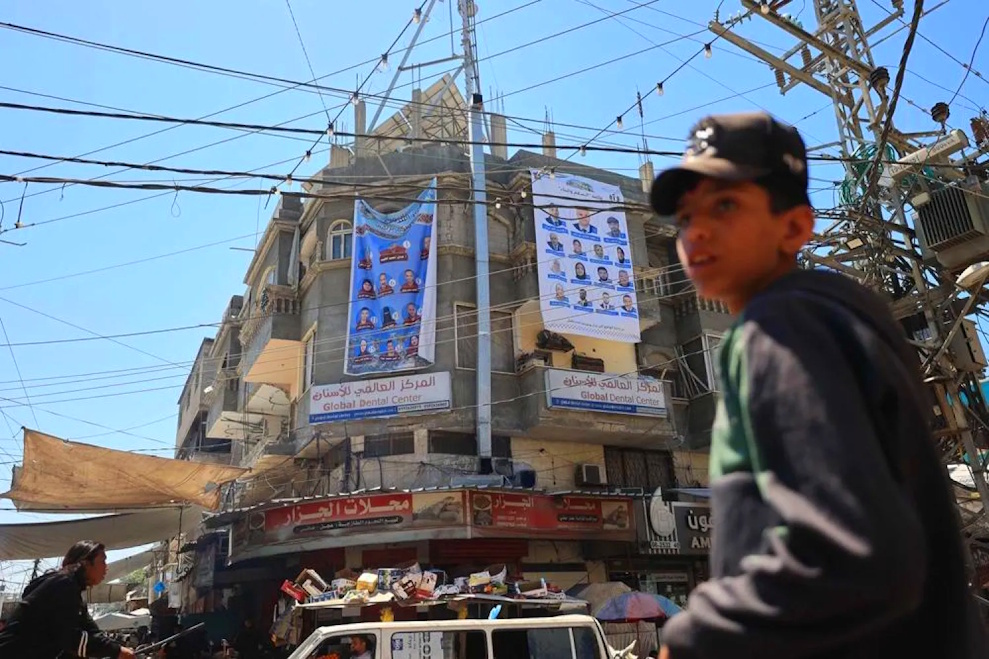
Deir al-Balah, Gaza Strip — For the first time in nearly 20 years, parts of the Gaza Strip are set to hold local elections. Voting is scheduled to begin on Saturday in the central Gazan city of Deir al-Balah, coinciding with municipal polls taking place across the occupied West Bank.
The election marks a rare political event in Gaza since Hamas took full control of the enclave in 2007. However, the process is limited in scope, shaped by ongoing war, mass displacement, and deep political divisions between the Palestinian Authority (PA) and Hamas.
Why Only Deir al-Balah?
A decree issued by Palestinian President Mahmoud Abbas designated Deir al-Balah as the sole voting site in Gaza. According to the PA-run Central Elections Commission (CEC), the city was chosen due to its relatively limited damage from Israel’s ongoing military campaign and its better-preserved infrastructure compared with other areas of the Strip.
The last local elections held across Gaza took place in 2005, when Hamas secured a majority of municipal councils. A year later, Hamas won legislative elections, and in 2007, following a violent conflict with its rival Fatah, the group consolidated control over Gaza. From 2005 until the current war, Hamas effectively appointed members of local councils and municipalities across the enclave, bypassing electoral processes.
Who Can Vote?
The CEC has confirmed that approximately 70,449 registered voters in Deir al-Balah are eligible to cast ballots at 12 polling centers. These centers include open areas equipped with tents, as schools traditionally used as polling stations remain shelters for tens of thousands of displaced residents.
Critically, the voter registry excludes the majority of displaced people now living in Deir al-Balah. Only original residents of the city are permitted to vote, a restriction that has drawn criticism from advocacy groups who argue it disenfranchises a large segment of the war-affected population.
The commission has accredited 292 observers from 10 local monitoring groups and 45 journalists. Around 675 staff members will oversee polling operations to ensure compliance with legal and professional standards.
How the Voting Works
Jamil al-Khalidi, the CEC’s regional director in Gaza, explained to Asharq Al-Awsat that the election uses a closed-list system. Voters select a single list and then cast votes for up to five candidates from within that list. A 15-member municipal council will be formed from the candidates who receive the most votes, with at least four seats reserved for women.
Ballot boxes and papers are ready, with 12 centers prepared across nine tented sites and three civil society facilities. Each center will contain eight polling stations. Preliminary results are expected on the morning after election day.
Who Is Running?
Four lists are competing. Observers note that campaigning has been more visible online than on the ground, with only limited posters appearing in the city. All competing lists are described as independent and clan-based, with competition driven largely by geographic and family ties rather than formal political platforms.
Notably, candidates were required to sign a pledge committing to the program of the Palestine Liberation Organization (PLO) and recognizing it as the “sole legitimate representative” of the Palestinian people. This requirement is politically contentious for Hamas, as it implies adherence to PLO positions including recognition of Israel and previous peace agreements. The Palestinian Authority has sought to enforce the pledge in line with its commitment to a two-state solution.
A local source indicated that some candidates have past ties to Fatah or Hamas but are running as independents. No faction has publicly endorsed any of the competing lists.
Security Challenges
Perhaps the most delicate issue is security. Al-Khalidi stated that the Palestinian civil police effectively the Hamas-run interior ministry force will secure the process. However, officers will keep their distance from polling centers due to the risk of Israeli airstrikes. They will deploy without visible weapons and intervene only if necessary, before returning to positions outside the sites.
A private security company had initially been considered to handle the task, but Gaza’s civil police insisted on taking responsibility. A security plan was ultimately agreed upon with all parties, al-Khalidi said.
A Vote Under the Shadow of War
This election comes after more than two years of war that have reshaped Gaza’s political and physical landscape. The vote is being closely watched as a test of whether any form of municipal governance can be revived amid , and whether the PA can reassert even a symbolic foothold in Gaza.
For now, Deir al-Balah stands as a small but significant exception a city attempting to hold a democratic exercise while surrounded by destruction, displacement, and uncertainty.
Reporting contributed by Asharq Al-Awsat. Editing and additional analysis by Dawatmedia24.
Our Pashto-Dari Website

Support Dawat Media Center
If there were ever a time to join us, it is now. Every contribution, however big or small, powers our journalism and sustains our future. Support the Dawat Media Center from as little as $/€10 – it only takes a minute. If you can, please consider supporting us with a regular amount each month. Thank you
DNB Bank AC # 0530 2294668
Account for international payments: NO15 0530 2294 668
Vipps: #557320

Comments are closed.