

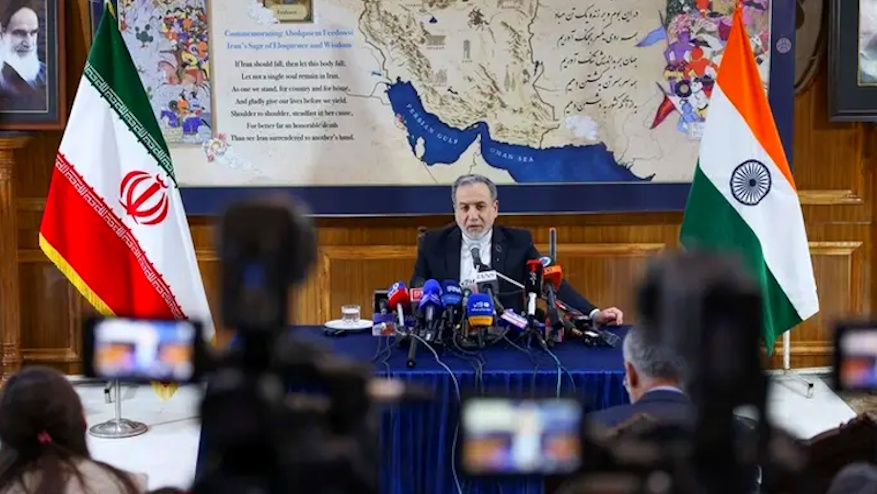
NEW DELHI — Iran has “no trust” in the United States and will only return to negotiations if Washington demonstrates genuine seriousness about reaching a durable agreement, Iranian Foreign Minister Abbas Araghchi said on Friday, as efforts to end months of conflict between the two countries remain stalled.
Speaking to reporters in New Delhi during a visit to attend the BRICS foreign ministers’ meeting, Araghchi said Tehran remains skeptical of Washington’s intentions due to what he described as “contradictory messages” coming from American officials.
“We have no trust in the United States at this stage,” Araghchi said. “Contradictory statements and actions have made us reluctant about the real intentions of the Americans regarding negotiations.”
His remarks underscore the growing uncertainty surrounding the fragile ceasefire announced last month between Iran and the United States after months of escalating military confrontation involving both Washington and Israel.
Strait of Hormuz Restrictions Remain in Place
Araghchi said all commercial vessels are currently permitted to pass through the Strait of Hormuz except those belonging to nations “at war” with Tehran provided they coordinate in advance with Iran’s navy.
The strategic waterway, one of the world’s most critical energy chokepoints, previously handled nearly one-fifth of global seaborne oil and gas shipments. However, Iran effectively restricted most shipping traffic through the strait after hostilities with the United States and Israel erupted in February, sending shockwaves through global energy and commodities markets.
“The situation around the Strait of Hormuz remains very complicated,” Araghchi said, adding that Tehran hopes negotiations can eventually lead to the full normalization of maritime traffic.
“We hope that, with progress in diplomacy, the Strait of Hormuz can be completely secured and that normal shipping operations can resume as quickly as possible,” he said.
Pakistani-Mediated Talks at an Impasse
Diplomatic negotiations mediated by Pakistan have been suspended after both Tehran and Washington rejected each other’s latest proposals last week.
Araghchi stressed that the mediation process had not collapsed entirely but acknowledged that it was facing serious difficulties.
“The mediation process has not failed, but it is in difficulty,” he said.
The Iranian foreign minister noted that Tehran remains committed to preserving the ceasefire in order to give diplomacy a chance. However, he warned that Iran is fully prepared to resume military operations if talks collapse.
“We are trying to preserve the ceasefire because diplomacy deserves an opportunity,” Araghchi said. “But Iran is fully prepared to return to fighting if necessary.”
This is not the first time diplomacy between Washington and Tehran has been derailed. Over the past 13 months, two earlier rounds of negotiations were cut short by US and Israeli military campaigns targeting Iranian infrastructure and strategic facilities.
Key Disputes: Nuclear Program and Hormuz Control
The most contentious issues preventing a final peace agreement remain Iran’s nuclear ambitions and Tehran’s strategic control over the Strait of Hormuz.
Washington has demanded stronger guarantees limiting Iran’s nuclear activities, while Tehran insists its program is peaceful and accuses the US of using negotiations as leverage for broader geopolitical concessions.
Hours before Araghchi’s comments, US President Donald Trump said his patience with Iran was “running out” and revealed he had discussed the issue with Chinese President Xi Jinping, with both leaders agreeing that Tehran should fully reopen the Strait of Hormuz.
Iran Welcomes Chinese Diplomatic Support
Asked whether Iran would accept direct mediation from Beijing, Araghchi signaled openness to any constructive diplomatic role China could play.
“We have very good relations with China,” he said. “We are strategic partners, and we know that the Chinese have good intentions. Anything they can do to help diplomacy would be welcomed.”
China has maintained close economic and strategic ties with Iran and has increasingly positioned itself as a regional diplomatic actor, particularly amid growing instability across the Middle East.
For now, despite the ceasefire holding, prospects for a permanent peace agreement remain uncertain as mistrust deepens and negotiations remain deadlocked.
Our Pashto-Dari Website

Support Dawat Media Center
If there were ever a time to join us, it is now. Every contribution, however big or small, powers our journalism and sustains our future. Support the Dawat Media Center from as little as $/€10 – it only takes a minute. If you can, please consider supporting us with a regular amount each month. Thank you
DNB Bank AC # 0530 2294668
Account for international payments: NO15 0530 2294 668
Vipps: #557320

Comments are closed.