

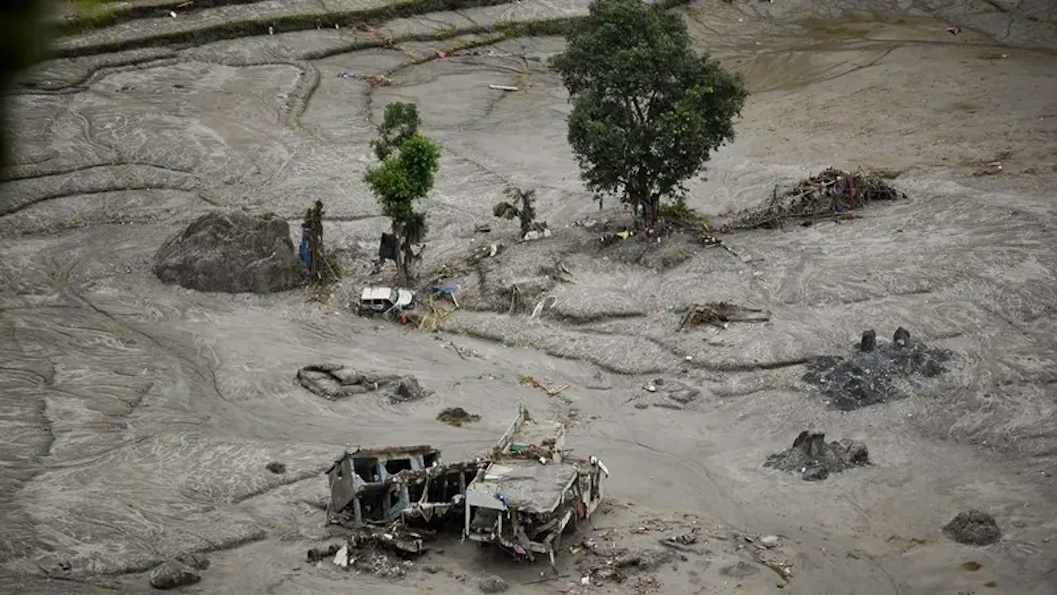
Kathmandu / Beijing — Rescue teams with sniffer dogs continued to scour mud, rock, and debris along the Nepal-China border on Tuesday, as the death toll from one of the worst glacial flood disasters in Himalayan history exceeded 1,000. With thousands still missing, authorities on both sides of the frontier are racing against time, treacherous weather, and collapsing terrain to reach isolated communities.
Soaring Casualties and Widespread Devastation
Nepal’s disaster management agency confirmed that 1,003 bodies had been recovered within its borders, while 3,916 people remain unaccounted for among them 583 foreign nationals. In China’s Tibet Autonomous Region, state media reported 16 deaths and 546 missing, including 261 foreigners. Combined, the disaster has left at least 1,003 dead and nearly 4,500 missing across the two countries.
The catastrophe was set in motion on August 26, when a high-altitude glacial collapse likely triggered by warming temperatures and bedrock failure sent a catastrophic surge of ice, rock, and meltwater cascading down steep valleys. The wave, described by survivors as a “wall of freezing water and boulders,” tore through settlements, hydropower projects, and transport infrastructure with little warning.
A Race Against Time in Treacherous Conditions
In Nepal, army and police personnel, aided by foreign experts, are concentrating efforts on a network of hydropower tunnels where an estimated 500 to 900 workers are believed to be trapped. So far, only corpses have been recovered from sludge-filled passages.
“We are focused on search and rescue at the tunnels our work is continuing,” said Raja Ram Basnet, spokesperson for the Nepali Army. “Our soldiers are also deployed to collect bodies and prevent the spread of disease.”
Helicopters have been ferrying relief supplies and evacuating the injured, but landslides and destroyed bridges have cut off many remote villages. In districts like Nuwakot and Rasuwa, soldiers were seen unloading body bags from aircraft as grieving families awaited news.
Mass Burials and DNA Sampling in Kathmandu
With mortuaries overflowing, Nepali authorities have begun mass burials of unidentified victims. In a rain-soaked field on the outskirts of Kathmandu, police dug multiple trenches, each marked with blue numbered identifiers. Before interment, officials collected DNA samples, photographed distinguishing features, and recorded personal effects hoping to help families eventually claim their loved ones.
At a hospital wall in the capital, crowds posted photographs of missing relatives a poignant ritual of fading hope. Debu Sapkota, 58, a driver from Trishuli Bazaar, pinned photos of his 83-year-old mother-in-law and his granddaughter. A warning siren had sounded before the flood, he recounted, but the elderly woman “was too old to run. Her granddaughter tried to help her escape, but both were swept away.” Holding their portraits, he said: “I am here hoping to find their bodies.”
Aid, Shelter, and Reconstruction Challenges
Entire communities have been erased. Thousands of families are now homeless, erecting makeshift tarpaulin shelters under persistent rain. Roads, dozens of bridges, and several power plants have been destroyed, severely hampering relief logistics.
According to Nepal’s authorities, at least 11,814 people have been rescued so far, but many more remain cut off. The government has warned that reconstruction costs could run into “billions of dollars” a crippling burden for a nation already struggling with economic headwinds.
China has dispatched a second batch of relief supplies, including drones, DNA testing kits, and water purification systems, along with forensic experts to assist in victim identification. Beijing’s foreign ministry spokesperson, Guo Jiakun, emphasized that information sharing has been “open, transparent, and timely,” dismissing international reports of undercounting.
Climate Justice and Global Responsibility
Nepal’s Prime Minister Balendra Shah has described the disaster as “unimaginable and heartbreaking.” In a late-night statement, he called for urgent international action, saying: “This incident has indicated that the risks we face in the Himalayan region are increasing with climate change. It is time for us to strongly raise with the international community the issue of disasters caused by climate change.”
Scientists have long warned that the Himalayas the world’s highest mountain range—are melting at an accelerating pace due to rising global temperatures. Satellite imagery analyzed by glaciologists suggests that the collapse involved not just glacial ice but also the failure of bedrock beneath it a phenomenon researchers describe as a “glacial detachment,” which registered as a magnitude 5.2 seismic event.
Despite contributing minimally to global greenhouse gas emissions, Nepal a largely rural nation of 30 million is bearing some of the harshest consequences of climate change. The disaster has reignited calls for wealthy industrialized nations to honor their commitments to loss-and-damage funding and climate adaptation support.
Geopolitical Tensions and Calls for Transparency
On the Chinese side, rescue crews have concentrated efforts around the Gyirong Port border crossing, a key trade and pilgrimage route that was completely destroyed. State media reported that over 2,000 personnel including soldiers and emergency workers are operating around the clock to clear highways, restore communications, and search for survivors.
However, Tibetan advocacy groups in exile have questioned the official narrative. Tencho Gyatso, president of the International Campaign for Tibet, urged Beijing to release “complete and verifiable information about the damage and casualties.” Beijing has rejected such criticism, maintaining that its reporting has been prompt and accurate.
Human Toll and Lingering Trauma
Among the missing are foreign tourists who had ventured to the Himalayas for trekking, as well as Hindu pilgrims en route to Tibet’s sacred Mount Kailash. Nationals from more than 30 countries are affected, complicating diplomatic and consular efforts.
In Chitwan district, relatives performed last rites for recovered bodies, while in Timure a border town that helicopter pilot Bimal Sharma had known for years the landscape was almost unrecognizable. “It felt like I was flying over an entirely different place,” he said. “I can see the pain in their eyes. It’s heartbreaking.”
A Crisis Without Precedent
The combined death toll of over 1,000 and nearly 4,500 missing makes this disaster one of the deadliest glacial flood events ever recorded. It underscores a grim new reality for the Hindu Kush-Himalaya region, where climate-induced hazards are becoming more frequent, more severe, and more unpredictable.
As rescue operations continue, the world watchesand mourns a tragedy that is as much a symptom of global inaction as it is a natural calamity. For the families still waiting by hospital walls and mass graves, the search for closure has only just begun.
Our Pashto-Dari Website

Support Dawat Media Center
If there were ever a time to join us, it is now. Every contribution, however big or small, powers our journalism and sustains our future. Support the Dawat Media Center from as little as $/€10 – it only takes a minute. If you can, please consider supporting us with a regular amount each month. Thank you
DNB Bank AC # 0530 2294668
Account for international payments: NO15 0530 2294 668
Vipps: #557320

Comments are closed.