
Spain’s PM Visits Ceuta as Migrant Death Toll Rises to 57 Amid Mass Border Breach from Morocco

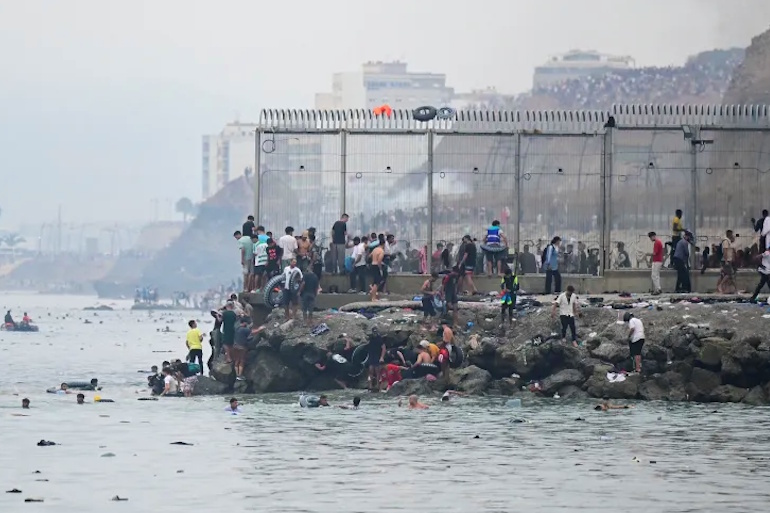
Regional leader says 60,000 crossed into the Spanish enclave by land and sea, as EU chief calls situation “unacceptable” and neighbouring countries tighten borders.
At least 57 migrants have died while attempting to reach the Spanish territory of Ceuta after breaching the border from Morocco, as tens of thousands of people poured into the North African enclave over the past 48 hours. The Spanish government confirmed the updated death toll on Friday evening, marking one of the deadliest migrant incidents on the EU–Africa frontier in recent years. Earlier that day, Juan Jesús Vivas, the regional president of Ceuta, had told reporters that 34 people had perished, though he did not specify the causes of death. Subsequent reports from local officials and rescue workers indicated that many drowned in rough coastal waters, while others were crushed or suffocated in a stampede near the Tarajal beach border crossing.
Vivas further stated that approximately 60,000 people had crossed from Morocco into Ceuta both by land and by swimming around the breakwater barrier that extends into the Mediterranean Sea. The vast majority were Moroccan nationals, but officials noted the presence of sub-Saharan Africans and other nationalities among the crowd. Many migrants swam the roughly five kilometres (three miles) from the Moroccan town of Fnideq, while others attempted the shorter crossing from Belyounech. Footage from Thursday showed vast crowds of people mostly young men, but also families with women and small children wading through the water and walking along local roads, overwhelming border guards and evading makeshift barriers.
In response, Spanish Prime Minister Pedro Sánchez travelled to Ceuta on Friday and vowed that his government was mobilising “all available resources” to restore order and protect territorial sovereignty. Sánchez described the mass crossings as a “violation” of Spanish sovereignty and confirmed that authorities were accelerating repatriation procedures. Spain’s Interior Ministry reported that roughly 25,000 people had already been returned to Morocco by Friday evening, though the pace of returns raised concerns among human rights groups about due process and the treatment of minors. Rachid Sbihi, head of a local workers’ association representing Civil Guard officers in Ceuta, labelled the situation a “serious humanitarian crisis,” noting that thousands of migrants including unaccompanied children were sleeping on pavements, while others wandered the streets in search of food, water, or shelter. He added that among the deceased, many had drowned, but some also died during a desperate stampede to cross the breakwater fence at Tarajal beach, near the main border checkpoint with Morocco.
On the Moroccan side, authorities deployed water cannon trucks and pushed crowds back from the border gates. Nearby, the charred remains of a bus and seven cars bore witness to violent clashes between security forces and groups of would-be crossers. Moroccan officials have not commented publicly on the scale of the breach, but local media reported that border police were overwhelmed despite reinforcements.
Ceuta, together with Melilla another Spanish autonomous city on the northern coast of Africa constitutes the European Union’s only land border with the continent. Both enclaves have long been flashpoints for irregular migration, with periodic spikes in crossing attempts as people flee poverty, conflict, or political instability in search of a better life in Europe. This week’s surge, however, is unprecedented in both scale and lethality, dwarfing previous mass-entry events.
Political fallout and EU response
Spanish authorities have linked the sudden influx to a recent Supreme Court ruling that barred the immediate return known as “hot returns” of migrants who arrive by sea, on the grounds that such expedited expulsions violate due process and international protections. The ruling does not apply to those who enter by land, including by climbing over the border fence. Speaking to reporters on Friday, Sánchez argued that trafficking mafias had exploited the ruling by spreading false rumours that all migrants would be allowed to stay, prompting the mass rush. “What has emerged from our talks with Moroccan authorities is that trafficking mafias took a self-serving interpretation of a Supreme Court ruling,” he said. “That interpretation spread like wildfire in recent hours.” However, activists and civil society groups in Morocco expressed scepticism, pointing out that most migrants especially those from remote rural areas would have little to no awareness of Spanish judicial decisions, and that deep-seated economic grievances and lack of legal pathways were more likely drivers.
European Commission President Ursula von der Leyen described the images from Ceuta as “unacceptable,” stating on social media: “We cannot allow anyone to come to our Union without abiding by our rules. Dangerous crossings must stop immediately. Smuggling networks must be dismantled. And returns must be swift, as our rules allow.” Her remarks underscored the EU’s hardening stance on border control, even as humanitarian groups called for greater solidarity and reception capacities.
German Chancellor Friedrich Merz expressed support for Spain’s intention not to allow undocumented migrants onto the European mainland, adding that his government was in close contact with Madrid. France also signalled readiness to assist Spain if necessary, including through the European border and coast guard agency Frontex. French President Emmanuel Macron’s entourage confirmed that Paris was in touch with both Spanish and Moroccan authorities. Meanwhile, French Interior Minister Laurent Núñez announced on Thursday night that France would immediately tighten border controls with Spain, activating the rapid intervention border force “for in-depth inspections” to prevent secondary movements of migrants into French territory.
The crisis has already produced ripple effects beyond the Iberian Peninsula. In Italy another major entry point for Mediterranean migrants Premier Giorgia Meloni threatened to suspend Italy’s participation in the Schengen open-border agreement with Spain, citing the need “to defend our borders and ensure the safety of our citizens.” Although Italy does not share a land border with Spain, Meloni’s warning highlighted growing intra-EU tensions over migration management and the perceived failure of shared responsibility mechanisms.
Calls for national emergency and military deployment
Juan Jesús Vivas, Ceuta’s regional president, had called on the national government to declare a state of emergency on grounds of national security, requesting additional police reinforcements and the deployment of military personnel along the border “to guarantee the inviolability of the frontier and citizen safety.” However, Spain’s Interior Ministry rejected the request, clarifying that the legal framework for national emergencies does not cover migration crises. Nevertheless, the ministry promised to allocate supplementary resources, including border patrol units and aerial surveillance, to assist local forces.
Human rights organisations, including Amnesty International and Spain’s own ombudsman, have urged authorities to prioritise the protection of vulnerable groups, especially unaccompanied minors and asylum seekers, and to ensure that any returns comply with international law, including the principle of non-refoulement. They have also called for independent investigations into the deaths and the use of force during the crossings.
Looking ahead
As Ceuta grapples with the aftermath of the largest border breach in its modern history, the episode has reignited debates over EU migration policy, the externalisation of border control to third countries like Morocco, and the urgent need for safe and legal routes to Europe. Moroccan authorities have yet to signal whether they will take additional measures to curb departures, while Spain faces the delicate task of balancing humanitarian obligations with domestic political pressure to secure its borders. With summer approaching and sea crossings typically increasing in warmer months, both European and North African officials are bracing for further waves and the tragic human toll that too often accompanies them.
Our Pashto-Dari Website

Support Dawat Media Center
If there were ever a time to join us, it is now. Every contribution, however big or small, powers our journalism and sustains our future. Support the Dawat Media Center from as little as $/€10 – it only takes a minute. If you can, please consider supporting us with a regular amount each month. Thank you
DNB Bank AC # 0530 2294668
Account for international payments: NO15 0530 2294 668
Vipps: #557320

Comments are closed.