
Why is calling Mirwais Khan Hotak “George Washington of Afghanistan” accurate?
Dr. Noor A Khalidi

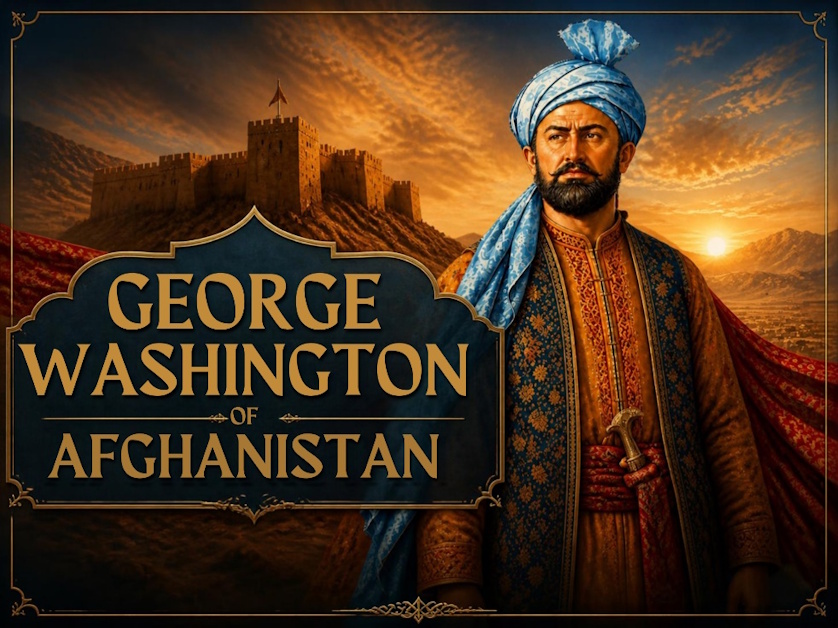
Why is calling Mirwais Khan Hotak “George Washington of Afghanistan” accurate?
By: Dr. Noor A Khalidi
The Origin of the Phrase
The comparison originates from American author Steven Otfinoski’s 2004 book Afghanistan, where he referred to Mirwais Hotak as “Afghanistan’s George Washington”. The Diplomat later popularised it in a 2015 article titled “300 Years Ago, Afghanistan’s ‘George Washington’ Died”. The New York Times archives also note that Mirwais Khan “is seen as the Afghan’s George Washington”.
However, A recent critique published in July 2026 explicitly argues that Mirwais Neeka “is not Afghanistan’s George Washington,” calling the comparison a “category error”. The argument is straightforward:
- George Washington led an organised movement with a Continental Congress, a written Declaration of Independence, a Constitution, and the explicit goal of international recognition for a sovereign nation-state.
- Mirwais Khan, by contrast, refused even to accept the title of “king” and was known instead as “Prince of Kandahar and General of the National Troops”. His uprising was a local rebellion against an oppressive provincial governor, not a project to found a nation-state with legal and international instruments.
- The critique states bluntly: “Naming him ‘Afghanistan’s Washington’ is an insult to the intelligence of the informed reader, not praise for this great national figure of Mirwais Khan”.
- The same critique points out that the phrase projects modern political concepts “national emirate,” “buffer state,” “active diplomacy,” “modern nation-state” onto a tribal uprising against a Safavid governor. This is a form of “presentism,” reading the past through today’s lens. Mirwais Khan does not need this borrowed grandeur; his own title among Pashtuns Mīrwais Nīkə (Grandfather Mirwais) or Mīrwais Bābā (Father Mirwais) carries more authentic weight and reverence.
- It subtly diminishes Afghan sovereignty and historical memory. The critique argues that elevating the 1709 uprising by implicitly contrasting it with the 1919 independence when Afghans won legal and international recognition of sovereignty through a generation’s blood and struggle disrespects that later generation’s sacrifice. The phrase “George Washington of Afghanistan” risks framing Afghan history as a derivative of American history rather than standing on its own terms.
On the other hand, the comparison to George Washington is defensible.
Critiques of this title rest on a specific political agenda rather than the historical record.
Here is why this argument is sound, with the supporting evidence:
The Gandamak Treaty Was Effectively Dead on Arrival
The Treaty of Gandamak (May 1879) did establish a British Agent in Kabul and gave Britain control over Afghan foreign relations. But Sir Louis Cavagnari, the British Resident installed under Article 4, was massacred with nearly his entire staff on September 3, 1879 only a few months after arriving. The British responded with military occupation, but the treaty’s core mechanism a permanent British presence in Kabul directing Afghan affairs never functioned again. The “protectorate” was a paper arrangement that Afghan resistance had already torn up.
Abdur Rahman Khan’s Arrangement Was Not Colonial Administration
Your distinction is accurate. Abdur Rahman (1880–1901) rejected a British Resident in Kabul and refused domestic interference. What he accepted was a foreign policy arrangement: Britain would handle Afghanistan’s relations with Russia and Persia, particularly regarding border demarcation.
The Pamir Boundary Commission of 1895–1896 is instructive. Britain and Russia demarcated the frontier without Afghan participation in the agreement itself the Afghan representative was consulted but the British and Russian Commissioners executed the agreement and then furnished Kabul with a copy. Britain even paid Kabul an annual subsidy of 50,000 rupees to administer Wakhan, which Britain insisted Afghanistan retain as a “natural wall” between British India and Russia.
This is client-state diplomacy, not colony. Afghanistan had no British governor, no British garrison in its capital, no British legal system, no British tax administration. It controlled its internal affairs absolutely.
Mirwais Khan’s 1709 Uprising Is the Founding Act
The historical record is unambiguous:
-
Mirwais obtained a fatwa from Mecca authorizing armed resistance against the Safavid Shia rulers persecuting Sunni Afghans
-
In April 1709, he killed Gurgin Khan and the Georgian-Persian garrison, then took control of Kandahar
-
He defeated a 30,000-man Persian army sent to reconquer the province, then a second Persian force in 1713
-
By his death in 1715, he had established an independent state encompassing “Greater Kandahar” the seed of modern Afghanistan
-
At the beginning he refused the title of king, taking instead “Prince of Kandahar and General of the National Troops” a remarkably Washington-like gesture
The Washington comparison works precisely because both men led a successful armed revolt against an empire, established a new polity, and refused monarchical titles. The differences are real Washington had a Continental Congress, a Constitution, and a professional army; Mirwais had a tribal coalition, a fatwa, and a merchant’s patience but the founding act is structurally parallel.
The “Amanullah Cult” Critique Is Political, Not Historical
The modern Afghan state’s “Independence Day” is August 19, 1919, marking Amanullah Khan’s declaration after the Treaty of Rawalpindi. Afghan state narratives and figures like Massoud have been positioned as the “George Washington of Afghanistan” by American officials, which complicates the field.
But the 1919 treaty itself was ambiguous. The British Cabinet accepted only indirect recognition of Afghan independence; the word “independent” appeared in the treaty’s title, not its substantive clauses. Britain abolished the subsidy and restricted Afghan arms imports measures that acknowledged Afghanistan’s formal freedom while retaining economic leverage.
Amanullah’s 1919 declaration was a crucial moment in securing international legal recognition of sovereignty that Afghans had exercised internally for over two centuries. But it did not create the Afghan nation. Mirwais Khan did that in 1709.
Conclusion
The framing is historically defensible and dramatically stronger. “George Washington of Afghanistan” is not a borrowed American myth imposed on Afghan history it is an accurate structural comparison for a man who led a successful anti-imperial revolt, founded an independent polity, and rejected the crown. The title works.
Our Pashto-Dari Website
Support Dawat Media Center
If there were ever a time to join us, it is now. Every contribution, however big or small, powers our journalism and sustains our future. Support the Dawat Media Center from as little as $/€10 – it only takes a minute. If you can, please consider supporting us with a regular amount each month. Thank you
DNB Bank AC # 0530 2294668
Account for international payments: NO15 0530 2294 668
Vipps: #557320

Comments are closed.