
Afghan Women and Allies Rally in Calgary, Demanding Global Action Amid Herat Crackdown

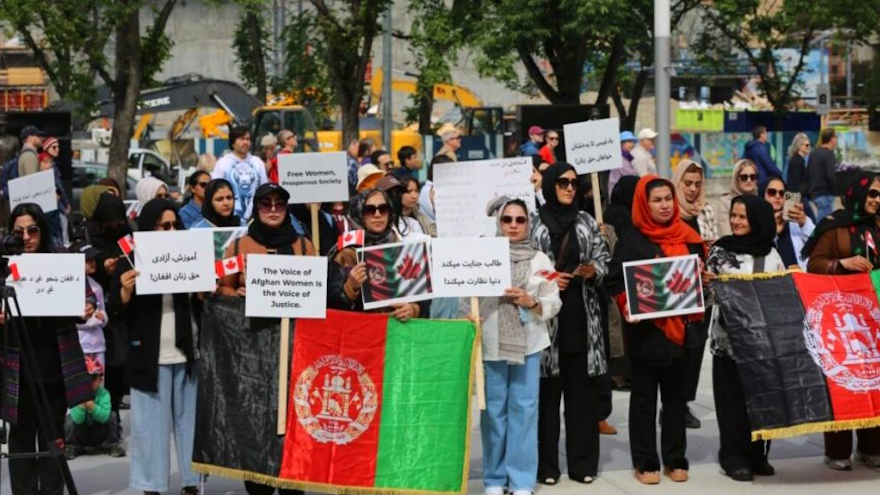
Calgary, Canada – In a powerful display of transnational solidarity, Afghan women, human rights defenders, and members of the diaspora community gathered outside Calgary City Hall on Saturday to condemn the Taliban’s latest crackdown in western Afghanistan and to urge the international community to move beyond condemnation toward concrete intervention.
The demonstration was organized in direct response to the recent detention of dozens of women and girls in Herat province, where morality officials reportedly rounded up individuals for allegedly violating strict dress codes. Those arrests sparked rare public protests in the city acts of defiance that were met with violent suppression. According to the United Nations Assistance Mission in Afghanistan (UNAMA), at least one protester was killed and several others wounded when Taliban forces opened fire to disperse the crowds.
“We are here because silence is complicity,” said one of the rally organizers, an Afghan-Canadian woman who fled the country after the Taliban’s return to power in August 2021. “For nearly five years, the world has watched Afghan women be erased from public life. We are asking our elected officials in Canada and allies abroad to treat this not as a cultural issue, but as a crime against humanity.”
The Calgary protest is part of a growing wave of global advocacy efforts as Afghan women increasingly describe their plight as “gender apartheid”—a term that some legal experts and human rights organizations are pushing to have recognized under international law. Speakers at the rally called on Western parliaments, the United Nations, and the International Criminal Court to formally investigate the Taliban’s policies and impose targeted sanctions on key leaders responsible for systematic gender-based repression.
Since seizing control of the country, the Taliban has enacted a sweeping suite of restrictions that have effectively severed women from nearly all facets of civic life. Girls are barred from secondary schools and universities; women are prohibited from most forms of employment, including NGO work and government positions; and they face severe limitations on movement, access to healthcare, and participation in public spaces such as parks and bathhouses. The UN has described these measures as among the most draconian gender-based restrictions in modern history.
“This is not about clothing. This is about control,” said another activist who addressed the crowd through a megaphone, holding a sign that read, “Herat is Everywhere.” “When they arrest a woman for a loose scarf, they are sending a message to every Afghan woman: you have no voice, no body, no future. We are here to say that message will not stand.”
The rally also drew support from Canadian human rights organizations and local politicians, some of whom reiterated calls for Ottawa to expedite family reunification visas for Afghan women at risk and to increase funding for underground education networks operating inside Afghanistan. Organizers emphasized that while symbolic gestures are important, tangible support including safe passage, legal aid, and financial backing for grassroots resistance is urgently needed.
As the chants of “Women, Life, Freedom” echoed across the plaza borrowing from the global feminist movement many in the crowd reflected on the bittersweet reality of protesting thousands of miles away from the violence they were condemning. For some, the rally was not just political but deeply personal: several attendees had family members currently in hiding in Herat or Kabul, fearful of retaliation for past activism or mere association with Western organizations.
“I speak for my sisters who cannot speak,” one participant told the crowd, her voice breaking. “I carry their names on my poster, but I carry their fear in my heart. We need the world to stop looking away. We need action before another mother buries her daughter.”
The protest concluded with a moment of silence for the victim of the Herat shooting and for all Afghan women who have lost their lives, freedoms, or futures under Taliban rule. Organizers pledged to continue their advocacy, with plans to submit a formal petition to the Canadian Parliament and coordinate with international women’s rights networks to push for a special UN session on Afghanistan.
As dusk fell over Calgary, the gathering disbanded, but the urgency of their message lingered a reminder that for Afghan women, the rally was not an event, but a lifeline, and the fight is far from over.
Our Pashto-Dari Website

Support Dawat Media Center
If there were ever a time to join us, it is now. Every contribution, however big or small, powers our journalism and sustains our future. Support the Dawat Media Center from as little as $/€10 – it only takes a minute. If you can, please consider supporting us with a regular amount each month. Thank you
DNB Bank AC # 0530 2294668
Account for international payments: NO15 0530 2294 668
Vipps: #557320

Comments are closed.