
The Vanishing Class: UNESCO Warns 2.4 Million Afghan Girls Lost to Education as a Generation Fades

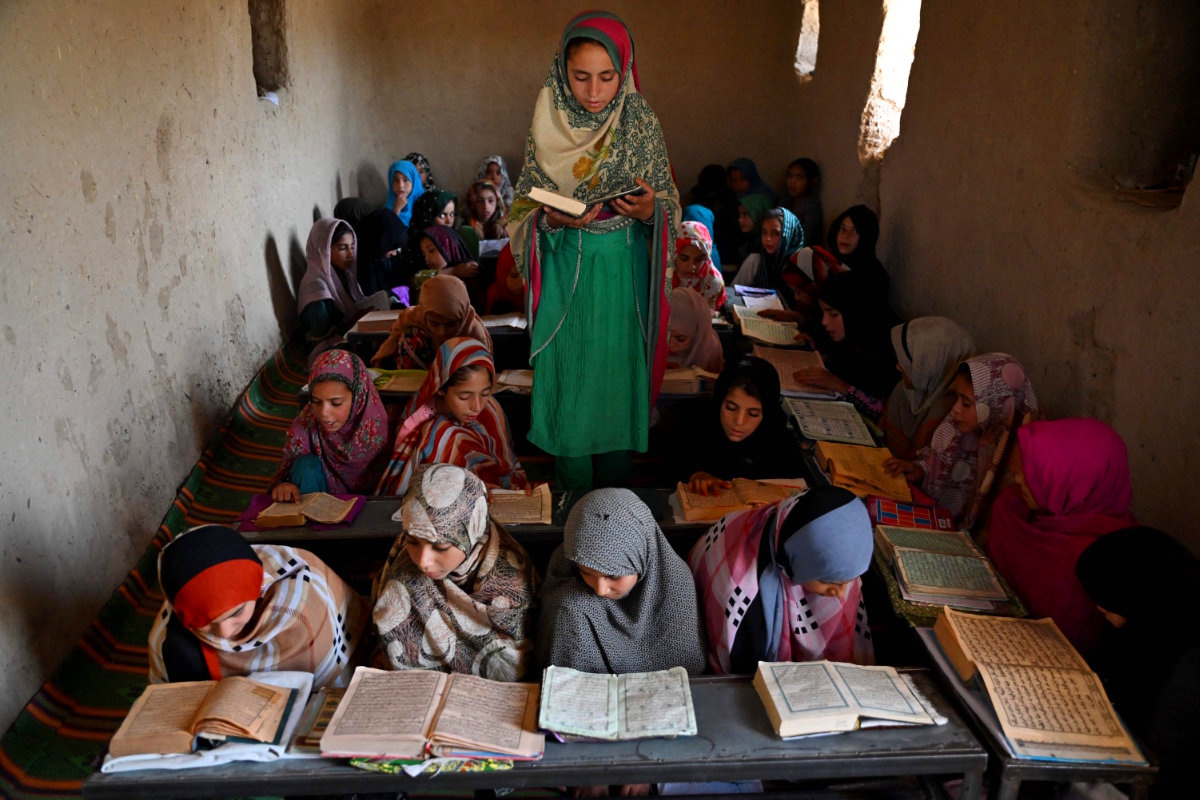
As the Taliban prepares to mark its fifth year in power, the United Nations Educational, Scientific and Cultural Organization (UNESCO) has issued a stark accounting of the regime’s lasting damage: 2.4 million Afghan girls have been systematically shut out of secondary education since the group’s return to Kabul in August 2021. The agency warned on Tuesday that what began as a policy of exclusion has metastasized into a long-term structural crisis one that is not only crippling Afghanistan’s present but systematically dismantling its future workforce, economy, and social fabric.
Afghanistan now stands as the only nation on earth where girls and women are formally prohibited from attending secondary school and university. This distinction, UNESCO noted, is not merely a statistical anomaly but a deliberate erasure of half the country’s intellectual capital. The bans have been layered over time: first, girls above sixth grade were barred from classrooms in 2021; then, in December 2022, women were expelled from universities. Concurrently, the Taliban has imposed sweeping restrictions on female employment, public movement, and participation in civic life effectively rendering women invisible in the public sphere.
A $9.6 Billion Economic Void
UNESCO’s projections reveal that the damage will reverberate for decades. The agency estimates that if current restrictions persist, Afghanistan could see 600,000 fewer women in its workforce by 2066 a shortfall that would drain approximately $9.6 billion in cumulative national income. This loss is not abstract; it translates into weakened household incomes, reduced tax revenues, and a diminished capacity to rebuild a country already crippled by decades of conflict and natural disasters.
Beyond economics, UNESCO warned that prolonged educational deprivation dramatically increases the risk of early and forced marriage, as families with limited options often view daughters as economic burdens rather than future breadwinners or professionals. The cycle of poverty and illiteracy, once set in motion, becomes nearly impossible to reverse.
The Teacher Drain and the Classroom Collapse
The restrictions have also triggered a silent exodus within the education system itself. Afghanistan is now facing a critical shortage of qualified female educators. UNESCO projects a deficit of more than 11,000 qualified female teachers by 2030 a figure that threatens to unravel what little remains of the country’s schooling infrastructure.
Hoda Jaberian, UNESCO’s coordinator for education in emergencies, painted a grim picture at a press briefing in Geneva. “Many teachers have left the country, and those who remained in the education system have been prevented from continuing to teach,” she said. The prohibition on women teaching boys has further constricted the pool of available instructors, Jaberian added, leaving some classrooms without any teacher and others in the hands of male educators who often lack formal training or adequate subject-matter expertise. The result is a hollowed-out education sector, where the quality of instruction plummets even as enrollment for boys remains superficially stable.
A Crisis Beyond Secondary School
The crisis, however, is not confined to adolescent girls. UNESCO reported that more than 2 million primary-school-age children both boys and girls are currently out of school for reasons unrelated to the gender bans, including poverty, displacement, and a lack of facilities. Even among those who do attend, learning outcomes are catastrophic: over 90% of 10-year-olds in Afghanistan cannot read and understand a simple, age-appropriate text. The national literacy rate currently hovers at just 37%, one of the lowest in the world.
These figures, UNESCO stressed, are not isolated data points but symptoms of a broader systemic collapse involving access, gender equity, and pedagogical quality. The agency warned that as fewer women enter skilled professions particularly in teaching and healthcare the country’s ability to deliver essential services will erode further, deepening the humanitarian catastrophe.
The International Community at an Impasse
The Taliban’s education decrees have drawn widespread international condemnation, including from the United Nations, the Organization of Islamic Cooperation, and individual governments. However, five years of diplomatic pressure, economic sanctions, and conditional aid have failed to reverse the policies. The regime has shown little willingness to compromise, framing its restrictions as matters of religious and cultural interpretation despite overwhelming opposition from Islamic scholars worldwide.
UNESCO reiterated that sustained international support for Afghan education remains essential not as an endorsement of the regime, but as a lifeline for the population. The agency called for the immediate and unconditional reinstatement of girls’ and women’s access to secondary and higher education, while also urging donors to fund alternative learning pathways, community-based schools, and remote education initiatives where formal systems have collapsed.
A Warning for the Future
“What started as a restriction on schooling has become a generational catastrophe,” a senior UNESCO official said. “If the international community looks away now, we are not just losing 2.4 million students we are losing an entire generation of mothers, teachers, doctors, and leaders.”
As Afghanistan approaches the bleak milestone of five years under Taliban rule, UNESCO’s report serves as both a reckoning and a plea. Without urgent action, the country’s human capital will continue to atrophy, and the cost measured in lost potential, shattered lives, and a fractured society will be paid not by the rulers in Kabul, but by the children who never had the chance to learn.
Our Pashto-Dari Website

Support Dawat Media Center
If there were ever a time to join us, it is now. Every contribution, however big or small, powers our journalism and sustains our future. Support the Dawat Media Center from as little as $/€10 – it only takes a minute. If you can, please consider supporting us with a regular amount each month. Thank you
DNB Bank AC # 0530 2294668
Account for international payments: NO15 0530 2294 668
Vipps: #557320

Comments are closed.