

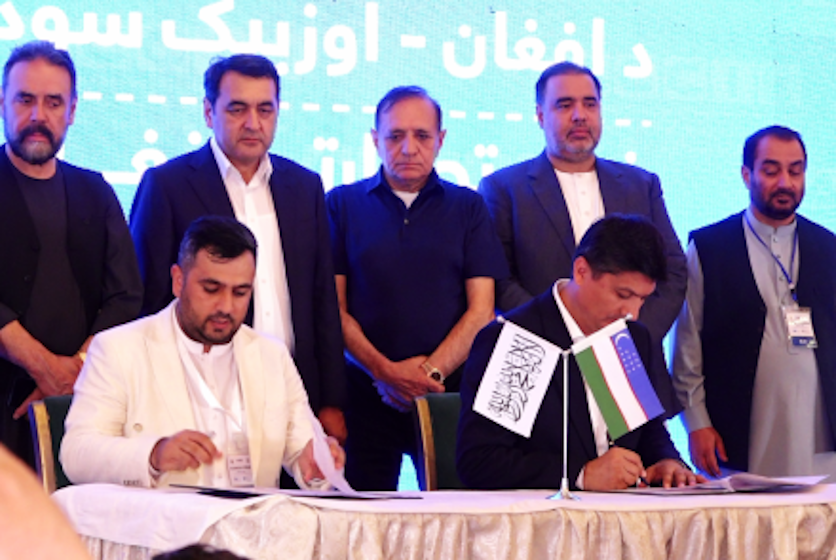
Afghanistan and Uzbekistan have signed 22 trade memorandums of understanding (MoUs) valued at over $200 million during the Afghan-Uzbek Business Forum in Kabul, signaling a renewed push to deepen economic cooperation and significantly boost bilateral trade volumes. The forum, held amid growing regional realignment, brought together a high-level gathering that included Afghanistan’s Minister of Industry and Commerce Nooruddin Azizi, Uzbekistan’s Deputy Prime Minister Jamshid Khodjayev, as well as the Afghan ministers of Mines and Transport, the governors of Uzbekistan’s Fergana and Tashkent regions, and a large cross-section of business leaders and private-sector representatives from both countries.
In his opening address, Minister Azizi underscored that bilateral relations had reached an unprecedented high, particularly following the recent visit of a senior Uzbek delegation accompanied by roughly 300 private-sector figures. He revealed that both governments have set an ambitious target of increasing annual bilateral trade to $5 billion, stressing that achieving this milestone would require not only political will but also sustained commercial and logistical collaboration. Azizi also pointed to Afghanistan’s untapped investment potential, noting that the large-scale return of Afghan migrants has intensified the domestic need for employment, and urged investors from both nations to channel capital into manufacturing, agriculture, and infrastructure projects. On the agricultural front, he announced that Afghanistan had already exported approximately 10,000 tonnes of cotton to Uzbekistan on a trial basis, and confirmed that Tashkent has committed to purchasing 100,000 tonnes of Afghan cotton in the near future a move that could provide a major boost to Afghan farmers and ginneries.
Deputy Prime Minister Khodjayev, for his part, welcomed the strengthening ties and described Afghanistan as a country in the midst of major infrastructure-driven transformation. He outlined a series of practical Uzbek measures to facilitate smoother cross-border commerce, including the opening of new transport corridors, the introduction of preferential transit tariffs, accelerated cargo processing at border points, and the establishment of dedicated logistics hubs to streamline supply chains. Khodjayev further emphasized that Afghanistan’s geographic position and resource wealth could serve as a vital engine for broader regional trade integration, benefiting not only the two signatories but also neighboring Central Asian economies.
The forum also heard from Sayed Karim Hashemi, chairman of the Afghanistan Chamber of Commerce and Investment, and the governor of Uzbekistan’s Fergana region, both of whom reiterated the strategic importance of deepening economic and trade cooperation. Their remarks were followed by the formal signing of the 22 MoUs, which span key sectors including transit logistics, energy infrastructure, agriculture and agribusiness, mining extraction, and direct investment in joint ventures. The agreements are expected to pave the way for more structured private-sector engagement, though specific implementation timelines, financing mechanisms, and project-level details have yet to be disclosed.
These developments come at a pivotal moment for Afghanistan, as Kabul actively seeks to diversify its economic partnerships beyond traditional routes. Persistent bottlenecks and political friction along the Pakistan transit corridor have long constrained Afghan trade, prompting a strategic pivot toward Central Asian states. The latest accords with Uzbekistan not only reinforce Tashkent’s growing role as a regional trade hub but also align with Kabul’s broader efforts to expand overland connectivity, energy imports, and industrial cooperation with neighbors to the north. However, analysts caution that while the political momentum is evident, the practical success of these agreements will depend on consistent policy implementation, secure financing, and the resolution of outstanding transit and customs coordination issues. Nonetheless, the forum marked a tangible step forward in normalizing and upgrading economic relations between the two countries, setting the stage for what could become a more resilient and mutually beneficial trade architecture in the years ahead.
Our Pashto-Dari Website

Support Dawat Media Center
If there were ever a time to join us, it is now. Every contribution, however big or small, powers our journalism and sustains our future. Support the Dawat Media Center from as little as $/€10 – it only takes a minute. If you can, please consider supporting us with a regular amount each month. Thank you
DNB Bank AC # 0530 2294668
Account for international payments: NO15 0530 2294 668
Vipps: #557320

Comments are closed.