

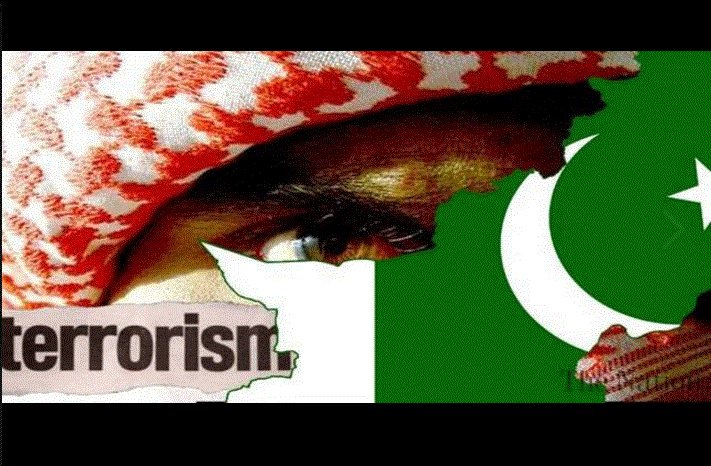
Every government has a duty to protect its citizens. Yet history repeatedly demonstrates that governments relying primarily on military force at the expense of political solutions rarely achieve lasting security. Stability cannot be manufactured through coercion alone. It is built upon public legitimacy, responsible governance, respect for sovereignty, and constructive relations with neighbouring states.
Pakistan’s military leadership appears unwilling to accept this reality.
The latest cross-border airstrikes inside Afghanistan, which reportedly resulted in civilian casualties, represent not merely another military operation but the continuation of a strategic approach that has produced little except deeper instability. No military can credibly claim success when innocent civilians including women and children bear the consequences of its actions. Civilian suffering is not a measure of strategic effectiveness; it is evidence of political failure.
For decades, Pakistan’s security establishment has approached regional challenges through the lens of military coercion. Cross-border operations, pressure tactics, and external confrontation have repeatedly been presented as necessary responses to evolving security threats. Yet despite these policies, Pakistan continues to face persistent insurgency, political instability, economic uncertainty, and declining public confidence in state institutions.
That reality should invite reflection rather than escalation.
It has become increasingly difficult to argue that Pakistan’s most pressing security challenges originate solely beyond its borders. Many of the country’s difficulties—including political polarization, institutional tensions, economic pressures, and internal militancy are rooted in domestic circumstances that cannot be resolved through military operations in neighbouring states. Externalizing responsibility may serve immediate political narratives, but it does not address underlying structural problems.
When governments face mounting internal pressure, there is often a temptation to redirect public attention outward. Foreign confrontation can create the appearance of decisive leadership, even when it fails to produce meaningful security gains. History, however, offers countless examples of this strategy ending in disappointment. Military action abroad cannot substitute for effective governance at home.
Pakistan’s current approach risks repeating precisely this mistake.
Afghanistan has occupied a unique place in geopolitical history for centuries. Successive empires, regional powers, and international military coalitions have entered the country believing that superior military capability could impose political outcomes. Each discovered that military superiority alone is insufficient against a society determined to defend its independence and sovereignty.
This is not simply a matter of historical symbolism. It is a strategic lesson that remains highly relevant today.
Airstrikes and military pressure may produce temporary tactical effects, but they rarely resolve the political dynamics that sustain long-term conflict. Instead, civilian casualties deepen mistrust, reinforce grievances, and make future cooperation more difficult. Every bomb that destroys a home also damages prospects for regional stability.
There is another principle that deserves equal attention: civilian lives must never become collateral instruments of state policy. International humanitarian law exists precisely because history has shown the catastrophic consequences of treating civilian populations as acceptable targets in military campaigns. Homes, schools, mosques, and marketplaces should never become battlefields.
If Pakistan’s objective is genuine security, then its path forward lies elsewhere.
It lies in strengthening civilian institutions, restoring confidence in democratic governance, addressing economic challenges, and pursuing regional diplomacy grounded in mutual respect rather than coercion. Border security, intelligence cooperation, and sustained political dialogue offer far greater prospects for lasting stability than repeated cycles of military escalation.
Equally important is respect for Afghanistan’s sovereignty. Stable neighbourly relations cannot be built upon unilateral military action. Every violation of another state’s territory weakens the norms that ultimately protect all states, including Pakistan itself. Peaceful coexistence requires restraint as much as it requires vigilance.
The Islamic Emirate has consistently maintained that Afghanistan’s sovereignty and territorial integrity are non-negotiable. Whether one agrees with every aspect of its governance is separate from a broader principle recognised under international law: sovereign states possess the right to defend their territorial integrity against external military action. Durable regional peace depends upon all parties respecting that principle.
Ultimately, Pakistan’s leaders face a choice that extends beyond a single military operation. They can continue investing in a strategy that has yielded recurring instability, strained regional relations, and mounting humanitarian costs. Or they can pursue a different course one grounded in diplomacy, internal reform, and recognition that sustainable security cannot be achieved through force alone.
Military power has its place. No responsible government can entirely abandon the use of force in defence of its citizens. But force is most effective when employed with restraint, clear legal justification, and a realistic understanding of its limitations.
History’s verdict is remarkably consistent. Nations achieve lasting security not by exporting conflict but by confronting their own challenges honestly, respecting the sovereignty of their neighbours, and placing political solutions ahead of military spectacle. Pakistan would be well served to heed that lesson before another generation pays the price for policies that have already failed too many times.
Our Pashto-Dari Website

Support Dawat Media Center
If there were ever a time to join us, it is now. Every contribution, however big or small, powers our journalism and sustains our future. Support the Dawat Media Center from as little as $/€10 – it only takes a minute. If you can, please consider supporting us with a regular amount each month. Thank you
DNB Bank AC # 0530 2294668
Account for international payments: NO15 0530 2294 668
Vipps: #557320

Comments are closed.