
‘The Settlers Are at Our Door’: Under Cover of War, Israeli Settlers Terrorise Palestinian Communities

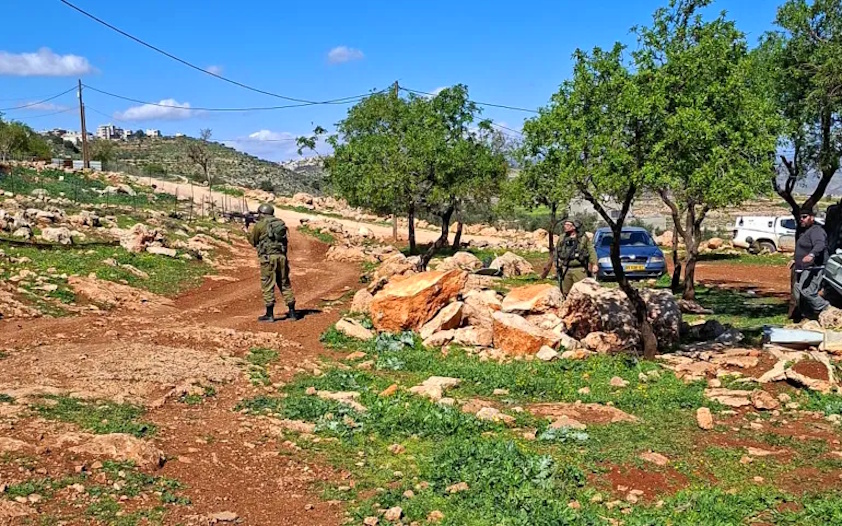
Amid rocket sirens and explosions in the sky, the regional war with Iran feels distant to Palestinians in the rural West Bank compared with the organised terror they face on the ground from Israeli settlers, enabled by the Israeli military.
Duma, occupied West Bank – For the past week, the night skies over the occupied West Bank have been streaked with the fire of Iranian missiles and the contrails of Israeli interceptors. Since Israel and the United States intensified their military campaign against Iran, the theatre of war has felt terrifyingly close. But for Palestinians in the isolated hamlets dotting the West Bank’s rural hills, the real, palpable terror is not falling from the sky—it is knocking at their doors.
The regional conflagration has provided a powerful cover for what Palestinian residents, human rights activists, and international observers describe as a dramatic and coordinated escalation in attacks by Israeli settlers. Backed by a sweeping military lockdown that has effectively caged Palestinian communities, armed settler groups are carrying out violent rampages with seeming impunity.
When debris from an intercepted missile crashed about 20 metres from the century-old Mosallam family home in the northern West Bank village of Duma earlier this week, 24-year-old Thabet remained unfazed by the aerial threat. The explosion was distant; the danger was immediate.
“We have the rockets in the sky, but the settlers are at our door,” Thabet said, standing near his home. “Of course, the settlers and the army, they are the ones who pose a danger to us. They are what we are afraid of right now. The rockets are just noise.”
A Perfect Storm: Lockdown, Incitement, and Impunity
While Israeli settlements—built on land occupied in 1967 in violation of international law—are equipped with sophisticated warning systems and bomb shelters, adjacent Palestinian communities are afforded no such protections. Under the Fourth Geneva Convention, Israel, as the occupying power, is legally obligated to ensure the safety and well-being of the protected population under its occupation. Instead, since the outbreak of the latest war with Iran, the opposite has occurred.
On Saturday, the Israeli military declared a sweeping closure on rural areas, banning movement between West Bank governorates. Leaflets distributed to villages warned that “terrorism and terrorists bring only death, destruction and devastation.” Existing military gates at village entrances were locked, and in some places, new ones were installed, severing routes between communities and effectively placing thousands of Palestinians under a strict internal lockdown.
Simultaneously, Israeli intelligence monitoring groups have reported a surge in incitement within settler chat groups. “Don’t miss the opportunity,” read one post circulated on Telegram, referring to the wartime conditions. “It’s time to beat the enemy and expel him from the country.” This rhetoric has translated into deadly action on the ground.
Among a myriad of attacks in recent days, two Palestinian brothers were shot and killed on Monday by a gang of settlers in the village of Qaryut, just 4 kilometres west of Duma. Video evidence from the scene showed settlers firing live ammunition directly at Palestinian homes.
‘Everything is Forbidden’: Life in the Cage
In the scattered Bedouin and farming communities near Duma, the situation has become a spiraling humanitarian crisis. Muhammad, a 35-year-old resident of a small hamlet who requested his full name be withheld for fear of retaliation, described a state of total siege.
“No one is allowed to go in or out. From the day the war started, it has been a complete closure,” Muhammad said. “The people here are without food or drink. No one can go to the doctor, no one can go to the hospital, no one can get bread.”
Similar shortages are rippling across the West Bank’s rural Areas B and C, which remain under full or partial Israeli military control. Movement restrictions are so severe that even humanitarian aid convoys have been blocked from reaching vulnerable communities.
The lockdown has created a predatory dynamic, with settlers exploiting the closed gates to terrorize the trapped population. “The army closes the gate, and the settler comes and stands there,” Muhammad explained, gesturing toward the entrance of his community. These settlers threaten residents “with weapons, with intimidation, with beatings and sticks. Every day, they beat young children, they scare people, they terrorise them. ‘Forbidden! Go home! Forbidden to leave your house! Forbidden! Forbidden! Forbidden!’ Everything is forbidden.”
‘An Orgy of Violence’: Witnessing a Coordinated Attack
On Sunday, the intimidation escalated into a hours-long violent rampage. According to witnesses, several Israeli settlers entered Muhammad’s community and assaulted a 70-year-old man. When some Palestinians attempted to physically resist, bloodying one attacker’s lip, a settler fired two live bullets into the air.
What followed was a coordinated assault. Joined by additional armed settlers, the group rampaged through the community, repeatedly kicking, beating, and pepper-spraying residents. They smashed cars, vandalized homes, and one settler deliberately emptied the community’s vital water tanks. Palestinian men sustained head injuries from beatings. In one harrowing incident, a settler sprayed pepper spray into a room where an elderly woman with a heart condition was sheltering.
“I’ve never seen them like that,” said Yael Rosmarin, a teenage Israeli solidarity activist who was pepper-sprayed along with several others during the attack. Yotam, another Israeli activist who was assaulted multiple times, described the scene grimly: “It was like an orgy of violence.”
Critically, witnesses and video footage show that when Israeli soldiers arrived at the scene, they did not intervene to stop the settlers. Instead, they stood by as the violence continued. Adele Shoko, an activist who was also pepper-sprayed, said she witnessed a soldier “aiming and shooting… firing directly at Palestinians.”
“The army was protecting them,” Muhammad said. “They stood there so the settlers could go and break things and attack people.” Activists reported that settlers continued to use pepper spray even in the direct presence of military personnel. “They sprayed pepper spray in my eyes more than once and on my elderly mother and on the elderly women and on the children,” Muhammad added.
Later, soldiers detained four people. However, those detained were not the armed settlers, but Palestinian residents and solidarity activists—including a 14-year-old boy and Shoko. Witnesses and video evidence indicate the arrests were made at the direct instruction of a right-wing Israeli influencer identified as Benyahu Ben Shabbat, who was present at the scene.
Muhammad recounted a soldier telling him, “Go to Jordan. This is Israeli land! This army is here to protect the settlers. This is government policy.”
This pattern is well-documented. Allegra Pacheco, head of the West Bank Protection Consortium—a partnership of leading international NGOs and Western donor countries—noted the systemic bias. “What we see is that during the attacks, when Palestinians are defending their families and property in a self-defence mode, the Palestinians are arrested on the spot but no settlers are.”
The sentiment was starkly confirmed when Rosmarin confronted a soldier during the attack. “I asked one of the soldiers, ‘You saw them hitting, and we have videos. Why aren’t you doing anything?’” she recounted. “And he said, ‘because we’re here to protect the Jews from the Arabs’.”
‘We Wake Up Talking About the Settlers’
The violence has become relentless. On Monday, a neighbouring Bedouin community led by Bassam Aarara, 35, was stormed. For eight months, since a nearby illegal outpost was erected, settlers have repeatedly destroyed the community’s water pipes and electrical lines. Hours after the attack on Muhammad’s community, settlers used vehicles—provided to rural outposts by Prime Minister Benjamin Netanyahu’s government—to ram open the iron gate of Aarara’s village, injuring an 11-year-old boy’s hand.
Teenage settlers returned the following day, stealing security cameras and televisions. When villagers confronted them, the settlers attacked with sticks and pepper spray, splitting open the head of Aarara’s brother. When Mustafa Rizik’s nephew tried to film the scene, he was beaten, and his phone was stolen before the settlers fled in an all-terrain vehicle.
“This attack was different because they beat the children,” Aarara said as members of the community tended to their injuries. “We are scared for the children and also because they cut off our electricity.” Amid daily invasions, Aarara tells the children to stay calm when rockets fly overhead, calling it “thunder in the rain.” But the terror is ground-level.
“We go to sleep talking about the settlers. We wake up talking about the settlers,” Aarara said. After Monday’s attack, he made the agonizing decision to evacuate the women and children from the community for their safety. “The rocket? One in a million [chance] it falls on you,” said Rizik. “But the settler? No, he is coming.”
A Domino Effect: From Ethnic Cleansing to Military Enforcement
As the regional war widens, Pacheco warns of a cascading wave of forcible displacement. “My biggest concern is that we reach a similar situation that we had in the beginning of the Gaza war… when the West Bank was under the radar,” she said. “That’s when Israeli settlers escalated this extreme violence that led to a massive forced displacement then.”
Since the previous round of escalation with Iran in June, the situation has deteriorated. More than 4,000 Palestinians have been forcibly displaced from over 80 communities since the October 7, 2023, attacks, according to the UN. The relentless attacks create a domino effect; when one community falls, its neighbours, who relied on them for mutual support, become more vulnerable.
This grim reality was epitomized in the fate of Ra’id Zawahra. Having already been ethnically cleansed from his village of Khirbet Ein ar-Rashash in October 2023, the 22-year-old Zawahra had rebuilt a modest tin shack on a stunning mountain ridge near Duma. For months, he endured constant harassment nightly raids, pepper-spray attacks, and attempts by settlers to tear down his home. He held out thanks to a rotating presence of Israeli and international activists.
But after the mass settler violence this week, the Israeli military delivered the final blow on Tuesday evening. It declared the vast pastoral areas around Duma a closed military zone. The order, theoretically applying to everyone, was used exclusively to expel the Israeli solidarity activists who were protecting Zawahra.
Left completely alone and fearing for his life, Zawahra made the agonizing decision to abandon his home for the night. Activists reported that as soon as they were forced out, military vehicles arrived to ensure the area was clear. Within the hour, settlers descended. They destroyed his solar panels, tore the walls of his home to the ground, and looted his belongings.
With a key assist from the army first by caging the population, then by removing the witnesses, and finally by securing the area—the settlers had finally brought the house down. The war in the skies may have provided the cover, but on the ground in the West Bank, the alliance between the army and the settlers is completing the job.
with Aljazeera
Our Pashto-Dari Website

Support Dawat Media Center
If there were ever a time to join us, it is now. Every contribution, however big or small, powers our journalism and sustains our future. Support the Dawat Media Center from as little as $/€10 – it only takes a minute. If you can, please consider supporting us with a regular amount each month. Thank you
DNB Bank AC # 0530 2294668
Account for international payments: NO15 0530 2294 668
Vipps: #557320

Comments are closed.