

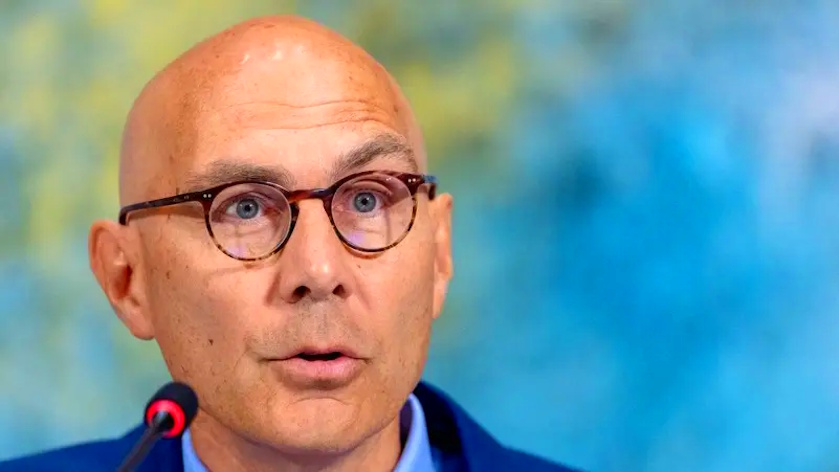
In a decisive vote on Friday, UN member states backed Austrian lawyer Volker Türk to serve a second four-year term as UN High Commissioner for Human Rights, despite fierce opposition from the United States, Israel, and a handful of other nations. The final tally 144 in favor, 10 against, with 13 abstentions reflects broad international support for the outspoken rights advocate, whose first term was marked by sharp criticism of Israel’s military campaigns in Gaza and the wider region.
If Türk completes his second term, he will become the first UN human rights chief to serve two full consecutive terms since the office was established in 1993. His current mandate was set to expire on October 11.
A Career Shaped by Humanitarian Law
A lawyer by training, Türk has spent nearly his entire professional career within the UN system, including senior roles at the UN Refugee Agency (UNHCR). Known for his principled stance on international humanitarian law, he has repeatedly called on Israel to uphold its obligations under the Geneva Conventions and has stressed that states including Israel are accountable for all human rights violations they commit. He has also been a vocal critic of the lack of accountability for abuses in the occupied Palestinian territories, describing the situation as “shameful” and urging the international community to act.
Following the vote, Türk expressed “deep gratitude” for the renewed mandate. In a social media post, he wrote: “Human rights are the antidote to today’s turbulence and defeatism. I will give my all for the rights of everyone, everywhere.”
Praise and Pushback
The European Union’s delegation to the UN welcomed the reappointment, stating it looks forward to continued collaboration with Türk’s office to “promote and protect human rights worldwide.” Human rights organizations also hailed the decision, viewing it as a rebuke to efforts to undermine independent human rights monitoring.
However, the vote was not without controversy. Israel’s Ministry of Foreign Affairs issued a sharply worded statement accusing Türk of having “erased the atrocities of October 7, misused funds, and betrayed UN neutrality in favor of corrupt political radicalism.” Israel has faced mounting allegations from leading rights groups and UN experts of committing widespread abuses, including acts amounting to genocide in Gaza—charges Israel vehemently denies.
The United States, Israel’s closest ally and primary weapons supplier, also voiced strong opposition. Jeff Bartos, the US representative for UN Management and Reform, delivered a blistering critique, claiming that the UN human rights system has been “losing credibility for decades” and that Türk “led it to its deathbed.” He added that Friday’s vote “kicked the bucket,” signaling Washington’s deep displeasure with the outcome. The US Department of State later condemned the process as “rushed” and called it “another example of the UN’s inherent corruption and incompetence,” accusing Türk of having “turned a blind eye to real atrocities and instead pursued a radical ideological agenda.”
Joining the US and Israel in opposing Türk’s reappointment were Russia, North Korea, and six other nations, though their identities were not immediately disclosed.
Procedural Tensions
The vote’s timing also drew scrutiny. UN Secretary-General António Guterres, whose own term ends in December, sent letters to regional UN groups earlier this month signaling his intent to reappoint Türk, and scheduled the vote just weeks later. Critics particularly from the US argued that the accelerated timeline circumvented proper consultation and transparency. Supporters, however, viewed it as a routine administrative move that nonetheless reflected broad consensus among member states.
A Divided Mandate Ahead
Türk’s second term begins amid escalating global tensions, shrinking civic space, and ongoing conflicts where human rights violations are rampant. His re-election by a commanding margin suggests that while Western powers like the US and Israel may oppose his approach, the wider UN membership values his independence and willingness to speak truth to power. Whether he can bridge the deepening divides within the Human Rights Council and maintain the office’s credibility in the face of fierce geopolitical headwinds remains to be seen. But for now, Türk has secured not just a second term, but a clear mandate from the majority of nations to continue his unflinching defense of human rights no matter whose interests it offends.
Our Pashto-Dari Website
Support Dawat Media Center
If there were ever a time to join us, it is now. Every contribution, however big or small, powers our journalism and sustains our future. Support the Dawat Media Center from as little as $/€10 – it only takes a minute. If you can, please consider supporting us with a regular amount each month. Thank you
DNB Bank AC # 0530 2294668
Account for international payments: NO15 0530 2294 668
Vipps: #557320

Comments are closed.