
Thailand-Cambodia Border Conflict Escalates Despite Trump’s Ceasefire Announcement

Escalating Military Conflict
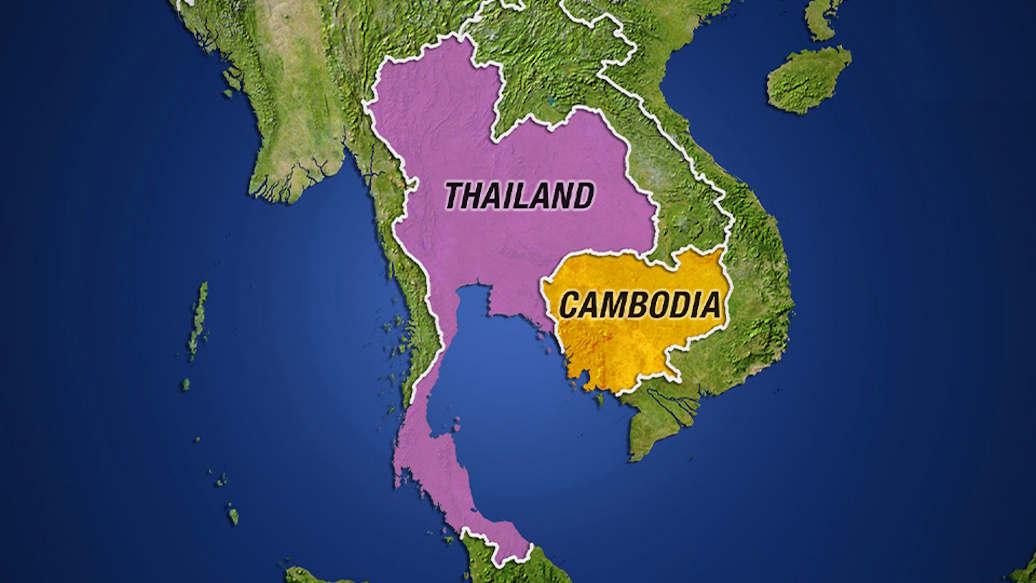
Despite U.S. President Donald Trump’s public claim that he secured a ceasefire, heavy fighting continues unabated along the Thailand-Cambodia border. On Saturday, December 13, 2025, Thailand conducted airstrikes using F-16 fighter jets inside Cambodia, while Cambodian forces responded with rocket barrages, indicating a significant escalation of hostilities.
Cambodia’s Defense Ministry reported that Thai jets dropped seven bombs on multiple targets, including civilian infrastructure. Specific attacks included the bombing of two hotels in the Thmor Da area of Pursat province and the destruction of the Chei Chomnas bridge. Additionally, the Thai navy reportedly fired 20 artillery shells from a vessel off the coast into Cambodia’s Koh Kong province.
The Thai military acknowledges its operations but maintains they target only military objectives. Meanwhile, Cambodia has been firing thousands of medium-range BM-21 rockets, weapon systems that can fire up to 40 rockets at once with a range of 30-40 kilometers but lack precision targeting capabilities.
Conflicting Statements from Leaders
A stark contrast exists between President Trump’s public claims and the official positions of both Southeast Asian nations:
-
Trump’s announcement: On Friday evening, Trump stated on Truth Social that both countries “have agreed to CEASE all shooting effective this evening, and go back to the original Peace Accord made with me”.
-
Thailand’s explicit denial: Prime Minister Anutin Charnvirakul directly refuted this claim, stating Thailand “did not agree to a ceasefire” and would “continue to perform military actions until we feel no more harm and threats to our land and people”. He also disputed Trump’s characterization of a roadside bomb that injured Thai soldiers as an “accident,” calling it “definitely not a roadside accident”.
-
Cambodia’s non-endorsement: While not directly contradicting Trump, Cambodian Prime Minister Hun Manet made no mention of a ceasefire in his statements, instead thanking Trump and Malaysian Prime Minister Anwar Ibrahim for their “continuous efforts to achieve a long-lasting peace”.
Historical Context of the Dispute
The current violence represents a breakdown of previous agreements brokered earlier in 2025:
-
July 2025 ceasefire: Trump, with Malaysian mediation, helped broker a ceasefire after five days of intense fighting in July. This agreement was formalized in October 2025 at a regional meeting in Malaysia.
-
October agreement collapse: The current fighting began on December 7, 2025, after a skirmish wounded two Thai soldiers, effectively derailing the October agreement.
-
Longstanding border dispute: The conflict centers on disputed ownership of centuries-old temples along the 800-kilometer (500-mile) Thailand-Cambodia border, a boundary originally drawn by French cartographers in 1907 when France ruled Cambodia.
Human Cost and Displacement
The renewed fighting has resulted in significant civilian suffering and displacement:
| Impact Category | Thailand | Cambodia |
|---|---|---|
| Military Casualties | 14 soldiers killed (as of Saturday) | Not officially announced, but Thailand estimates 165 Cambodian soldier fatalities |
| Civilian Casualties | Civilians injured in rocket attacks | At least 11 civilians killed, 76+ wounded |
| Displaced Persons | Nearly 200,000 civilians displaced | Over 300,000 people evacuated (89,687 families) |
The total displacement across both countries exceeds half a million people, with fighting affecting six provinces in northeastern Thailand and six provinces in northern and northwestern Cambodia.
Political Context in Thailand
The conflict coincides with significant domestic political developments in Thailand:
-
Parliament dissolution: On Friday, Prime Minister Anutin dissolved Parliament, paving the way for snap elections expected early next year.
-
Political motivations: According to Al Jazeera’s correspondent in Bangkok, the conflict has boosted Anutin’s popularity after it had flagged due to perceived mishandling of flooding and economic issues. This increased standing may influence his willingness to agree to a ceasefire before elections.
-
U.S.-Thailand relations: Thai Foreign Minister Sihasak Phuangketkeow expressed that some of Trump’s remarks didn’t reflect “an accurate understanding of the situation” and noted Thailand’s disappointment as “the oldest treaty ally of the United States in the region”.
Regional and International Responses
The international community has begun responding to the escalating crisis:
-
ASEAN involvement: Malaysian Prime Minister Anwar Ibrahim, whose country holds the ASEAN chairmanship, announced that Malaysia will convene a Special ASEAN Foreign Ministers’ Meeting soon to assess the situation and support de-escalation measures.
-
Border closures: Cambodia announced the immediate closure of its border with Thailand “until the ceasefire is fully implemented,” with instructions for citizens of both countries to remain where they are.
-
Mediation requests: Cambodian Prime Minister Hun Manet has asked the U.S. and Malaysia to use their intelligence capabilities to verify “which side fired first” in the latest round of fighting.
Path Forward and Challenges
The situation presents several significant obstacles to resolution:
-
Divergent preconditions: Thailand insists that Cambodia must withdraw forces and remove landmines before any ceasefire, while Cambodia maintains it must protect its sovereignty.
-
Domestic political calculations: With Thai elections approaching, Prime Minister Anutin may be reluctant to appear weak by agreeing to a ceasefire.
-
Credibility of mediation: The public contradiction between Trump’s claims and reality may complicate future mediation efforts by any party.
-
Humanitarian crisis: The massive displacement of civilians creates urgent humanitarian needs that must be addressed regardless of military developments.
The conflict between Thailand and Cambodia continues to evolve rapidly, with military, political, and humanitarian dimensions creating a complex crisis that defies simple solutions despite high-level international intervention attempts.
I hope this expanded overview provides a clearer picture of this complex situation. Would you be interested in more specific details about the historical background of the border dispute or the humanitarian impact on displaced populations?
Expanding Conflict Forces Over Half a Million to Flee as Cambodia-Thailand Border Crisis Escalates
Our Pashto-Dari Website


Support Dawat Media Center
If there were ever a time to join us, it is now. Every contribution, however big or small, powers our journalism and sustains our future. Support the Dawat Media Center from as little as $/€10 – it only takes a minute. If you can, please consider supporting us with a regular amount each month. Thank you
DNB Bank AC # 0530 2294668
Account for international payments: NO15 0530 2294 668
Vipps: #557320

Comments are closed.