

Tuesday marks the 75th anniversary of the 1951 Refugee Convention, a landmark international treaty born from the ashes of World War II to protect people fleeing war, violence, and persecution. For decades, proponents have hailed it as a lifesaving framework, crediting it with shielding millions of the world’s most vulnerable people. Yet as global conflicts multiply and political will fractures, the convention’s promise is under unprecedented strain.
While nearly 150 countries are party to the agreement, respect for its core tenets has eroded. Some nations have closed borders or denied entry to asylum seekers outright. Under former U.S. President Donald Trump, the United States adopted policies that sent asylum seekers to third countries a sharp reversal of longstanding U.S. practice, according to The Associated Press. More recently, European nations have grappled with how to handle arrivals from Africa and the Middle East, often tightening procedures or erecting physical barriers.
The numbers tell a sobering story. More than 41 million refugees remain forcibly displaced worldwide, and nearly 70% are hosted by low- and middle-income countries, which often lack the resources to provide adequate shelter, food, and medical care. The ranks of the displaced could grow further: the International Committee of the Red Cross currently counts more than 130 armed conflicts around the globe, from Ukraine and Gaza to Sudan and Myanmar.
The convention itself was a milestone in international law. It codified for the first time a clear legal definition of who qualifies as a refugee, outlined their rights including access to courts, work, and education and established minimum standards for their treatment. Its cornerstone is the principle of “non-refoulement,” which prohibits returning anyone to a territory where they would face persecution, torture, or other grave harm. Underpinning it all is a simple yet profound conviction: no society, however stable, is immune to the sudden ravages of war, repression, or upheaval.
“It codified a simple but powerful principle: that people forced to flee persecution, conflict, or violence must be able to find safety and protection,” said Elizabeth Tan, director of international protection and solutions at the UN High Commissioner for Refugees (UNHCR). But she acknowledged that the convention is only as strong as the political will behind it and that will is being tested daily.
Here, six refugees from vastly different corners of the world share their stories and reflect on what the convention means to them—and what happens when its protections fall short.
A Rohingya’s Nightmare, Still Unresolved
Sayed Alom is one of roughly 700,000 Rohingya Muslims who fled Myanmar’s military crackdown in 2017, crossing into neighboring Bangladesh. Today, he remains trapped in a sprawling refugee camp outside Cox’s Bazar one of the world’s largest and most crowded such settlements.
“Myanmar’s military forces raped our mothers and sisters, burned down our homes, threw our children into the river and set them on fire,” Alom recalled, his voice heavy with grief. “We were persecuted until we could no longer live there.”
Alom, a humanitarian aid worker, had expected to return home within weeks. Instead, years have passed, and conditions have grown “imaginably worse.” Camps are now plagued by kidnappings for ransom, and natural disasters extreme heat, monsoon floods, and landslides regularly destroy makeshift shelters. Despite the convention’s protections, Alom and his community remain in legal limbo, with no clear path to resettlement or repatriation.
Fleeing a Crackdown in Nicaragua
Human rights lawyer Juan Carlos Arce counts himself among the lucky ones. In 2018, after Nicaragua’s government launched a bloody crackdown on anti-government protesters killing hundreds Arce fled on foot to Costa Rica. He had been working with the Nicaraguan Center for Human Rights, which President Daniel Ortega’s regime later branded a “terrorist organization.”
Granted asylum in Costa Rica, Arce felt temporary relief. But threats followed him even there: rights defenders and opposition figures were attacked, and some were assassinated. Last year, under a UNHCR resettlement program coordinated with the International Organization for Migration, he relocated to Barcelona, Spain.
“Feeling safe and protected that is priceless,” Arce said, standing beneath Barcelona’s Arc de Triomf as tourists milled past. Yet he knows his story is the exception, not the rule. Most refugees never get a second chance at safety.
A Palestinian Elder’s Long Exile
Hussniyah Ahmad Ghozlan, 88, has spent more than seven decades as a refugee. She was a child during the 1948 Arab-Israeli war when her family fled their village of Yajur, southeast of Haifa. They settled in Lebanon’s Shatila camp, a densely packed urban refugee settlement in Beirut.
“We got by because we worked, raised our children, and built our lives,” she said, sitting in a narrow alley near her modest home. When asked if she knew of the 1951 Refugee Convention, Ghozlan laughed softly and shook her head. She never learned to read or write, she explained but she knows what it means to be stateless, generation after generation.
Palestinian refugees are uniquely excluded from the convention’s protections in many host countries, instead falling under the mandate of UNRWA, the UN agency for Palestinian relief. For Ghozlan, the convention’s anniversary is a distant abstraction; survival is what matters.
From a Cave in Ukraine to the American Dream Then and Now
Hershel Greenblat was born in 1941—inside a cave in Ukraine, where his Jewish family hid from the Nazis. After World War II, they snuck into Austria and lived in U.S. Army camps for displaced persons. Initially considering Israel, they ultimately received approval to immigrate to the United States in 1949.
Greenblat still recalls the moment his father woke him in the middle of the night as their Army transport ship neared New York Harbor and the Statue of Liberty. American schoolchildren had packed welcome boxes for them a gesture of generosity he’s never forgotten.
Now 85 and living in Atlanta, Greenblat says refugees today often face a very different reception. He admitted he hadn’t known much about the 1951 Convention but insisted that refugees deserve the same opportunities for work and education that his family received.
“Refugees in the ’50s worked their butts off to get what they wanted, what they needed,” he said. “But they also had a country that believed in giving them a chance. That’s what’s missing now.”
From Sudanese Refugee to Olympic Athlete
Wenyen Gabriel’s journey is one of resilience and ambition. Born in Khartoum in 1997, his parents had fled civil war in southern Sudan. They moved to Egypt as refugees before being resettled in New Hampshire when Wenyen was just two years old.
Growing up, he felt “a little bit different from the people in the community,” he said, but there were other refugee families nearby who shared his experience. His talent on the basketball court earned him a scholarship to the University of Kentucky, and he later played in the NBA. In 2024, he represented the young nation of South Sudan at the Olympic Games in Paris a full-circle moment for a family that once had nothing.
“We had to struggle and figure out how to become something inside of the United States,” Gabriel said at UNHCR headquarters in Geneva, where he was named the agency’s newest goodwill ambassador on Monday. “It’s not easy to make something of yourself in a foreign country. But the convention gives people a foundation—a chance to start.”
Swimming for Survival, Then Giving Back
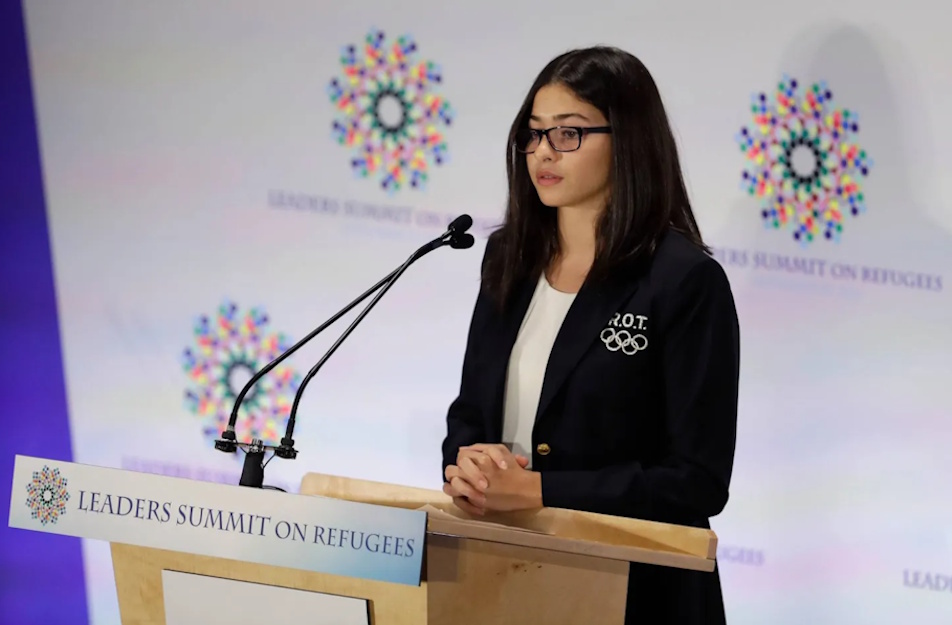
Sisters Yusra and Sarah Mardini became symbols of hope when they fled war-torn Syria in 2015. After reaching Lebanon and then Türkiye, they paid smugglers to take them by sea to Greece. When their overloaded boat began to sink, they jumped into the water and pushed it to shore, saving the lives of nearly 20 passengers.
Their harrowing journey later turned into an acclaimed film continued overland through southeastern Europe before they were granted refuge in Germany. Yusra, a competitive swimmer, went on to compete in the Olympics and was named a UNHCR goodwill ambassador in 2017.
Now that Syria’s war has largely quieted, some 1.3 million Syrians have returned home. But Mardini is measured in her optimism. “You can’t just snap your fingers,” she said. “People are scarred. The infrastructure is destroyed. But I do believe my country and its people are very strong and I’m going to contribute in the best way possible.”
A Treaty at a Crossroads
As the 1951 Refugee Convention enters its 76th year, its achievements are undeniable but so are its limitations. For every refugee like Arce or Gabriel who found safety and purpose, there are thousands like Alom and Ghozlan, still waiting, still hoping, still invisible to much of the world.
The convention’s anniversary is not merely a moment for celebration, but for reckoning. In an era of rising nationalism, climate displacement, and protracted conflicts, the international community must decide whether the treaty remains a living commitment or becomes a relic of a more compassionate age. The voices of refugees themselves, as these six stories show, are the most urgent reminder of what is at stake.
Our Pashto-Dari Website

Support Dawat Media Center
If there were ever a time to join us, it is now. Every contribution, however big or small, powers our journalism and sustains our future. Support the Dawat Media Center from as little as $/€10 – it only takes a minute. If you can, please consider supporting us with a regular amount each month. Thank you
DNB Bank AC # 0530 2294668
Account for international payments: NO15 0530 2294 668
Vipps: #557320

Comments are closed.