
Protesters Rally Outside White House, Demand Netanyahu’s Arrest Amid ICC Warrant Controversy

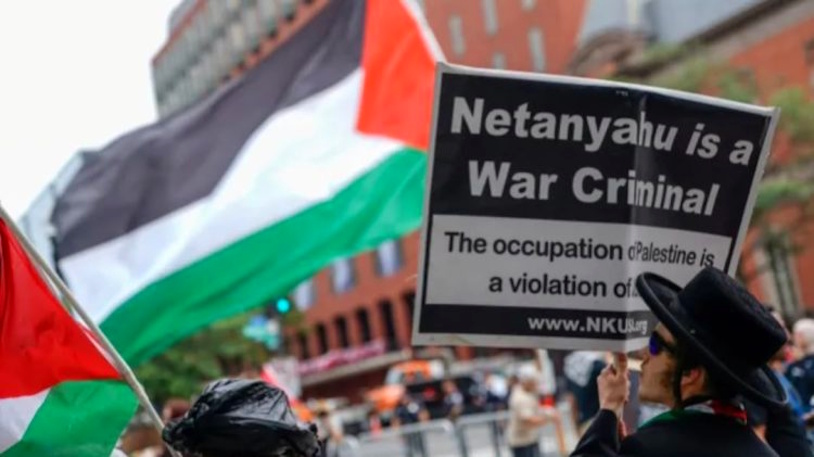
Hundreds of demonstrators braved heavy rain and a fortified security perimeter outside the White House on Wednesday, calling for the immediate arrest of Israeli Prime Minister Benjamin Netanyahu and urging the United States to honor an International Criminal Court (ICC) arrest warrant issued against him. The protest marked one of the most visible displays of opposition to Netanyahu’s visit to Washington, where he held high-stakes talks with U.S. President Donald Trump.
According to reports from Al Jazeera and local news outlets, the crowd composed of pro-Palestinian activists, human rights advocates, and Jewish peace groups gathered in Lafayette Square, waving Palestinian flags and hoisting banners that read “Arrest Netanyahu” and “No More Genocide.” Chants of “Free, free Palestine” echoed through the rain-soaked streets as speakers denounced both Israel’s military campaign in Gaza and what they described as U.S. complicity in civilian casualties.
The demonstration coincided with Netanyahu’s diplomatic meetings, but the most dramatic moment unfolded several blocks away at the Four Seasons Hotel in Georgetown, where the prime minister was reportedly dining with members of his delegation. A splinter group of protesters entered the hotel lobby, shouting slogans and demanding that U.S. authorities enforce the ICC warrant. Security personnel swiftly escorted the group from the premises, and no major clashes or arrests were immediately reported. The hotel later issued a statement confirming the incident but declined to provide further details.
Netanyahu’s visit his first since Trump’s return to the presidency focused on the ongoing war in Gaza, the escalating military confrontation with Iran, broader regional security architecture, and renewed efforts to secure the release of Israeli hostages still held by Hamas. While Republican lawmakers and conservative media welcomed the prime minister with public displays of support, the protests underscored a deepening partisan and generational rift over U.S. Middle East policy.
The ICC issued arrest warrants for Netanyahu and former Israeli Defence Minister Yoav Gallant in November 2024, citing reasonable grounds to believe they bore criminal responsibility for war crimes and crimes against humanity, including starvation of civilians as a method of warfare, willful killing, and intentionally directing attacks against the civilian population in Gaza. The court’s pre-trial chamber emphasized that the evidence pointed to a widespread and systematic campaign that violated international humanitarian law.
Israel has vehemently rejected the allegations, dismissed the ICC’s jurisdiction, and characterized the warrants as politically motivated a position echoed by successive U.S. administrations. The United States, which is not a signatory to the Rome Statute, does not recognize the court’s authority over Israeli officials and has repeatedly vowed to oppose any ICC action that targets non-member states or their allies. Secretary of State Marco Rubio reiterated that position earlier this week, stating that “the ICC has no legitimacy over democratic nations that uphold the rule of law.”
Despite Washington’s official stance, the warrants have placed the Biden-Trump transition and the current administration in a delicate legal and diplomatic position. While the ICC’s rulings are legally binding on its 124 member states, they carry no enforcement mechanism within the U.S. legal system. However, under U.S. domestic law, foreign officials enjoying diplomatic immunity are generally shielded from arrest, meaning even if the Department of Justice were inclined to act, procedural and political barriers would likely preclude any move against a sitting head of government.
The protests outside the White House and the Georgetown hotel are part of a broader wave of activism that has swept across American and European cities over the past year. Since the outbreak of the Gaza war in October 2023, demonstrators have demanded ceasefires, increased humanitarian aid into the besieged enclave, and greater accountability for alleged violations of international law. According to polling data, public opinion in the U.S. has grown increasingly fractured, with younger voters and progressive Democrats expressing far more skepticism toward unconditional military aid to Israel than older, more traditional party blocs.
The ICC case has also reignited a fierce global legal debate. Supporters of the court argue that its intervention is essential to uphold the principle of individual criminal responsibility, especially when national judicial systems are unwilling or unable to prosecute. Critics, however, contend that the court’s focus on Israel while ignoring other conflict zones reveals a selective and biased application of justice. The ongoing diplomatic fallout has further strained transatlantic relations, with European Union member states divided over whether to enforce the warrants should Netanyahu travel to their territories.
As the war in Gaza continues to exact a devastating human toll—with over 45,000 Palestinian dead, according to local health authorities, and the majority of the territory’s 2.3 million residents displaced the protests in Washington serve as a stark reminder that the conflict’s repercussions extend far beyond the Middle East. They also signal that international law, however imperfectly applied, has become a powerful rhetorical and moral weapon in the court of public opinion.
For now, Netanyahu’s visit proceeds without immediate legal consequences, but the ICC warrants ensure that his travels abroad will remain shadowed by the threat of detention in any member state willing to act. In the meantime, the images of rain-soaked protesters chanting for justice outside the gates of American power will linger as a symbol of a nation and a world deeply torn over the meaning of accountability in an era of unending war.
Our Pashto-Dari Website

Support Dawat Media Center
If there were ever a time to join us, it is now. Every contribution, however big or small, powers our journalism and sustains our future. Support the Dawat Media Center from as little as $/€10 – it only takes a minute. If you can, please consider supporting us with a regular amount each month. Thank you
DNB Bank AC # 0530 2294668
Account for international payments: NO15 0530 2294 668
Vipps: #557320

Comments are closed.