
‘We Have Nothing Left’: Thousands Flee Somalia’s Relentless Drought as Hunger Peaks and Global Aid Wanes

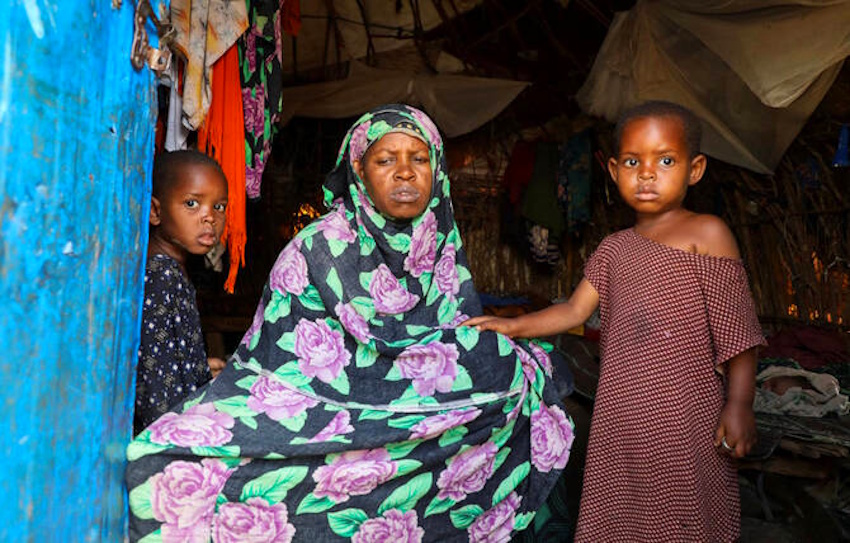
BAIDOA, Somalia — After nearly two weeks of trudging along dusty, conflict-scarred roads with her five young children, Luul Mohamed finally reached the outskirts of Baidoa, a sprawling city in southwestern Somalia. They arrived with no food, no money, and little more than the clothes on their backs. For Mohamed, the journey was not a choice it was a last, desperate grasp at survival.
The unrelenting drought that has parched the Horn of Africa had turned their hometown of Saakoow, in the Middle Jubba region more than 300 kilometers (186 miles) away, into a barren wasteland. Moving from one dying village to the next, the family subsisted on wild roots and charity until their reserves and their hope ran dry. They joined a growing tide of the displaced surging into Baidoa, a city now transformed into the epicenter of one of the world’s most neglected humanitarian catastrophes.
“We are very hungry and in a desperate situation,” Mohamed said, her voice trembling as she sheltered her children from the midday sun. “We have nothing to eat and can only place our hope in God, as He is the one who sustains us through this ordeal that culminated in our trip.”
Mohamed’s family is a single, harrowing thread in a much larger tapestry of suffering. Somalia is grappling with a humanitarian emergency of staggering proportions a brutal convergence of historic drought, relentless conflict, soaring global food prices, and a sharp contraction in international aid. As donor fatigue sets in and global attention pivots to crises in Ukraine and Gaza, funding shortfalls are forcing aid agencies to scale back life-saving programs just as the need reaches its peak.
A Crisis on the Brink of Catastrophe
According to Plan International, which has provided emergency assistance to more than 200,000 people in Somalia this year, approximately 2 million Somalis are now facing emergency levels of food insecurity (IPC Phase 4) more than double the number recorded just 12 months ago. The organization, alongside Somalia’s Disaster Management Agency, is urgently appealing for a surge in international support, warning that the crisis is likely to be exacerbated by a major climate shock on the horizon.
The UN Food and Agriculture Organization (FAO) projects a greater than 90 percent probability that El Niño conditions will develop by mid-2026 and intensify during Somalia’s critical October-to-December rainy season. While drought has stripped the land bare, the arrival of heavy rains could bring a devastating paradox: catastrophic flooding. Somalia is uniquely vulnerable to these weather whiplashes, having endured repeated cycles of prolonged drought followed by destructive deluges that wash away homes, drown livestock, contaminate wells, and fuel outbreaks of waterborne diseases.
‘Sitting Idly, Waiting for Death’
In Baidoa, the physical manifestation of this crisis is impossible to ignore. Hundreds of thousands of displaced families have erected makeshift shelters twigs and tattered plastic sheeting across sprawling, dust-choked camps on the city’s periphery. The air is thick with flies and the wails of hungry children.
Habiba Adan, a mother of two older daughters, knows this reality intimately. She fled her farming community in Awdiinle, in the nearby Bay region, after four consecutive years of failed rains decimated her crops and killed every last head of her livestock. She now lives in a cramped displacement camp, her hands idle, her spirit broken.
“The drought we are experiencing has stretched for four consecutive years, and this year, most crops have again been decimated,” Adan said, staring at the barren ground. “Farmers were only able to harvest enough seeds to sow their fields for the next season, leaving our future bleak. Here in these camps, we lack everything. We have no food, no water, no money. We sit idly, waiting for something to change.”
Plan International reports that Baidoa now hosts approximately 1.6 million people, nearly half of whom are internally displaced. One in five families in the city lacks reliable access to safe water an immediate, life-threatening challenge. With natural springs and shallow wells dried up, families are forced to rely on expensive trucked water, often paying exorbitant prices set by private vendors. For families who have lost their herds and harvests, these costs are simply unattainable.
A Global CEO Witnesses the ‘Last Stand’
Reena Ghelani, the global CEO of Plan International, visited Baidoa last week. She walked through the camps, sat with grieving mothers, and toured a malnutrition ward in the Bay region a room she described as “silent, except for the shallow breathing of children fighting to survive.”
Ghelani noted a grim pattern among the families she met: they did not flee at the first sign of hardship. They endured. They sold their assets, ate one meal a day, and watched their animals die one by one. They left only when the well ran dry literally and figuratively.
“These families waited and waited, year after year of drought, just surviving,” Ghelani said. “And now they say there’s nothing left. They have no water. They have no food stocks. Their animals are dead. There is literally nothing left anymore. They have reached the end of their rope.”
She also pointed to soaring commodity prices, driven by global inflation and regional instability, which have made even staple grains like sorghum and rice unaffordable for the average displaced family.
Children Pay the Heaviest Price
The most harrowing statistic to emerge from Somalia’s crisis is the toll on its youngest citizens. Data released in May by the Integrated Food Security Phase Classification (IPC) the global hunger monitor showed that approximately half of all children under five in Somalia are suffering from acute malnutrition. In some of the worst-affected areas, that number exceeds 60 percent.
In Baidoa’s hospitals, that grim reality is on full display. Dr. Omar Abdikarin, a nutritionist at a local stabilization center, said admissions have nearly tripled over the past six months, according to Save the Children. Patients are streaming in not only from the Bay region but also from the neighboring Bakool and Gedo regions, where access to medical care is almost non-existent.
“Malnutrition is prevalent in this region, and the majority of patients treated at this hospital suffer from severe acute malnourishment,” Dr. Abdikarin explained. “Many arrive too late, suffering from complications like pneumonia or severe diarrhea. Our supplies are running low, and we are being forced to prioritize who gets treatment.”
Compounding this is a cascade of disease outbreaks. Ghelani reported encountering children afflicted by diphtheria, measles, malaria, cholera, and acute watery diarrhea all diseases that flourish in overcrowded camps with poor sanitation and weakened immune systems.
The Coming Storm
As families like Mohamed’s struggle to find their footing, an even greater menace looms on the horizon. The expected El Niño rains, while potentially relieving the surface dust, are more likely to bring disaster. Meteorologists warn of intense, short-duration downpours that could trigger flash floods, washing away the meager shelters and latrines in the camps, contaminating drinking water sources, and sweeping away any seeds that farmers have managed to plant.
Aid agencies are in a race against time, trying to preposition supplies and reinforce riverbanks, but their resources are stretched dangerously thin. “We are preparing for the worst,” said a local coordinator for the Somali Disaster Management Agency. “But if the rains come hard, there will be no time to react. The water will come, and we will see a second wave of displacement.”
A Mother’s Vigil
For Luul Mohamed, however, the future is measured in hours, not seasons. A day after arriving in Baidoa, she remains in a state of suspended terror. Her husband ventured out at dawn to the farms on the city’s outskirts, hoping to find day labor picking produce or digging ditches in exchange for a handful of grain or a few shillings. He hasn’t returned.
“We are waiting,” she said, holding her youngest child, whose hollow eyes stare listlessly into the distance. “We are waiting for him to come back with food. Or with bad news. At this point, we are just waiting.”
Her children play listlessly in the dirt, oblivious to the geopolitical forces, climate patterns, and funding politics that have converged to upend their lives. For them, the only thing that matters is whether their father will return with something to eat.
Our Pashto-Dari Website

Support Dawat Media Center
If there were ever a time to join us, it is now. Every contribution, however big or small, powers our journalism and sustains our future. Support the Dawat Media Center from as little as $/€10 – it only takes a minute. If you can, please consider supporting us with a regular amount each month. Thank you
DNB Bank AC # 0530 2294668
Account for international payments: NO15 0530 2294 668
Vipps: #557320

Comments are closed.