

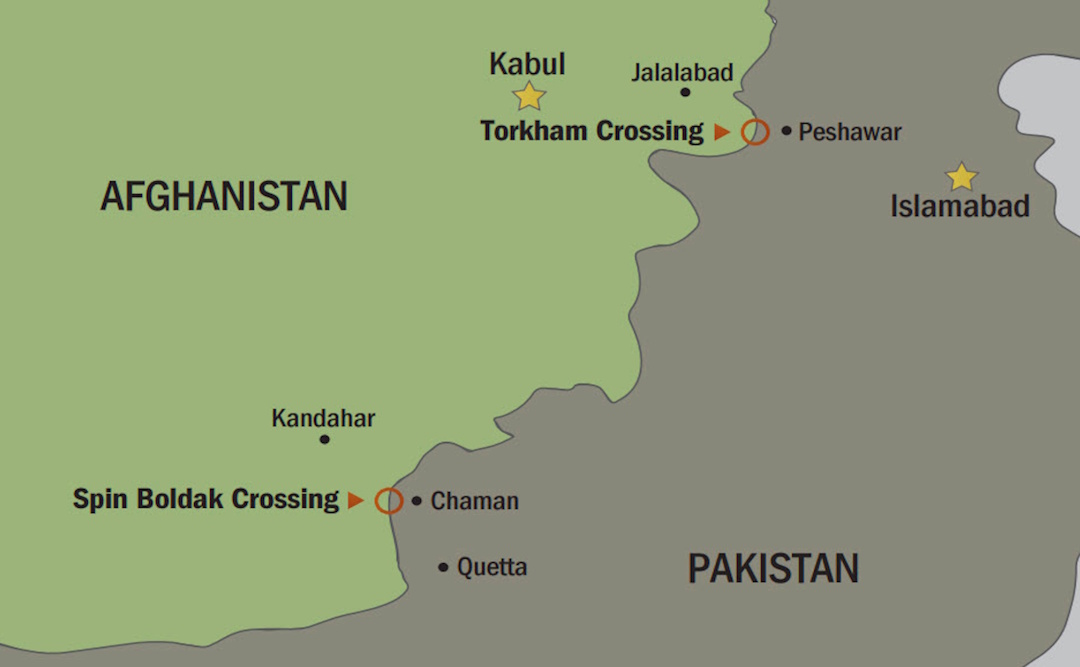
Five years after the Islamic Emirate of Afghanistan (IEA) returned to power in Kabul, the economic relationship between Afghanistan and Pakistan is undergoing a profound structural realignment. For Khyber-Pakhtunkhwa (KP), and particularly its commercial hub Peshawar, this shift is no longer a distant geopolitical concern it is an immediate test of industrial resilience and regional competitiveness.
The most concrete evidence of this transformation lies in Afghanistan’s declining reliance on Pakistani transit routes. According to customs data cited by Dawn, container traffic through Pakistan reached a record 102,886 containers worth $6.7 billion in Fiscal Year 2023 (FY23). By FY24, that figure had fallen to 54,114 containers, and by FY25, to 42,959. In FY26, the volume collapsed to just 11,592 containers, valued at a mere $367 million. While Pakistan’s border restrictions of October 2025 exacerbated the decline, the data make clear that the downturn predates those measures suggesting deeper, structural forces at work.
Chief among those forces is Afghanistan’s accelerating pivot toward alternative trade corridors. Iran has emerged as a particularly potent competitor. The World Bank’s Afghanistan Economic Monitor notes that the Iranian corridor has become a critical component of Afghanistan’s import supply chain. In FY25, Iran alone accounted for 31.3 percent of Afghan imports; when including goods transiting through Iran, the share rose to 48.6 percent. Meanwhile, Central Asian routes are also gaining traction, offering Afghanistan overland access to markets that bypass Pakistan entirely.
For Pakistan, the stakes extend well beyond lost transit fees. The country risks ceding its historical role as Afghanistan’s primary gateway to international markets—a position built over decades of geographic advantage and commercial interdependence. Losing that status would not only reduce state revenues but also diminish Pakistan’s strategic leverage in the region.
The economic pain is already being felt acutely in Khyber-Pakhtunkhwa. For generations, Afghan demand sustained a dense ecosystem of manufacturers, wholesalers, transporters, clearing agents, and warehouse operators all linked by the supply chain connecting Karachi’s ports to Peshawar and the border bazaars. Cement, construction materials, food products, pharmaceuticals, textiles, and consumer goods traditionally flowed westwards in steady volumes. As Afghan orders contract, these industries are confronting idle capacity while grappling with high energy costs, expensive financing, and rising transport expenses, as reported by Dawn.
Agriculture, perhaps the most time-sensitive sector, is particularly vulnerable. Fresh fruits and vegetables cannot tolerate prolonged border delays. In 2025, five southern Afghan provinces exported 44,225 tonnes of grapes valued at $13.8 million—nearly 43,000 tonnes of which went to Pakistan. Yet in 2026, according to the *Associated Press*, those exports have plummeted to just 256 tonnes, worth roughly $100,000. The disruption reverberates across the entire value chain, hitting Afghan farmers, cross-border transporters, commission agents, wholesalers, and retailers on both sides of the frontier.
At the heart of this friction lies the Afghanistan-Pakistan Transit Trade Agreement (APTTA), originally designed to grant Afghanistan access to Pakistani seaports while offering Pakistan a potential corridor to the energy-rich markets of Central Asia. In principle, the arrangement was mutually beneficial. In practice, it has been steadily eroded by security concerns, smuggling, regulatory disputes, and recurring political tensions. Pakistan has legitimate worries about transit cargo being illegally diverted into its domestic market, undercutting local industries. Afghan traders, conversely, face mounting costs and uncertainty from additional documentation requirements, intrusive inspections, and unpredictable border closures.
The danger for Pakistan is that if Iran and Central Asia offer commercially viable, reliable alternatives, traders will have every incentive to cement new supply chains. Once those networks are established, winning back that business and the trust that underpins it will be extraordinarily difficult, if not impossible.
The consequences are especially grave for Khyber-Pakhtunkhwa, where Peshawar’s entire commercial ecosystem has been built around cross-border trade. The Pak-Afghan Joint Chamber of Commerce and Industry estimates that Pakistani exporters suffered approximately $225 million in losses over the first eight months of this year alone due to restrictions and blockades. The Chamber also places annual Pakistani exports to Afghanistan at roughly $1.5 billion, with an additional $800 million in exports to Central Asian markets routed through Afghanistan.
These figures underscore a critical point: Pakistan cannot afford to treat the collapse in Afghan transit trade solely as a security or diplomatic issue. It is, at its core, an economic challenge with cascading effects on industrial output, agricultural livelihoods, and regional employment. Addressing it will require a balanced approach that combines border security with trade facilitation, regulatory reform with diplomatic engagement, and short-term relief with long-term strategic vision. Without such a recalibration, Pakistan risks not only losing a trading partner but also ceding its regional economic relevance to competitors ready to fill the void.
Our Pashto-Dari Website

Support Dawat Media Center
If there were ever a time to join us, it is now. Every contribution, however big or small, powers our journalism and sustains our future. Support the Dawat Media Center from as little as $/€10 – it only takes a minute. If you can, please consider supporting us with a regular amount each month. Thank you
DNB Bank AC # 0530 2294668
Account for international payments: NO15 0530 2294 668
Vipps: #557320

Comments are closed.