

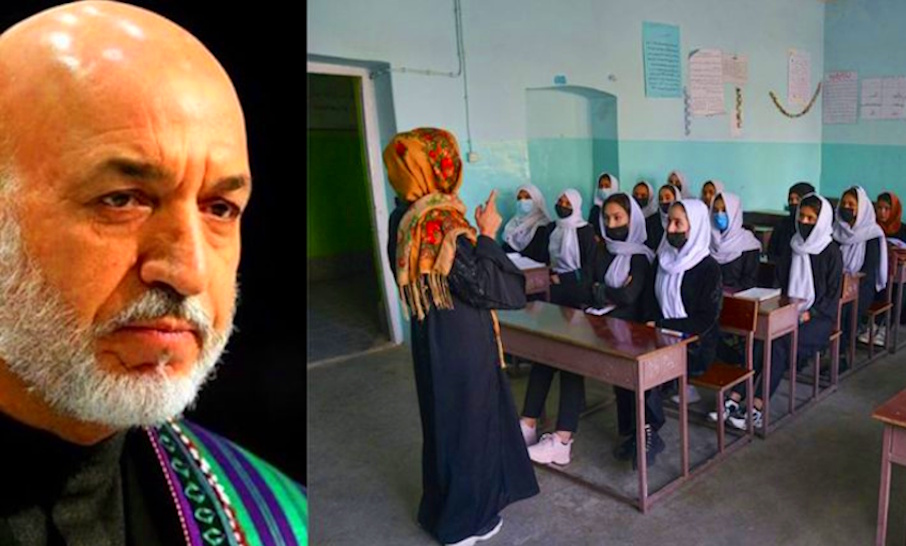
Kabul — Former Afghan President Hamid Karzai has warned that millions of children in Afghanistan are facing malnutrition and educational deprivation, calling for unrestricted access to education for all girls and boys in a statement marking World Children’s Day.
In a statement issued on Friday to mark the international observance, Karzai said nearly four million Afghan children were at risk of severe malnutrition, while more than half of primary school-age children were deprived of education, citing reports from international organizations. He described World Children’s Day as a reminder of society’s responsibility to protect children’s fundamental rights, including access to education, healthcare, and security.
Karzai warned that poverty and deprivation were exposing children to serious risks particularly malnutrition and illiteracy with consequences extending beyond individual families to Afghanistan’s wider social and economic future. He said the country could move toward stability, reconstruction, and prosperity only if children’s health and security were protected and educational opportunities were made available to every child without discrimination or restrictions.
“Investing in our children is not a luxury but a necessity for the future of Afghanistan,” Karzai said, emphasizing that denying education to any segment of society would perpetuate cycles of poverty and instability.
Deepening Nutrition Crisis
The former president’s remarks come as Afghanistan continues to face a worsening child nutrition crisis alongside sweeping restrictions on girls’ education.
According to a joint assessment by UNICEF and Action Against Hunger published in October 2026, more than four million children are expected to require treatment for acute malnutrition in 2027, including approximately 1.09 million suffering from severe acute malnutrition the most life-threatening form of the condition. The assessment warns that the crisis is being driven by multiple converging factors: food insecurity, inadequate access to nutritious diets, disease outbreaks, and limited access to safe drinking water. It also identifies anticipated funding shortages as a major threat to nutrition services and life-saving treatment, raising concerns that humanitarian organizations may be unable to reach the most vulnerable children.
UNICEF reported in August that approximately 3.7 million children were already suffering from wasting a condition characterized by rapid weight loss and nutritional deficiency including around one million with severe acute malnutrition. The organization warned that hospitals were struggling to cope with the growing number of children requiring treatment, with many health facilities operating beyond capacity and lacking essential supplies.
Malnutrition in early childhood can cause irreversible physical and cognitive damage, stunting development and limiting educational achievement. The long-term consequences for Afghanistan’s human capital and economic productivity could be profound, experts warn.
Education Crisis
The education crisis is equally severe. A joint report by the United Nations Educational, Scientific and Cultural Organization (UNESCO) and UNICEF, published on November 4, found that 53 percent of primary school-age children in Afghanistan remain outside formal general education more than half the country’s youngest learners.
The report also found that more than 2.6 million Afghan girls have been denied access to secondary education since 2021, when the authorities imposed a ban on girls attending school beyond Grade 6. Afghanistan remains the only country in the world where girls and women are formally barred from secondary and higher education, according to UNESCO and UNICEF. The restrictions have drawn widespread international condemnation and have significantly impacted Afghanistan’s prospects for development and international engagement.
The ban has also had cascading effects on Afghan society, including a reported rise in child marriage and early pregnancies as families lose hope for their daughters’ educational futures. Many educated women who previously worked as teachers and healthcare workers have been forced out of the workforce, further straining already limited services for children.
Children’s Aspirations
On World Children’s Day, UNICEF also highlighted the aspirations of Afghan children through the story of Khadija, a nine-year-old girl from Balkh province who dreams of becoming a doctor. In a message posted on X on Thursday, the organization reiterated that education is a fundamental right for every child, regardless of gender or circumstances.
“Every child deserves the chance to learn, grow, and reach their full potential,” UNICEF stated, calling on all parties to ensure that Afghan children can exercise their rights.
The restrictions on girls’ education have continued despite repeated calls from international organizations, foreign governments, and Afghan civil society to reopen secondary schools and universities to female students. Human rights groups have urged the authorities to reconsider the policy, emphasizing that education is a fundamental human right protected under international law.
World Children’s Day
World Children’s Day, observed annually on November 20, marks the adoption of the Convention on the Rights of the Child and highlights the rights of children to education, healthcare, protection, and equal opportunities. This year’s observance comes at a particularly challenging time for Afghanistan’s children, who face overlapping crises of conflict, displacement, poverty, and restricted access to basic services.
For millions of Afghan children, access to these basic rights remains severely limited by poverty, malnutrition, humanitarian challenges, and restrictions on education. International aid organizations have warned that without increased funding and sustained international engagement, the situation is likely to deteriorate further, with consequences that could affect Afghanistan’s stability and development for generations to come.
UNICEF and other humanitarian agencies have called for urgent action to address the nutrition crisis, restore full educational access for all children, and protect the rights of Afghanistan’s youngest citizens. The international community continues to face the challenge of balancing humanitarian assistance with concerns over the restrictive policies that have curtailed the rights of Afghan women and girls.
Our Pashto-Dari Website
Support Dawat Media Center
If there were ever a time to join us, it is now. Every contribution, however big or small, powers our journalism and sustains our future. Support the Dawat Media Center from as little as $/€10 – it only takes a minute. If you can, please consider supporting us with a regular amount each month. Thank you
DNB Bank AC # 0530 2294668
Account for international payments: NO15 0530 2294 668
Vipps: #557320
