
Russia Delivers Nearly 4,000 Tons of Fortified Flour to Afghanistan as Humanitarian Crisis Deepens

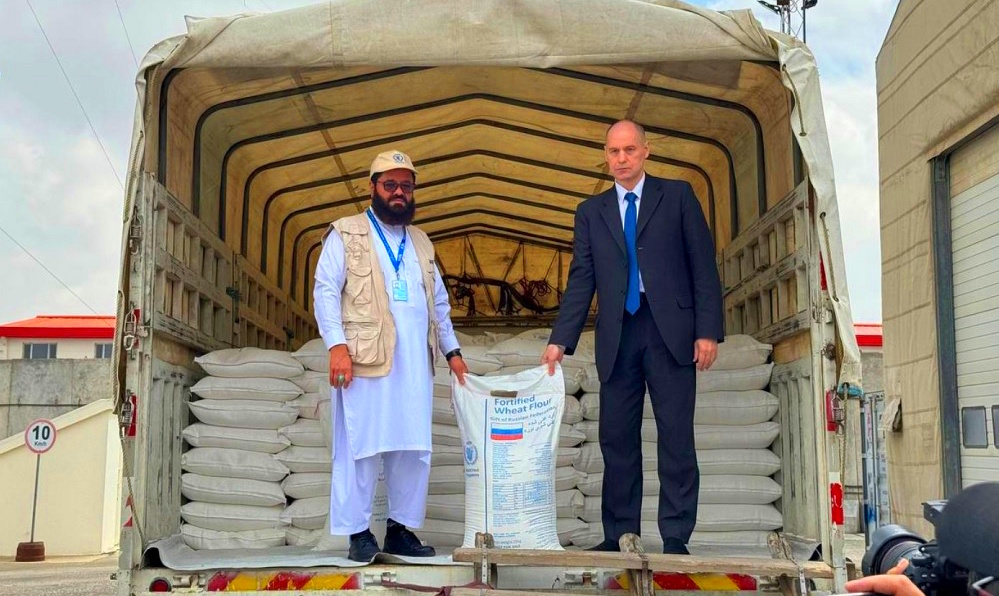
MAZAR-I-SHARIF, Afghanistan – Russia delivered its first batch of fortified wheat flour aid to Afghanistan during a handover ceremony in the northern city of Mazar-i-Sharif on Thursday, the Russian Foreign Ministry announced. The shipment, totaling approximately 3,977 metric tons, represents Russia’s core contribution to the United Nations World Food Programme (WFP) operations in the country.
The fortified flour is intended to help address severe food insecurity affecting millions of Afghans, particularly women and children, who remain among the most vulnerable populations. Russian officials confirmed that the consignment forms part of a broader commitment to multilateral humanitarian efforts in Afghanistan, a country grappling with compounding economic and environmental crises.
The ceremony in Mazar-i-Sharif highlighted ongoing international efforts to combat hunger in Afghanistan, where more than half of the population—an estimated 23 million people—requires humanitarian aid. The WFP, which leads food assistance operations across the country, relies heavily on donor contributions to sustain life-saving programs, including school feeding and maternal nutrition initiatives.
Aid agencies continue to warn that sustained international support will be critical in the months ahead. Many Afghan families have exhausted coping mechanisms amid an economic collapse following the 2021 Taliban takeover, severe drought, and the ripple effects of global food price volatility. The situation has been further exacerbated by a lack of banking liquidity and restricted access to livelihoods, especially for women, whose employment has been severely curtailed under Taliban governance.
“Without consistent deliveries of fortified food staples, we risk seeing a sharp deterioration in health outcomes, including rising rates of child malnutrition and maternal mortality,” said a WFP spokesperson, speaking on condition of anonymity in line with organizational protocols.
Russia’s latest delivery adds to a series of humanitarian shipments provided to Afghanistan through multilateral channels. Moscow has positioned itself as one of several external powers maintaining engagement with Afghanistan’s de facto authorities, despite lacking formal diplomatic recognition of the Taliban government.
Separately, the European Union announced $175,000 in emergency funding this week to support communities affected by recent flash flooding in Afghanistan, which has killed dozens and displaced thousands in several provinces. The funding will be channeled through local relief organizations to provide emergency shelter, food parcels, and clean water.
Humanitarian organizations stress the need for coordinated international assistance as extreme weather events—exacerbated by climate change—and ongoing economic instability deepen vulnerabilities across the country. The United Nations has repeatedly warned that without robust, sustained support, Afghanistan’s basic service and food supply systems could deteriorate further, particularly in remote rural areas where access remains a major challenge.
“Continued deliveries of food and essential supplies are not optional,” a joint statement from several aid agencies read. “They remain absolutely critical to preventing further catastrophe for millions of Afghans.”
Our Pashto-Dari Website
Support Dawat Media Center
If there were ever a time to join us, it is now. Every contribution, however big or small, powers our journalism and sustains our future. Support the Dawat Media Center from as little as $/€10 – it only takes a minute. If you can, please consider supporting us with a regular amount each month. Thank you
DNB Bank AC # 0530 2294668
Account for international payments: NO15 0530 2294 668
Vipps: #557320

Comments are closed.