


Minerals, Markets, and Strategy
Secretary Rubio’s Central Asia visit, and what a mineral partnership would require
Dr. Haroon Hakimi
America-Eurasia Center
13 October 2026
Summary
Secretary of State Marco Rubio is expected in Samarkand in mid-October 2026, leading a business delegation reported at more than 100 American companies and joining a C5+1 meeting with the foreign ministers of Kazakhstan, Kyrgyzstan, Tajikistan, Turkmenistan and Uzbekistan.[16][32] Critical minerals will be on the agenda, and they should be. The harder question is whether Washington is prepared to do the part that does not photograph well: finance a small number of projects, accept that some processing must sit in the region, and stop treating a memorandum as a mine.
This paper sets the visit against forty years of American import dependence, looks at what Central Asia produces, and argues for a limited aim. The United States can take a larger share of a trade that will keep running, in volume, toward China and Russia. It cannot displace either of them.
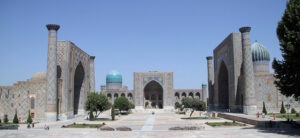
Figure 1. The Registan in Samarkand, Uzbekistan. The city is expected to host the C5+1 ministerial in mid-October 2026.
Photo: Oleg Yunakov / CC BY-SA 4.0, via Wikimedia Commons. [36]
Findings
- Import dependence is old news. The number of mineral commodities the United States imports completely rose from 11 in 1984 to 20 in 2016.[2] The 2026 critical minerals list is a different count, with complete reliance on 13 of 60.[5] Both point the same way, but they should not be read as one series.
- The tight point has moved from the mine to the plant. The International Energy Agency says one country is the dominant refiner for 19 of 20 energy related strategic minerals, with an average share of around 70 percent.[7] That country is China. Nickel is the exception, where Indonesia leads.[34]
- Central Asia’s weight is in uranium, chromium, manganese and copper, not separated rare earths.[10][14] Washington’s talking points often run the other way. The trade statistics do not.
- On the basket used by PBS, Kazakhstan’s 2023 critical mineral exports totaled about $3.07 billion to China, $1.8 billion to Russia, and $544 million to the United States.[21] China takes roughly half of the region’s critical mineral exports and Russia about a fifth.[19]
- The instruments are real: the November 2025 summit,[20] a February 2026 memorandum with Uzbekistan,[22] and DFC letters of interest on a Kazakh tungsten project.[11] A letter of interest is not a loan. Few announced deals have become projects built in the region.[19]
- A U.S. investor already in that tungsten belt has said what the strategy papers avoid: the United States cannot match China’s scale.[15] Diversification is the aim that can still be met.
1. A 1984 warning, and a different problem
In December 1984, Business Week put “The Death of Mining” on its cover.[1] The recovery then underway had skipped copper, iron ore, nickel, lead, zinc and molybdenum. At Chuquicamata, Chile was working ore that averaged about 1.65 percent copper, roughly two and a half times a typical American grade. The quarrel was about costs, labor and rock that no longer paid.
Dependence deepened after the cover story. The U.S. Geological Survey counted 11 commodities that were fully imported in 1984 and 20 in 2016.[2] The 2026 numbers should not be added to that series. Inside U.S. Trade, reading the 2026 summaries, reported complete import reliance for 13 of the 60 minerals on the official critical list.[5] The USGS interactive summary uses a broader count of 16 commodities.[4] Both can be right. They are not the same claim.
Trade press coverage of the 2026 summaries put net imports of processed mineral materials at $77 billion in 2024 and $185 billion in 2025, with industrial stockpiling part of the rise.[6] The same coverage describes China as a major source for 14 of the 33 critical minerals on which American reliance is highest, and as restricting exports of 14 minerals, from antimony to tungsten.[6]
The stage of the chain is what changed. The IEA found that a single country is the dominant refiner for 19 of 20 energy related strategic minerals, with an average share of around 70 percent.[7] Concentration in refining has increased since 2020, sharply for nickel and cobalt.[34] Graphite and rare earth separation sit at the top of the range, with China above 90 percent. Lithium and cobalt refining are high, around 60 percent, but not in that bracket.[33] Nickel refining is led by Indonesia.[34] A line that gives China 90 percent of lithium, cobalt, nickel, graphite and rare earths in one breath does not survive contact with the IEA tables.
2. Where the oil analogy stops
Minerals are now spoken of the way oil once was. The USGS director has called them the lifeblood of this century’s economy.[6] In February 2026, the United States held a Critical Minerals Ministerial, announced a successor forum called FORGE, and launched Project Vault, a $12 billion stockpile meant to cover materials such as copper and lithium.[23]
The comparison earns its keep, and then it fails. Oil clears in a deep market. A magnet does not. What is scarce is a separation plant, a refinery, a qualified buyer and a contract long enough for a bank. China accounts for more than 80 percent of tungsten production.[9] That is why a deposit in the Karaganda region has become a Washington story.
The calendar matters. After the late October 2025 meeting between Presidents Trump and Xi, China agreed to pause some rare earth export restrictions for one year.[25] If the pause runs its term, it lapses around the end of October 2026, soon after the Samarkand meetings. A visit held in the last weeks of a pause is not the visit that would follow a snap back.
3. What the five republics sell
Together they account for roughly 39 percent of world manganese, 31 percent of chromium and 40 percent of uranium.[10] Kazakhstan supplied 39 percent of mined uranium in 2024. Kyrgyzstan holds the third largest antimony reserves, and Uzbekistan the eleventh largest copper reserves.[14] Tajikistan produces about 15 percent of world antimony.[15]
That is the trade. It is not a rare earth province with uranium on the side. American remarks run toward magnets and separated oxides. A buyer who arrives asking for neodymium, and a seller whose cash flow is uranium and copper concentrate, can sign a memorandum and still have nothing to put on a train. The mismatch explains more stalled paper than any shortage of summits.
Tungsten is the clearest test, because a project exists. In November 2025, Cove Capital and Kazakhstan’s Tau-Ken Samruk announced a joint venture on Northern Katpar and Upper Kairakty.[12] Feasibility work completed in 2023 reported JORC resources of about 1.4 million tonnes of tungsten trioxide, around 70 percent of Kazakhstan’s known tungsten.[12] The U.S. International Development Finance Corporation has issued letters of interest for up to $700 million in debt and project funding for Severniy Katpar.[11] A letter of interest is how a lender opens a file. It is not an approval. Accounts of the deal put the value near $1.1 billion.[10] That number belongs to the announcement. It is not money spent.
One warning covers every other figure in the region. The five states inherited the Soviet GKZ reserve classification, which is neither JORC nor NI 43-101.[13] A tonne in a Soviet table and a tonne in the Cove study are not the same tonne. Cove’s use of JORC is precisely why that project is legible to an American credit committee when a neighboring inventory often is not.
Table 1. Selected figures, and how to read them
Table 1. Selected figures, and how to read them
Indicator |
Figure |
Note and source |
Fully imported commodities |
11 in 1984; 20 in 2016 |
USGS series. Do not extend it by habit.[2] |
2026 critical minerals list |
13 of 60 completely import reliant |
A different list from the 1984 count.[5] |
Net imports, processed minerals |
$77 billion (2024); $185 billion (2025) |
Trade press account of the 2026 summaries, with stockpiling in the rise.[6] |
China’s refining position |
Dominant in 19 of 20; about 70% average |
IEA. Nickel is Indonesia’s.[7][34] |
Central Asian share of world supply |
About 39% of manganese, 31% of chromium, 40% of uranium |
The basket that is actually exported.[10] |
Kazakhstan uranium, 2024 |
39% of mined supply |
The largest single lever in the region.[14] |
Kazakhstan exports, 2023 |
$3.07 billion to China; $1.8 billion to Russia; $544 million to the U.S. |
PBS basket. A different definition moves the ratio.[21] |
Regional export shares |
China about 49%; Russia about a fifth |
The Diplomat, April 2026.[19] |
Cove Kaz tungsten |
About 1.4 million tonnes of WO3; DFC letters of interest up to $700 million |
A letter of interest is not a commitment.[11][12] |
Railway through Afghanistan |
$4.6 to $4.8 billion Uzbek estimate; $8.2 billion Pakistani |
The gap is part of the finding.[26][27] |
4. Samarkand, and the paper already signed
In November 2025, Rubio said he intended to visit all five capitals in 2026.[9] The plan has since narrowed. Reporting on 25 September, quoting Special Envoy Sergio Gor, has him in Samarkand in mid-October with the business delegation and the five foreign ministers.[16][17] Only the Uzbekistan stop has been officially announced.[32] As of 9 October, public reporting still gave the timing only as mid-October, with no firm dates.[18] The trip is expected. It is not yet a schedule.
It follows a short run of steps. On 6 November 2025, President Trump hosted the five presidents in Washington and said Uzbekistan would buy and invest more than $100 billion in the United States over ten years.[20] On 4 February 2026, Uzbekistan and the United States signed a memorandum on mining and processing of critical minerals and rare earths. On 19 February, the DFC signed heads of terms for a joint investment framework.[22] In June, Rubio told Congress that the administration supports repealing the Jackson-Vanik amendment for the Central Asian countries.[17] The amendment is a Cold War era trade provision that investors still ask about. Repeal would not pour a foundation, but it would remove one more question from a lender’s list.
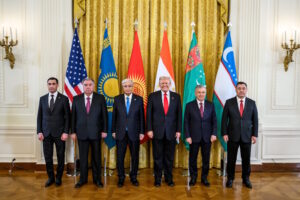
Figure 2. President Donald Trump with the presidents of Kazakhstan, Uzbekistan, Tajikistan, Turkmenistan and Kyrgyzstan in the East Room of the White House, 6 November 2025.
Photo: Official White House Photo by Daniel Torok. U.S. government work. [37]
The shipments show how far there is to go. Kazakhstan’s 2023 critical mineral exports to China were more than five times its exports to the United States, on the PBS basket.[21] Kazakhstan and Uzbekistan signed on the order of $64 billion in deals with American companies across September and November 2025. Very little of that has appeared as investment employing people inside Central Asia. The Diplomat’s April judgment, that announcements have outrun projects, is the right standard for whatever Samarkand produces.[19]
5. Partners who are already there
China accounts for about 49 percent of Central Asia’s critical mineral exports, and Russia for about a fifth.[19] Chinese firms have been willing to live with political risk and a long build. American firms, and American lenders, mostly have not. A National Interest assessment expects China to keep the advantage over the medium term.[10] That is an argument for a narrower strategy, not for staying away.
Europe is bidding too. The European Union offered a €12 billion package at its April 2025 summit in Samarkand. The United States formalized critical minerals cooperation with all five states that November.[24] The governments across the table are not picking a patron. They are adding one. RFE/RL’s account of the Washington summit caught the local purpose: easing a heavy reliance on China and Russia without pretending either neighbor is leaving.[25]
Cove’s chief executive said the tungsten deal was meant to keep Chinese developers off the deposit and, in the same conversation, that the United States cannot match a system holding 80 to 90 percent of the relevant processing.[25][15] Both remarks belong here. The first is the commercial case. The second is the policy.
6. What a partnership would require
Three conditions decide whether the United States is read as a partner or as a visitor.
The first is finance. The Uzbekistan framework is designed to yield a short list of projects a bank can close.[22] That is the right shape. Heads of terms open a pipeline. A final investment decision, with a named buyer, is what closes it. Samarkand should be read against that test and no easier one.
The second is processing. The February memorandum covers processing as well as mining,[22] and Central Asian governments have been plain that they want more of the value kept at home.[14] A contract that ships concentrate to a plant the seller does not trust will be signed and then delayed. How much American money goes into a concentrator, a refinery or a separation line inside the region is the open question. It is also the question that separates diversification from a press release.
The third is rules a lender can read. GKZ figures will not clear a U.S. credit committee.[13] Tax terms that move after an election will not either. Uzbekistan is outside the WTO and scores below Kazakhstan on most World Bank governance indicators.[24] None of that is a reason to walk off. It is a reason to price the risk, and to prefer the deposit that already carries international reporting.
Under the three conditions sits the mismatch. The region can move uranium, chromium, manganese, copper and, if Katpar is built, tungsten. It cannot, on present capacity, replace Chinese rare earth separation. A partnership written only in the language of magnets will disappoint both sides. A partnership written against the export basket that exists can still loosen American supply in a few materials that are genuinely tight.
The objections deserve to stay on the page. Some analysts think Washington is already losing, because the announcements landed first.[19] Others note that Astana and Tashkent will keep selling to China and Russia whatever is said in Samarkand. Both sit comfortably with a smaller aim: a larger American share, a few financed projects, and processing that is not entirely on the Chinese coast.
7. The railway, and the limit it sets
For twenty years, American policy in this neighborhood meant Afghanistan. It now means minerals.[18] The two meet on a railway.
On 17 July 2025, Uzbekistan, Afghanistan and Pakistan signed a framework in Kabul for a feasibility study of a line from Termez toward Pakistani ports.[26] Uzbek estimates put the cost at $4.6 to $4.8 billion. Pakistan’s figure is $8.2 billion.[26][27] The difference is large enough to be the finding. The line would cut several days off the haul from Uzbekistan to the sea.[28] Russia and Uzbekistan signed documents in April 2025 to begin practical work,[27] and on 4 July 2025 Russia became the first state to recognize the Taliban authorities.[26] The United States has not. That fact limits any American role in an Afghan transit corridor. Minerals can be financed in Kazakhstan without a train through Baghlan. They cannot reach Karachi without one, or without the longer haul across the Caspian and the South Caucasus.
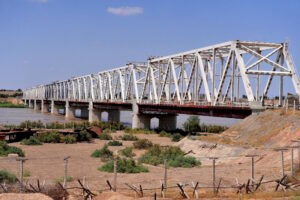
Figure 3. The Friendship Bridge, a road and rail crossing of the Amu Darya between Uzbekistan and Afghanistan.
Photo: U.S. Air Force, public domain, via Wikimedia Commons. [38]
China already runs freight from Kashgar to Hairatan, through Kazakhstan and Uzbekistan, a service open since September 2022.[35] The Wakhan road is a separate dispute, and the reporting on it does not agree. It does not have to be settled for this brief.
China’s record in Afghan minerals is mixed, and it is hard to assess in full because public information is limited and independent verification is difficult under present conditions. Reporting describes a financially constrained administration that looks to extractive projects for revenue.[29] In January 2023, a Chinese firm, CAPEIC, signed a contract worth $540 million over 25 years for oil in the Amu Darya basin. The Taliban authorities terminated it in June 2025, citing breaches, and the company disputes that account.[29][30] China Metallurgical Group won the Mes Aynak copper concession in 2007 with a $3 billion commitment, and the project remains undeveloped while the Taliban press for it to restart.[31] Other Chinese companies are reported to be active in the sector, but their activity is difficult to document. Pakistan hosts the China-Pakistan Economic Corridor and sits on any southern route, and Mongolia, which has long looked for third neighbor partners to balance Russia and China, could be part of a wider market for processed minerals.
8. After the speeches
8. After the speeches
-
- Whether any Samarkand text names a sum, a lender and a date, or only a workstream.
- Whether processing capacity is announced inside the region, and whose balance sheet stands under it.
- Any movement on Jackson-Vanik. A symbol, and one that investors still price.
- What Beijing does when the rare earth pause runs out, around the end of October.
- Whether the cost gap on the Afghan railway narrows, or the feasibility study slips.
- A Central Asian reserve statement issued under JORC or an equivalent, rather than GKZ alone.
Conclusion
The 1984 warning was about ore that cost too much to dig. The problem in 2026 is plainer, and harder: who refines, who signs the loan, and whose reserve table a lender will accept. Central Asia can widen American supply in a handful of materials. Its governments would like another partner in the room. They will not unwind China’s position in separation and magnets, and they will not stop selling to their neighbors.
The Samarkand visit serves that limited purpose only if something is financed, and if part of the processing is allowed to sit where the ore is. Another memorandum will be filed with the others. American manufacturers will be no less exposed in November than they are today.
References
1. Business Week, via Republic of Mining. “The Death of Mining.” 17 December 1984.
2. U.S. Geological Survey. News release on the Mineral Commodity Summaries covering 2016. 2017.
3. U.S. Geological Survey. Mineral Commodity Summaries 2026. 2026.
4. U.S. Geological Survey. Mineral Commodity Summaries 2026, interactive summary. February 2026.
5. Inside U.S. Trade. “USGS report: U.S. completely import-reliant on 13 of 60 critical minerals.” 6 February 2026.
6. Rubber World, on the USGS release. “USGS releases Mineral Commodity Summaries 2026.” 10 February 2026.
7. International Energy Agency, reported by E&E News. Dominant refiner for 19 of 20 strategic minerals. 12 November 2025.
8. International Energy Agency, Global Critical Minerals Outlook, reported by Fortune India. Refining shares by mineral. 14 December 2025.
9. Orda.kz. Rubio on a 2026 visit to Central Asia. 6 November 2025.
10. Arjun Singh, The National Interest. “Central Asia’s Critical Minerals Rush: Between the US and China.” 4 August 2026.
11. U.S. Embassy in Kazakhstan. DFC letters of interest for Severniy Katpar. February 2026.
12. Business Wire. Cove Capital and Tau-Ken Samruk joint venture. 6 November 2025.
13. OECD. Regional note on critical minerals in Central Asia. April 2026.
14. The Times of Central Asia. “Central Asia Seeks More Local Value From Critical Minerals.” 13 July 2026.
15. Fastmarkets. “Central Asia’s tungsten test.” 12 March 2026.
16. Gazeta.uz. Rubio to visit Uzbekistan in October. 25 September 2026.
17. Kursiv Uzbekistan. Rubio’s first Central Asia trip, and Jackson–Vanik. 25 September 2026.
18. The Diplomat. “Will US President Donald Trump Visit Central Asia?” October 2026.
19. The Diplomat. “The United States Is Losing the Race for Central Asia’s Critical Minerals.” 30 April 2026.
20. Council on Foreign Relations. U.S.–Central Asia Summit. November 2025.
21. PBS NewsHour. Trump hosts Central Asian leaders. November 2025.
22. The Times of Central Asia. “Uzbekistan Joins a U.S. Critical Minerals Implementation Track.” 17 June 2026.
23. Bloomsbury Intelligence and Security Institute. “Uzbekistan’s Critical Minerals Diplomacy.” 18 February 2026.
24. The Oxus Society. “Can Uzbekistan Capitalize on Critical Minerals?” 28 May 2026.
25. RFE/RL, via GlobalSecurity.org. Account of the Washington summit. 7 November 2025.
26. Eurasianet. “A trans-Afghan railway chugs toward reality.” 16 September 2025.
27. Interfax. Uzbek endorsement of the railway feasibility framework. 9 February 2026.
28. The Jamestown Foundation. “Uzbekistan, Afghanistan, and Pakistan Expedite Work on Joint Railway Project.” 7 July 2025.
29. The Diplomat. “Taliban End Chinese Oil Field Contract in Afghanistan.” 1 August 2025.
30. OilPrice.com. “Oil Deal Between China and Taliban Falls Apart.” 29 August 2025.
31. Wilson Center. “Mining for Influence: China’s Mineral Ambitions in Taliban-Led Afghanistan.”
32. Asia Plus. “Marco Rubio to visit Uzbekistan for C5+1 meeting with Central Asian foreign ministers.” 26 September 2026.
33. China Global South Project. “China Critical Minerals Dominance: A Global Overview.” 30 June 2025.
34. International Energy Agency. Global Critical Minerals Outlook 2025, executive summary. May 2025.
35. Observer Research Foundation. “China and Afghanistan’s Jousting Over the Wakhan Corridor.” 21 April 2025.
36. Oleg Yunakov, via Wikimedia Commons. Registan, main square in Samarkand. Photograph, licensed CC BY-SA 4.0.
37. The White House. “President Donald Trump hosts a dinner with leaders of C5 Central Asian countries in the East Room of the White House.” Official White House Photo by Daniel Torok, 6 November 2025.
38. U.S. Air Force, via Wikimedia Commons. “The friendship bridge connects Mangusar, Uzbekistan and Hariatan, Afghanistan.” Photograph, image ID 100722-F-7552L-156.
Our Pashto-Dari Website

Support Dawat Media Center
If there were ever a time to join us, it is now. Every contribution, however big or small, powers our journalism and sustains our future. Support the Dawat Media Center from as little as $/€10 – it only takes a minute. If you can, please consider supporting us with a regular amount each month. Thank you
DNB Bank AC # 0530 2294668
Account for international payments: NO15 0530 2294 668
Vipps: #557320

![[36]](https://commons.wikimedia.org/wiki/File:Registan,_main_square_in_Samarkand.JPG)
![[38]](https://commons.wikimedia.org/wiki/File:The_friendship_bridge_connects_Mangusar,_Uzbekistan_and_Hariatan,_Afghanistan.jpg)
Comments are closed.