

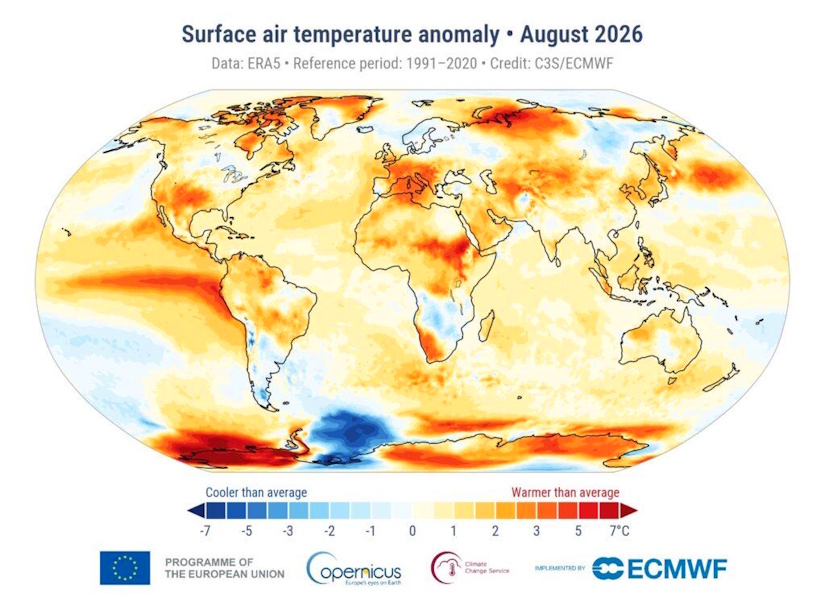
August 2026 tied July 2023 as the hottest month on record globally, with the average surface air temperature reaching 16.96 degrees Celsius, the European Union’s Copernicus Climate Change Service (C3S) said on Thursday.
According to Copernicus, the August temperature was 0.85 degrees Celsius above the 1991–2020 average for the month and 1.65 degrees Celsius above the 1850–1900 pre-industrial average. It was the first month since November 2025 in which the global average temperature exceeded 1.5 degrees above pre-industrial levels. The 1.5-degree threshold, the more ambitious of the two limits set by the 2015 Paris Agreement, is meant to be assessed over many years rather than a single month.
The service said August 2026 was also warmer than August 2023 and 2024, although the difference from July 2023 was within the margin of uncertainty, meaning the two months are considered tied for the record. Copernicus observations date back to 1940, but other evidence such as ice cores, tree rings and coral skeletons allows scientists to place today’s climate in a much longer historical context. Samantha Burgess, strategic lead for climate at the European Centre for Medium-Range Weather Forecasts (ECMWF), which oversees Copernicus, said humans have not seen temperatures as hot as today for arguably at least the last 100,000 years .
Meanwhile, the average sea surface temperature outside the polar regions reached 21.07 degrees Celsius in August, also tying the highest monthly level on record. Global sea surface temperatures remained exceptionally high across much of the tropical Pacific, where El Niño conditions are intensifying and could develop into one of the strongest episodes ever recorded . Copernicus warned that warmer oceans contribute to sea-level rise through thermal expansion and increase the likelihood and intensity of marine heat waves, threatening coral reefs, seagrass meadows, fisheries and aquaculture .
The June–August 2026 period was among the hottest three-month periods recorded globally, alongside the same period in 2024. Western Europe also experienced its warmest summer on record, surpassing the long-standing record set in 2003, after a succession of exceptionally early, persistent and intense heatwaves that shut schools, dried up rivers and primed the land for devastating wildfires . Between mid-July and mid-August, the continent’s EuroMomo monitoring platform estimated that Europe saw more than 32,000 excess deaths . In the contiguous United States, the National Oceanic and Atmospheric Administration reported the hottest summer in more than 130 years of records .
United Nations climate chief Simon Stiell said the evidence was “irrefutable,” describing the findings as “the spiralling price of humanity’s fossil fuel addiction, and the global climate crisis it is fuelling” . Friederike Otto, a climate scientist at Imperial College London, warned that “climate change makes every El Niño hotter, and until we stop burning coal, oil, and gas these record-shattering months will simply keep on coming” .
Copernicus is the EU’s Earth observation programme, while its Climate Change Service provides climate data and assessments based on observations and the ERA5 climate dataset .

Support Dawat Media Center
If there were ever a time to join us, it is now. Every contribution, however big or small, powers our journalism and sustains our future. Support the Dawat Media Center from as little as $/€10 – it only takes a minute. If you can, please consider supporting us with a regular amount each month. Thank you
DNB Bank AC # 0530 2294668
Account for international payments: NO15 0530 2294 668
Vipps: #557320

Comments are closed.